

Quarterly Social Content Planning: A 90-Day Framework
Quarterly social content planning means deciding your goals, themes and big dates for the next 90 days in one session, then filling in specific posts one month at a time. It gives you enough runway to coordinate a team and enough data to judge results, without locking you into posts that go stale. Photofy gives small businesses, direct sellers, franchises and dealer networks the templates, scheduling and analytics to carry that plan from the quarter-level page to published posts.
TL;DR
- Plan themes and key dates three months ahead, and write specific posts only one month ahead.
- Set two to four measurable goals, then give each theme a job tied to a goal.
- Write down what stays fixed (message, voice, visuals) and what each channel or location can change.
- Schedule a one-hour check-in around week seven and a full review at the end of the quarter.
- Keep templates, assets and approvals in one place so a team can publish on time.
Table of Contents
- What is quarterly social content planning?
- Why not plan every post for the quarter?
- How do you set goals and choose themes?
- How do you turn the quarter into a calendar?
- How do teams stay consistent across channels and locations?
- How do you measure results and adjust mid-quarter?
- Perspective
- How can Photofy help you carry out the plan?
- FAQ
- Sources
What is quarterly social content planning?
A quarterly plan is the middle layer between your yearly marketing strategy and your weekly posting calendar. One quarterly planning guide describes it as a single page holding themes, launches, events, seasonal peaks, monthly goals and any changes to posting slots or platforms, set in about an hour using the previous three months of results.
The strategy answers who you are talking to and why. The calendar answers what goes out on Tuesday. The quarterly plan answers what you will talk about this season and what you want it to achieve.
Why a quarter rather than a month? Monthly plans keep you focused on short-term goals and often force you to shuffle resources, which can lead to rushed content. A quarterly approach supports a longer narrative, gives you more time to collect data worth analyzing and still leaves room for reactive posts.
The quarter also suits the way many businesses work. Direct selling companies run seasonal promotions. Franchises roll out national campaigns that local owners need to receive early. Dealers prepare for model-year launches and sales events. In each case, people other than you need lead time to prepare.
If your industry moves fast and depends on trends, a one-month window may fit better. Shopify’s planning guide suggests that more stable industries can use a quarterly plan, and that any plan should leave room for flexibility.
Why not plan every post for the quarter?
Because offers change and news happens. A full quarter of specific posts tends to be rewritten before it publishes, according to the same quarterly planning guide. The more useful split is this:
| Planning layer | Horizon | What you decide |
|---|---|---|
| Quarterly plan | 90 days | Goals, 3 to 5 themes, launches, events, seasonal peaks |
| Monthly calendar | 4 to 5 weeks | Specific posts, formats, owners, due dates |
| Weekly check | 7 days | Small fixes, timely posts, replies |
The quarter gives the month advance warning. The month gives the week its posts.
Seasonal content is where this pays off most. The same guide notes that seasonal posts often need to start four to eight weeks before a peak, so holiday campaigns belong in the July to September plan, not in November.
How do you set goals and choose themes?
Start with the last quarter. Look at which posts earned saves, shares, replies, clicks and inquiries, and which ones got little attention. Then set your direction for the next 90 days.
Pick two to four measurable goals
Vague goals produce vague calendars. SocialDay’s content calendar guide suggests two to four measurable quarterly goals, such as growing LinkedIn followers by 20% or generating 50 leads from Instagram. A small business owner might choose one awareness goal and one sales goal. A franchise marketer might choose local participation, for example how many locations post the national campaign.
A useful test: could you tell on the last day of the quarter whether you hit it? If not, add a number and a date.
Choose three to five content pillars
Pillars are the recurring topics your audience can count on from you. The same guide recommends three to five, with a mix of roughly 80% value-led content and 20% brand or product content. Value-led means tips, answers, stories and examples. Product posts then land better because they are not every post.
For the quarter, assign each pillar a job. One pillar educates new followers, one builds trust through behind-the-scenes content and customer stories, one drives the offer. When you review, you can ask which pillar delivered which goal.
Mark the fixed dates first
Add holidays, product launches, trade shows, promotions, local events and any deadlines from your sales team. Fixed dates anchor the calendar. Everything else fills the space between them.
How do you turn the quarter into a calendar?
Use a 13-week rhythm. This outline is adapted from a 90-day social plan template:
- Weeks 1 to 2: audit and goals. Review last quarter’s results and set the new goals.
- Weeks 2 to 3: audience, channels and pillars. Confirm where you will post and what each pillar covers.
- Weeks 3 to 4: build the calendar. Detail month one post by post. Outline months two and three by week and theme.
- Weeks 4 to 11: produce, publish and engage. Create content in batches and respond to comments and messages.
- Weeks 11 to 13: report and plan the next quarter.
In month one, each row should show the pillar, format, owner and due date. Book production time as well as publish time, because the most common reason a calendar fails is that no one had time to make the post.
Want to see what a working calendar contains? Our guide to the fields every content calendar should include lists them, and our free content calendars give you a starting layout. If you want a view of what a month-level plan looks like from the SEO side, this monthly content plan walkthrough follows the same planning logic.
How often should you post?
Set cadence by team size and number of platforms. SocialDay’s framework suggests 3 to 5 posts per week per platform for a solo manager on one or two platforms, and 5 to 7 for a small team on three or four. The American Marketing Association offers starting points such as 3 to 5 posts a week on Instagram, 2 to 3 on LinkedIn and 3 to 5 on Facebook.
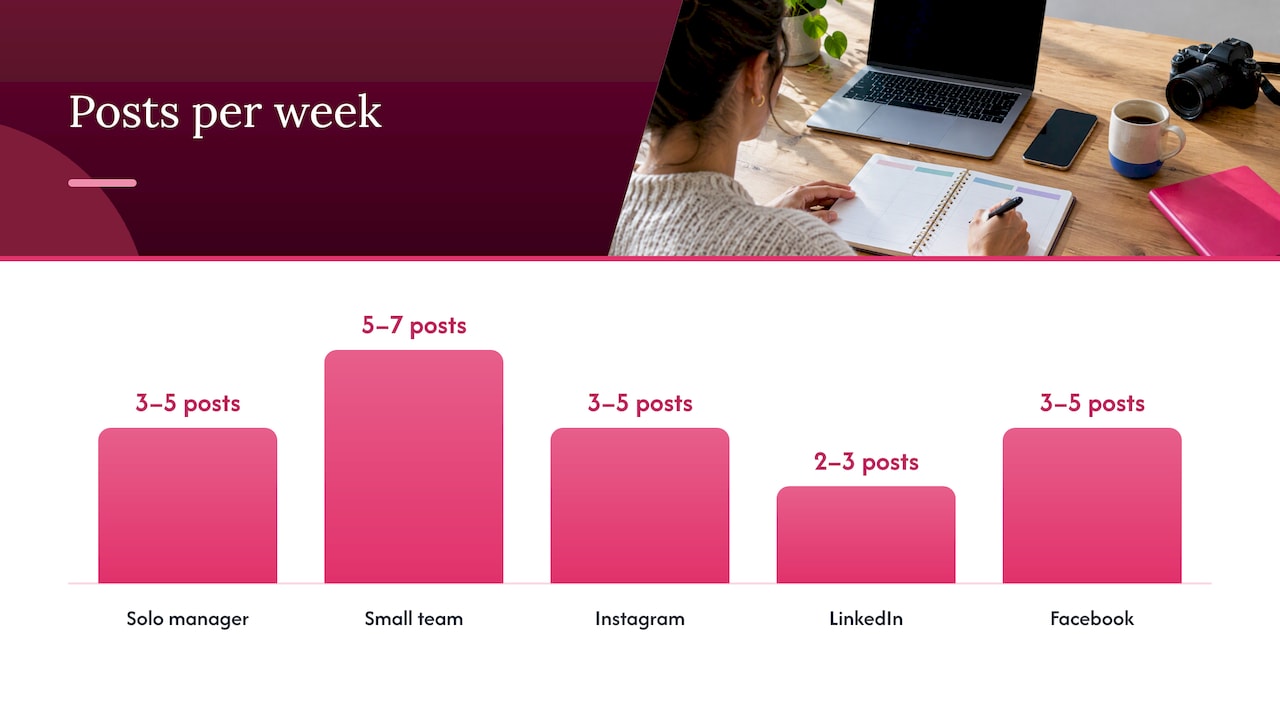
Choose a rhythm you can keep for 13 weeks. Consistency beats an ambitious schedule that collapses in week five. For timing within the week, see our Instagram posting times guide.
How do you leave room for timely content?
Schedule your planned posts at about 70 to 80% of capacity and keep the remainder open. That space is for trends, customer wins, news and quick responses. A plan that is full on day one will be ignored by day ten.
How do teams stay consistent across channels and locations?
A quarterly plan only works if everyone who posts follows it. This matters most when many people publish for one brand: franchisees, direct sales consultants, dealership staff, regional marketers.
Consistency does not mean identical posts. According to Siteimprove, core message, proof points, terminology, voice and visual identity stay fixed across channels, while length, format, tone intensity, call to action and emphasis can flex. Its advice is to start from one approved source message, write down adaptation rules per channel, and review at handoffs, not only at the end.
The step most teams skip is writing down in advance which elements are fixed and which are flexible. Without that, each channel decides for itself what is negotiable and the brand drifts.
Create a one-page rules sheet with:
- The quarter’s message and three proof points
- Approved terms, claims and phrases to avoid
- Which template, logo and color rules cannot change
- What a local team may customize, such as photo, offer, city or call to action
- Who approves what, and how fast
A production pipeline helps too. Rock.so recommends the same steps for every post: brief, produce, review and approve with a 24-hour window, schedule, publish, engage and measure. It also notes that posting identical content to every platform reads as low effort, so adapt each post to its platform.
Where does the platform fit?
This is where the plan meets daily work. Photofy combines branded content creation, team approvals, asset management and automated publishing in one platform, so local reps can create authentic, compliant content quickly while the central team keeps brand control. Pre-designed and custom templates, a stock asset library, video stitching, graphic and text overlays, scheduling and analytics are available on iOS, Android and desktop. White-labeling is available for enterprise clients.
If you manage a larger group, read our guide to template management for marketing teams and how to scale a calendar for a larger team. For automotive networks, our dealer marketing assets guide covers what to build, share and track across photo, video and PDF.
How do you measure results and adjust mid-quarter?
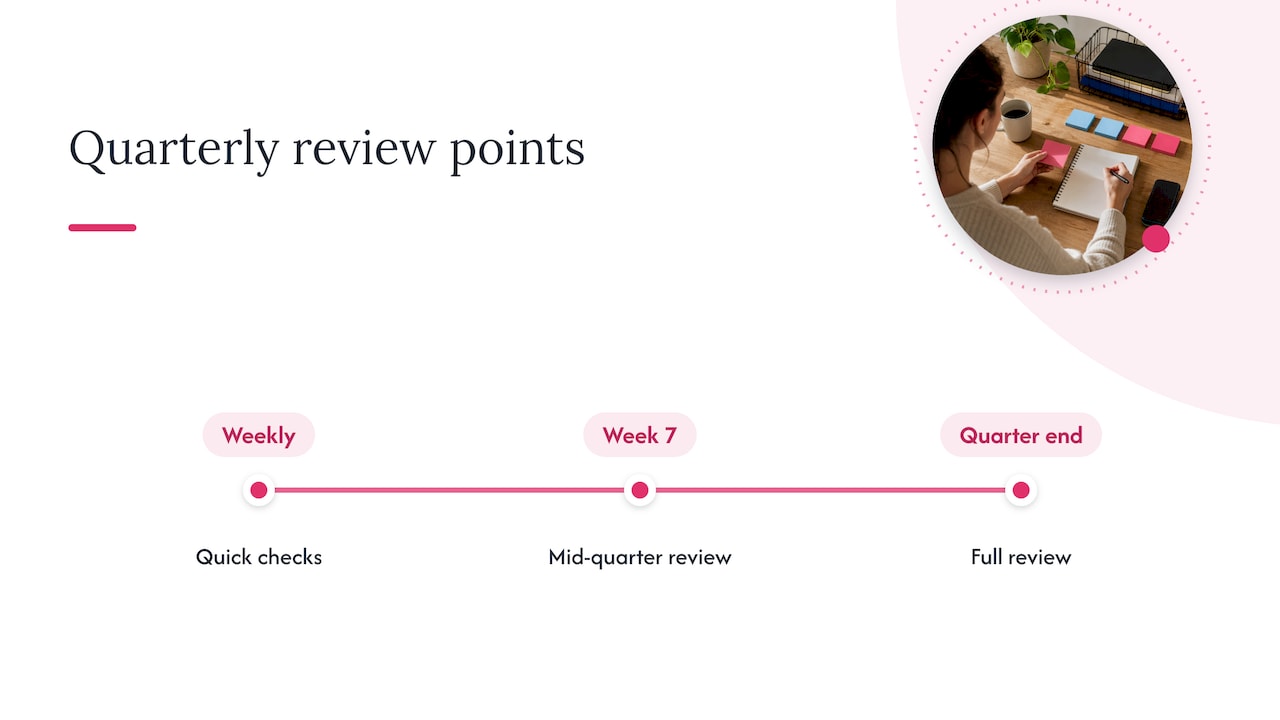
Build three review points into the quarter.
Weekly: quick checks. Look at what published, what is late and which posts are drawing replies or saves. Rock.so calls saves, shares, comments and direct messages leading indicators, which you can watch weekly, and branded search, click-throughs and share of voice lagging indicators for the monthly and quarterly view.
Around week seven: a one-hour mid-quarter review. Use the first seven weeks of data to adjust the back half of the plan. Move effort toward the pillar that is working, rewrite weak calls to action and drop a format that nobody engages with.
End of quarter: the full review. Relato’s check-in guide recommends a 60-minute session that sorts performance into keep, fix and stop piles, checks that goals still fit company objectives, reviews team capacity and finishes with two or three named changes, each with an owner and a date. Its reasoning is that monthly reviews lead to constant tweaking while annual ones let priorities drift.
Tie metrics to business results
Likes are easy to count and easy to misread. Velledigital’s local business plan recommends tagging every link with UTM parameters (short tags added to a URL so your analytics show which post sent the visit) and tracking qualified inquiries, booked revenue, response time to direct messages, local reach, profile actions and the top three posts by inquiries. If you cannot trace inquiries back to social, you end up judging the plan on likes.
For a deeper walkthrough, see how to measure the success of a digital marketing campaign.
Perspective
Most teams we talk with about planning have a calendar. What they lack is a shared decision about what the calendar is for.
We built Photofy around the idea that planning and publishing should live in the same place. When the quarter’s themes, approved templates, assets and scheduling sit together, the plan stops being a document people admire in week one and forget by week three.
This matters most for distributed teams. A franchise owner, a direct sales consultant or a dealership salesperson wants to post something good quickly. The central team wants every post to look and sound like the brand. Branded templates with local customization let both happen: the brand sets the frame, and the local person adds the photo, the offer and the voice.
Our advice is to plan themes three months out, make the posts one month out, and keep every asset your team needs in one library. Then a mid-quarter review is a quick look at results, not a hunt for files.
Jon
How can Photofy help you carry out the plan?
Once your quarter is mapped, the work is production and consistency. Photofy lets you build posts from pre-designed or custom templates, add graphic and text overlays, stitch video, pull from a stock asset library, schedule and track analytics from your phone or desktop.
The Small Business plan is $10.99 per month or $99 per year. Individual plans are $11.95 per month, $29.97 per quarter or $99.95 per year. Team plans are Pro Teams at $13.00 per month per user and Enterprise Teams at $9.00 per month per user. Franchise and enterprise needs are handled through direct inquiry. See Small Business plans or the full pricing page.
A quarter planned well and published on time is easier to repeat. Start your next quarter with a platform that keeps your whole team on the same page.
FAQ
What is a quarterly marketing plan?
It is a 90-day plan that turns your yearly goals into specific priorities: goals, themes, campaigns, key dates and owners. For social media, it tells you what you will talk about and why before you schedule individual posts. It is reviewed at least once mid-quarter and once at the end.
What is the 30/30/30 rule for social media?
It is a rule of thumb for balancing a content mix. One explanation of the rule splits posts into three categories at 30% each, such as education and culture, with the remaining 10% for community engagement. Versions differ, so treat it as a starting ratio for your pillars and adjust it to your goals.
How far ahead should I schedule social posts?
Schedule detailed posts about one month ahead and outline months two and three by week and theme. This keeps you ready for peaks without rewriting a full quarter whenever an offer changes.
Can a quarterly plan work for a small business?
Yes. Keep it to one page: two or three goals, three pillars, your key dates and a realistic posting rhythm. A one-hour planning session and a one-hour check-in at week seven are enough to start.
Sources
- A quarterly social media plan above the monthly calendar
- Quarterly social media strategies vs. monthly plans
- Content planning: how to create a content plan
- The Social Media Content Calendar Guide
- Social media plan template: 90-day layout
- 8 steps to build a successful social media strategy
- Consistent messaging across channels
- Social media marketing plan: template, pillars, pipeline
- Quarterly content strategy check-in template
- Social media marketing plan for local businesses
- What is the 30 30 30 rule for social media?