

Sales Content Distribution: Get Approved Content to Your Team
Sales content distribution is the routine that moves approved marketing material, such as photos, videos, PDFs and social posts, from the people who create it to the people who sell with it, and keeps it on brand along the way. Done well, your reps, dealers, franchisees or direct sellers find the right asset in seconds, personalize it within set limits and publish it. Done badly, content gets emailed around, buried in folders and ignored. Photofy puts branded templates, an asset library, team approvals and scheduled publishing in one platform on iOS, Android and desktop, so the content you create is the content your network actually uses.
TL;DR
- Sales content distribution is how approved content reaches sellers and gets used. It is different from promoting content to customers, and the gap between the two is where most content is wasted.
- Research shows that teams with automatic distribution report better-informed sales teams and higher content use than teams that distribute manually or randomly.
- A working system has four parts: one library, clear approvals, easy customization and usage tracking.
- Photofy offers templates, a stock asset library, video stitching, scheduling, analytics and white-label content management. Small Business starts at $10.99 per month.
- Start small: one library, one approval rule and one report, then grow it across your team or network.
Table of Contents
- What is sales content distribution?
- Why does distribution matter more than creation?
- How does content usually reach sellers today?
- What does a working sales content distribution system include?
- What content types should you distribute?
- How does this work for different kinds of teams?
- How do you automate delivery so reps do not have to search?
- How do you know it is working?
- Why involve sellers in the process?
- How does Photofy fit into your sales content distribution?
- Our perspective
- A 30-day plan to get started
- FAQ
- Sources
What is sales content distribution?
Most articles on content distribution describe how a marketer promotes a blog post across owned, earned and paid channels. That is outward-facing: content going to prospects. Sales content distribution points the other way first. It is about getting content to the people who talk to customers, whether they are salespeople, car dealership staff, franchise owners or independent direct sellers, and then helping them share it.
Three things make it its own discipline:
- The audience is internal or semi-internal. Your readers are reps, dealers, distributors or franchisees. They need content that is ready to use, not a campaign brief.
- Control matters as much as speed. Logos, disclaimers, pricing language and legal copy have to stay intact when thousands of people post under your name.
- The last step is the seller’s own channel. A rep’s social profile, a text message to a customer, a PDF attached to a quote. Content has to work on a phone, between appointments.
It overlaps with sales enablement, which is the wider job of equipping sellers with training, playbooks and content. Distribution is the delivery piece of that job: how the right asset gets to the right person at the right moment.
Why does distribution matter more than creation?
Many teams assume they have a content problem. The evidence points to a delivery problem.
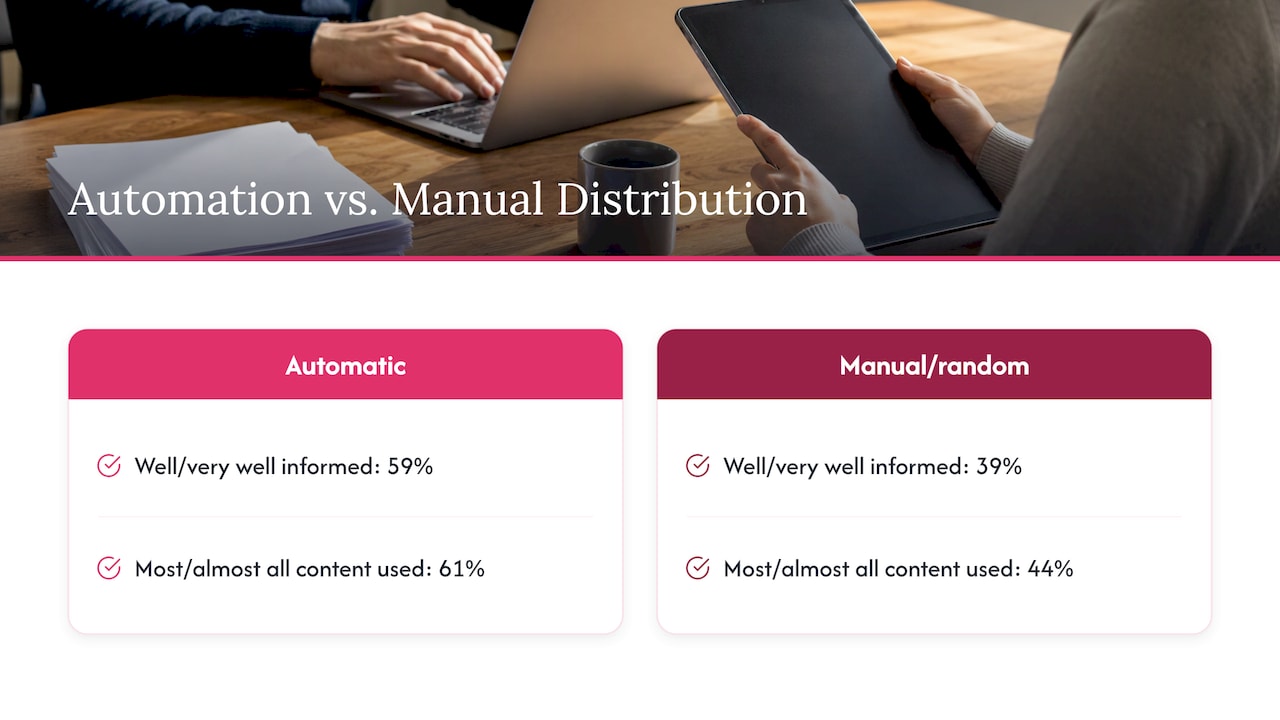
A Seismic and Demand Metric study of 300 marketing and sales respondents, reported by MarketingCharts, found that close to half of sales content distribution was manual (32%), random (13%) or not happening at all (2%). The same study showed what automation changes. Among teams using automatic distribution, 59% said their sales teams were well or very well informed about content, compared with 39% of manual or random users. And 61% said most or almost all content gets used, versus 44%.
The time cost is just as telling. A productivity study cited by MarketingProfs found salespeople spent 31% of their time searching for content. That is nearly a third of a week spent hunting instead of selling or posting.
The Content Marketing Institute describes a Fortune 500 global marketing team where less than half of the developed content was used and distributed by sales until sales was brought into planning. After the author’s clients systematized internal distribution, asset consumption increased by as much as 100%.
The lesson is practical. Before you produce another brochure or video, make sure the ones you have reach the field.
How does content usually reach sellers today?
The 2017 CSO Insights Sales Enablement Optimization Study, with nearly 500 participants and just over half from North America, shows the pattern. Marketing created only 39.3% of the content salespeople need, and salespeople created 18.4% themselves. Meanwhile 29.0% of firms still emailed content to salespeople, up from 24.5% a year earlier, and 22.6% placed content in multiple repositories. Both are weak ways to deliver content.
Email attachments go stale the moment a price or a logo changes. Multiple folders mean nobody knows which version is current. And when sellers cannot find what they need, they build their own, which is how off-brand graphics end up on public profiles.
If you recognize your own business in that description, you are in good company. The fix is not more content. It is one place where approved content lives, with a way to put it in sellers’ hands.
What does a working sales content distribution system include?
Think of it as four parts. Each one has a common failure point.
1. One library, organized the way sellers think
Sellers search by situation, not by campaign name: “new model arrives,” “open house,” “product launch,” “holiday offer.” Organize photos, videos, PDFs and templates around those moments, and tag them consistently so search works. Where it goes wrong: a folder structure that makes sense to marketing but not to the person on the lot or in the field.
Photofy gives you a stock asset library alongside pre-designed and custom templates, so the starting point for any post is already in the app. For a walkthrough of tagging and setup, see our metadata-first social media asset library checklist.
2. Approvals that protect the brand without slowing anyone down
Not every post needs the same scrutiny. A seasonal greeting is not a financing offer. Sorting content into risk tiers lets low-risk material flow freely while regulated or high-value claims get a second look. Where it goes wrong: a single approval queue that turns every request into a week-long wait, so reps stop asking.
Photofy brings team approvals into the same platform as creation and publishing, and our guide to building a content approval workflow with risk tiers covers the setup in seven steps.
3. Customization inside guardrails
Sellers share more when content feels like theirs. The GTMnow article on building a sales content supply chain notes that marketing content speaks in a one-to-many voice while sales content is a one-to-one conversation. Your system has to allow for that difference. Lock the logo, colors and required legal text, and leave the headline, photo choice, local contact details and caption open.
Photofy offers graphic and text overlays and video stitching, so a rep can add a personal touch to an approved template without redesigning it. White-label content management lets your brand stay consistent across the whole team. If video is part of your mix, see how video stitching simplifies video creation.
4. Tracking what gets used
If you cannot see what sellers open, post and skip, you cannot improve the library. The same GTMnow piece describes content enablement as notifying reps of new content, monitoring usage, measuring efficacy and running a feedback loop. Where it goes wrong: tracking only views of the library, not whether content went out to customers.
Photofy includes scheduling and analytics, which gives you a place to see what is being published.
What content types should you distribute?
Sellers need a mix, and the mix depends on how they talk to customers. According to the Content Marketing Institute’s 2025 B2B research, 92% of marketers used short articles or posts, 76% used videos and 75% used case studies. Videos were rated most effective at 58%, followed by case studies at 53%.
For a sales network, that translates into a practical starter kit:
| Content type | Best for | Example |
|---|---|---|
| Photos | Social posts, text messages | New inventory, product shots, team portraits |
| Short video | Social feeds, follow-ups | Walkaround clips, product demos, testimonials |
| PDFs | Quotes, email, in-person meetings | Spec sheets, price guides, brochures |
| Branded templates | Daily social presence | Promotions, announcements, holiday posts |
| Captions and talking points | Every channel | Approved copy reps can edit |
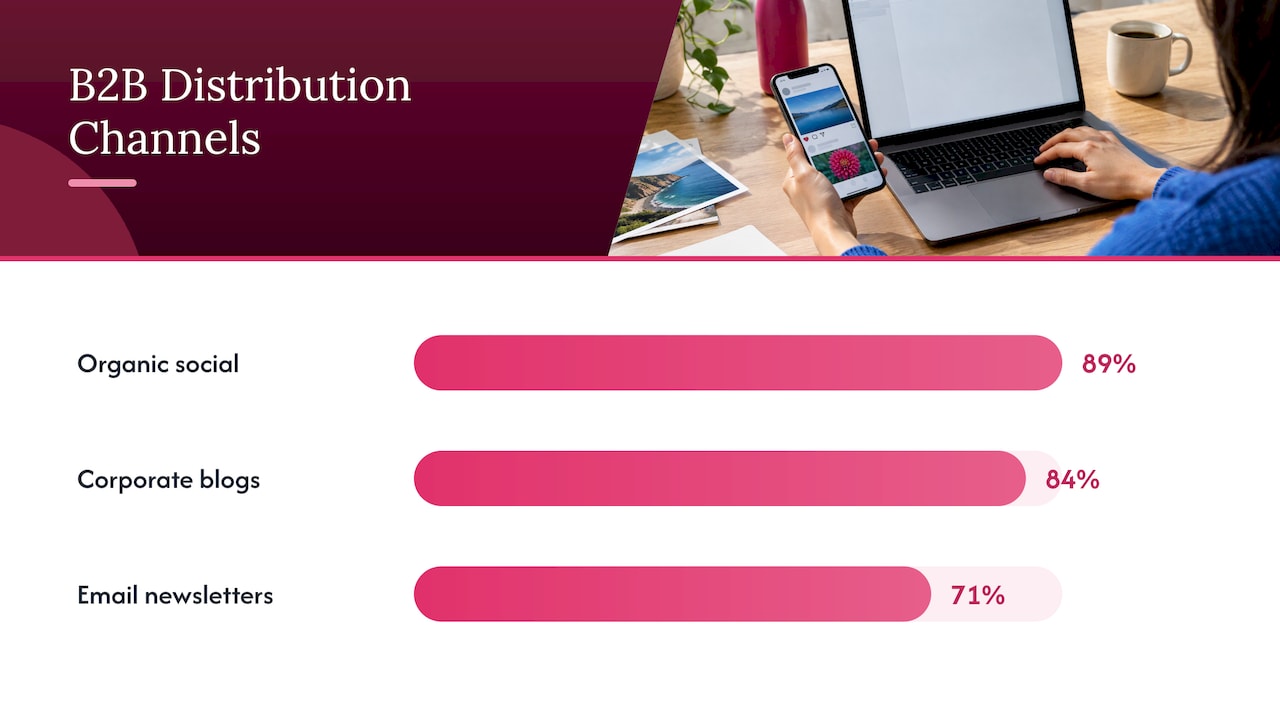
The same research found that organic social media (89%) was the most-used distribution channel among B2B marketers, ahead of corporate blogs (84%) and email newsletters (71%). For a network of individual sellers, social is where your brand shows up under a human face, which is why the distribution system needs to end there.
How does this work for different kinds of teams?
Direct selling companies
Independent consultants post under their own names but represent your brand. They need fresh, compliant content every week and no design skills. Our guides on direct sales social media content and personal branding for direct sales show how corporate and individual voices fit together.
Franchises and distributors
Franchisees want local relevance, and the franchisor wants consistency. The answer is shared templates with local fields. Read more in our guide to distributor content sharing and our playbook for distributing content to teams.
Car manufacturers and dealers
Dealer sales staff need photos, video and PDFs at the same time: a model walkaround, a spec sheet, an offer graphic. Group them into one asset pack per campaign so nothing gets shared without its companion pieces. Our article on dealer marketing assets lists what to build, share and track.
Small businesses and freelancers
You are the whole team, so the system is lighter: a handful of templates, a scheduled calendar and one place for photos and clips. The goal is the same: stop rebuilding posts from scratch.
How do you automate delivery so reps do not have to search?
The strongest idea in the research comes from Brian Fravel at MarketingProfs, who frames this as a distribution problem and compares it to just-in-time inventory in a grocery store. Ship the right content to sellers before they go looking. Keep it a click or two away, searchable and paired with short coaching tips.
You can apply that in three ways:
- Push by moment. When a new offer or product goes live, release the asset pack and notify the team.
- Pull by search. Keep the library tagged so a rep can find an item in seconds.
- Schedule by default. Give sellers pre-approved posts they can schedule for the week with one tap.
For more on delivering content to sellers at the moment they need it, see this overview of multi-channel funnels with AI content.
How do you know it is working?
Measurement is where most teams stall. The Content Marketing Institute’s 2025 research found that 56% of B2B marketers have difficulty attributing ROI to content, 44% cannot tie performance to business goals and 37% face data silos. Only 26% said their organization has the right technology to manage content across the organization, down from 31% the year before.
Start with measures you can actually collect:
- Adoption: What share of your team posted or sent approved content this month?
- Coverage: Which assets are used most, and which never leave the library?
- Consistency: How many posts carry the correct logo, colors and required text?
- Speed: How long does a new campaign take to reach the field?
Then connect usage to results over time, such as inquiries, test drives booked or orders from social. Review the numbers monthly, retire what nobody uses and build more of what they do. The campaign asset checklist is a handy way to make sure every launch ships with a complete set.
Why involve sellers in the process?
GTMnow’s Erika Davis notes that the biggest predictor of whether a team adopts a sales platform is how involved end users feel in content creation. When reps are not consulted, they go rogue and make their own materials, and you lose predictability, visibility and adoption.
A simple habit fixes this. Ask a few of your best sellers or dealers what they would post if they had the right asset, and build those first. CSO Insights also points out that sales enablement teams are well placed to know which content types add value for sellers, so bring them into planning when you have them.
How does Photofy fit into your sales content distribution?
Photofy is built for the situation this article describes: a brand that needs content created, approved, organized and published by many people without losing control. You get pre-designed and custom templates, a stock asset library, video stitching, graphic and text overlays, scheduling and analytics, and white-label content management, available on iOS, Android and desktop.
Here are the plans as published on our site:
| Plan | Price |
|---|---|
| Small Business | $10.99 per month or $99 per year |
| Individual Plans | $11.95 per month, $29.97 per quarter or $99.95 per year |
| Pro Teams | $13.00 per month per user |
| Enterprise Teams | $9.00 per month per user |
Franchise and enterprise setups are arranged by direct inquiry, and Individual and Enterprise pricing is on our pricing page. If you run a small team, start with the Small Business plan. Individual options are on our Individual Plans page.
You can see the full platform at Photofy and decide which plan matches the size of your team or network.
Our perspective
We built Photofy around one belief: the best content in the world does nothing if the people who need it cannot find it, trust it and post it in under a minute.
Distributed organizations carry a real tension. Headquarters wants brand control, and local reps want to sound like themselves. We think those goals work together when creation, approvals, asset management and publishing live in one place. Reps get ready-made, compliant content, and the brand gets consistency across every profile.
That is why we offer industry-specific template libraries and white-labeling alongside team approvals and automated publishing. Your people can customize what matters locally, while the logo, colors and required language stay protected.
If you take only one step this month, make it this: gather your best twenty assets into one library, tag them by the situations your sellers face, and share them with a small pilot group. You will learn more from one week of real use than from another planning meeting.
Jon
A 30-day plan to get started
Week 1: Audit. List the content sellers ask for most, where it lives today and how it reaches them. Note every channel you currently use, including email threads and shared drives.
Week 2: Build the core. Create or collect the assets for your top three selling moments. Add templates for social posts, and prepare short captions that can be edited.
Week 3: Set the rules. Decide which content is free to use as is, which can be customized and which needs approval. Write the rule on one page.
Week 4: Pilot and measure. Give the library to a small group of sellers, dealers or franchisees. Track adoption, coverage and speed, then collect their feedback and adjust before you roll it out wider.
The result is a repeatable routine rather than a one-time project, and each new campaign becomes easier to ship than the last.
FAQ
What is the difference between content distribution and sales content distribution?
Content distribution usually means promoting content to prospects through owned, earned and paid channels. Sales content distribution focuses on getting approved content to the sellers, dealers or franchisees who use it with customers. It adds questions of access, approval and brand control.
How often should we add new content for sellers?
Match the pace of your selling moments: new products, offers, seasons and local events. Many teams find a steady weekly or biweekly release easier to follow than large occasional drops. Retire outdated assets as often as you add new ones so the library stays trustworthy.
Can sellers customize content without breaking brand rules?
Yes, if you decide in advance what is locked and what is open. Lock logos, colors and legal text, and allow edits to photos, captions and local details. Photofy supports graphic and text overlays and white-label content management for this kind of controlled flexibility.
What content formats do dealers and distributors need?
Most need photos, short videos and PDFs together: images for social, video for walkarounds or demos, and PDFs for specs and offers. Packaging them by campaign keeps the set complete and easy to share.
How much does Photofy cost for a small team?
Small Business is $10.99 per month or $99 per year. Pro Teams is $13.00 per month per user, and Enterprise Teams is $9.00 per month per user. Franchise and enterprise arrangements are handled by direct inquiry.
Sources
- B2B Sales Content Hampered by Lack of Visibility, MarketingCharts
- You Don’t Have a Sales Content Problem, You Have a Distribution Problem, MarketingProfs
- The Best Content Distribution Channel You’re Overlooking, Content Marketing Institute
- 2017 CSO Insights Sales Enablement Optimization Study
- How to Support Your Outbound Motion With a Sales Content Supply Chain, GTMnow
- B2B Content Marketing: 2025 Benchmarks & Trends, Content Marketing Institute