

Social Media Scheduling for Marketers: Pick the Right Tool
If you want one recommendation, it’s this: choose a platform that handles design, approval, and publishing in one place. Photofy does exactly that, combining branded templates, a shared asset library, and auto-publishing so you’re not bouncing between a design app, a scheduler, and a shared drive every week.
Here’s a quick shortlist by use case:
- Best overall for brand-first workflows: Photofy — creates, approves, and schedules branded content without switching apps
- Best for teams and agencies: Team-focused platforms with approval workflows and multi-client dashboards
- Best for Instagram-first creators: Creator-focused schedulers with native Instagram previews and first-comment scheduling
- Best free/budget option: Entry-level schedulers with limited post queues and profile connections
- Best for Pinterest and visual content: Visual-first schedulers with drag-and-drop calendar and pin scheduling
- Best for enterprise and franchise networks: White-label platforms with pre-approved templates and multi-location management
TL;DR: If you’re a marketer, small business owner, or part of a franchise network, start with Photofy’s free personal plan or request a demo to see the integrated workflow in action. Photofy is available through a free tier, with paid small business and enterprise plans listed transparently on the Photofy pricing page.
Pro Tip: Before trialing any scheduler, confirm it supports direct auto-publishing (not just push notifications) for every platform you actively use — the Meta/Instagram Graph API, for example, has specific requirements that not every tool meets.
Table of Contents
- How do the top social media scheduling tools compare?
- Short reviews of every tool on the shortlist
- How do you choose the right social media scheduler?
- What scheduling features actually matter, and when?
- How we evaluated these scheduling tools
- Why Photofy is our recommended pick for brand-first scheduling
- Key Takeaways
- What marketers most often get wrong when picking a scheduler
- Photofy gives you a faster path to consistent, branded content
- Useful sources to check during your trial
How do the top social media scheduling tools compare?
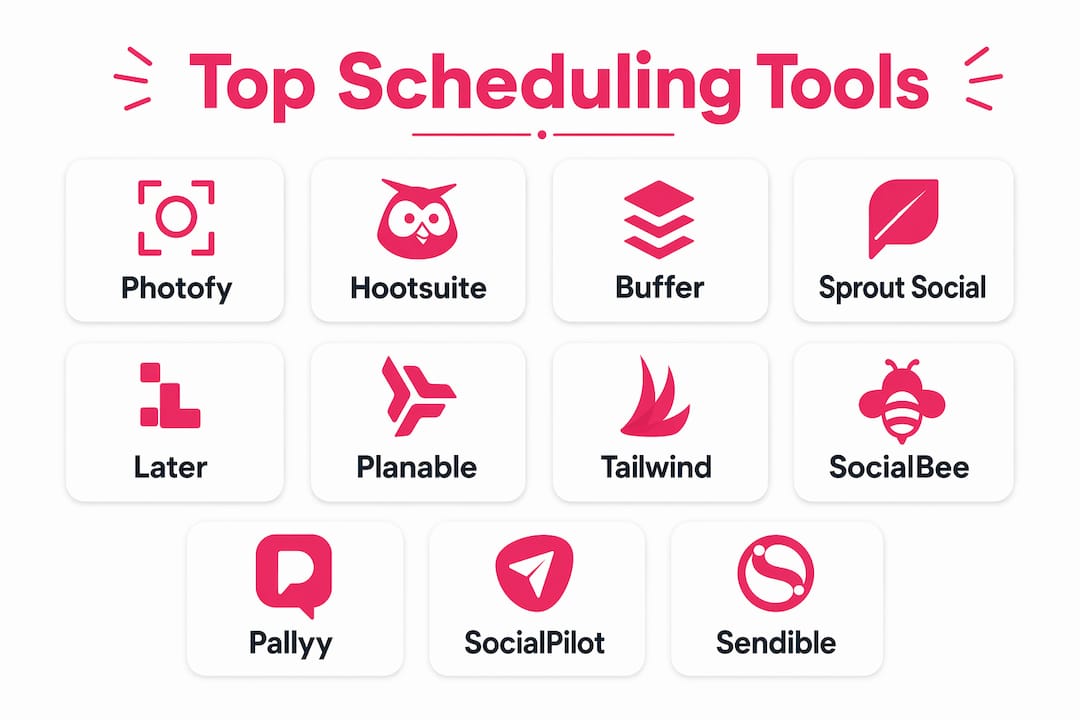
The table below maps the tools most commonly evaluated in 2026 across the dimensions that actually drive purchase decisions. Pricing reflects publicly listed tiers; always verify current rates on each vendor’s pricing page before committing.
| Tool | Best for | Platforms supported | Auto-publish / bulk upload | Content creation / templating | Team & approvals | Analytics | Ease of use | Free plan / pricing |
|---|---|---|---|---|---|---|---|---|
| Photofy | Brand-first scheduling, franchises, enterprise | Facebook, Instagram, LinkedIn, X, TikTok, Pinterest | Yes / Yes | Yes — branded templates, asset library, video overlays | Yes — roles, approvals, white-label | Yes | Very easy | Free tier available; paid plans and enterprise pricing listed at Photofy pricing page |
| Hootsuite | Agencies, large teams | Facebook, Instagram, X, LinkedIn, TikTok, YouTube, Pinterest | Yes / Yes | Limited native design | Yes — full approval workflows | Advanced | Moderate learning curve | No free plan; paid from ~$99/mo |
| Buffer | Solopreneurs, small teams | Facebook, Instagram, X, LinkedIn, TikTok, Pinterest, YouTube | Yes / Yes | Minimal | Basic | Basic | Very easy | Free (3 channels); paid from ~$6/mo per channel |
| Sprout Social | Mid-market teams, agencies | Facebook, Instagram, X, LinkedIn, TikTok, Pinterest, YouTube | Yes / Yes | Minimal | Yes — robust | Advanced | Moderate | No free plan; paid from ~$249/mo |
| Later | Instagram and TikTok creators | Instagram, TikTok, Facebook, X, LinkedIn, Pinterest | Yes / Yes | Basic media library | Limited | Moderate | Easy | Free (1 profile/platform); paid from ~$25/mo |
| Planable | Content teams, agencies | Facebook, Instagram, X, LinkedIn, TikTok, YouTube | Yes / Limited | Basic | Yes — strong approvals | Basic | Easy | Free (50 posts); paid from ~$33/mo |
| Tailwind | Pinterest and Instagram | Pinterest, Instagram, Facebook | Yes / Yes | Basic templates | Minimal | Moderate | Easy | Free (20 posts/mo); paid from ~$14.99/mo |
| SocialBee | Small businesses, solopreneurs | Facebook, Instagram, X, LinkedIn, TikTok, Pinterest, YouTube | Yes / Yes | Basic AI captions | Limited | Moderate | Moderate | No free plan; paid from ~$29/mo |
| Pallyy | Agencies, visual content | Instagram, TikTok, Facebook, X, LinkedIn, Pinterest, Google Business | Yes / Yes | Basic media library | Yes — client approvals | Moderate | Easy | Free (15 posts/mo); paid from ~$25/mo |
| SocialPilot | Agencies, small businesses | Facebook, Instagram, X, LinkedIn, TikTok, Pinterest, YouTube, Google Business | Yes / Yes | Basic | Yes — approval workflows | Moderate | Easy | No free plan; paid from ~$30/mo |
| Sendible | Agencies, multi-client | Facebook, Instagram, X, LinkedIn, TikTok, YouTube, Pinterest | Yes / Yes | Basic | Yes — approval workflows | Moderate | Moderate | No free plan; paid from ~$29/mo |
A few caveats worth noting:
- Instagram Reels and Stories auto-publishing depends on the Meta Graph API — some tools still rely on push notifications for certain content types. Verify this during your trial.
- TikTok’s API limits direct publishing for some account types; check whether your scheduler auto-publishes or sends a mobile reminder.
- Free plans across most tools cap scheduled posts and connected profiles. Auto-publishing reliability and team workflows are the most common reasons professionals upgrade to paid tiers.
Short reviews of every tool on the shortlist
1. Photofy
Photofy is built for marketers who need more than a queue. The platform combines professional-grade design, branded templates, a shared asset library, video stitching, and auto-publishing in one place, so your team isn’t toggling between Canva, Google Drive, and a separate scheduler.

Key features: Branded template library, video overlays, native platform previews, auto-publish, white-label content management, team roles and approvals, analytics, available on iOS, Android, and desktop.
Pros:
- Unified create-to-publish workflow reduces app switching
- White-label and enterprise features for franchise networks
- Tailored vertical solutions (real estate, direct sales, franchise)
- Free content calendars and onboarding resources available
Cons:
- Enterprise pricing requires direct inquiry
- Deepest value realized by teams, not casual solo users
Pricing: Free personal tier available, with transparent small business and enterprise plans listed on the Photofy pricing page.
Best for: Small business owners, franchise networks, real estate agents, enterprise marketing teams, and direct selling brands.
2. Hootsuite
Hootsuite is one of the most established names in the category. It supports a wide platform mix, offers advanced analytics, and has mature approval workflows that suit agencies managing multiple clients. The trade-off is cost: there’s no free plan, and entry-level pricing starts around $99/month, which prices out many small businesses.
Pros:
- Broad platform support including YouTube
- Advanced analytics and reporting
- Mature team and approval workflows
Cons:
- No free plan; expensive for small teams
- Interface can feel dense for new users
- Limited native design tools
Pricing: Paid from approximately $99/month. Free trial available.
Best for: Agencies and larger marketing teams with complex multi-platform needs.

3. Buffer
Buffer is the go-to for solopreneurs and small teams who want simplicity above all else. Its free plan covers three channels, and the paid tiers are among the most affordable in the category. What it doesn’t offer is any meaningful design or asset management, so you’ll still need a separate creative tool.
Pros:
- Very easy to learn and use
- Affordable paid tiers
- Clean, minimal interface
Cons:
- No built-in design or templating
- Analytics are basic on lower tiers
- Limited team collaboration features
Pricing: Free (3 channels); paid from approximately $6/month per channel.
Best for: Solopreneurs and very small teams prioritizing simplicity and low cost.
4. Sprout Social
Sprout Social sits at the premium end of the market. Its analytics are genuinely advanced, its CRM-adjacent features help teams manage conversations alongside publishing, and its approval workflows are thorough. The starting price of approximately $249/month makes it a serious investment, justified mainly for mid-market teams and agencies with reporting-heavy requirements.
Pros:
- Advanced analytics and social listening
- Strong team collaboration and approval tools
- CRM-style inbox management
Cons:
- High cost; no free plan
- Overkill for small businesses
- Minimal native design capabilities
Pricing: Paid from approximately $249/month. Demo available.
Best for: Mid-market marketing teams and agencies with advanced reporting needs.
5. Later
Later built its reputation on Instagram scheduling and has expanded to TikTok, Pinterest, and other platforms. Its visual drag-and-drop calendar is genuinely useful for creators managing image-heavy feeds. The free plan covers one profile per platform, which works for individual creators but not for teams.
Pros:
- Strong Instagram and TikTok scheduling
- Visual calendar is intuitive
- Link-in-bio tool included
Cons:
- Limited team features on lower tiers
- Analytics are moderate, not advanced
- Design tools are basic
Pricing: Free (1 profile per platform); paid from approximately $25/month.
Best for: Instagram and TikTok creators managing a single brand.
6. Planable
Planable’s standout feature is its content approval workflow. Teams can preview posts exactly as they’ll appear on each platform, leave comments, and approve content before it goes live. It’s particularly popular with agencies that need client sign-off before publishing. The free plan caps at 50 total posts, which is a hard limit, not a monthly reset.
Pros:
- Best-in-class approval and collaboration UX
- Accurate native platform previews
- Clean, visual interface
Cons:
- 50-post lifetime cap on free plan
- Analytics are minimal
- Limited design or asset management
Pricing: Free (50 posts lifetime); paid from approximately $33/month.
Best for: Content teams and agencies that prioritize client approval workflows.
7. Tailwind
Tailwind is purpose-built for Pinterest and Instagram. Its “SmartSchedule” feature identifies optimal posting times, and its Tribes (community sharing) feature can extend organic reach on Pinterest. Outside of those two platforms, its utility drops significantly.
Pros:
- Strong Pinterest scheduling and analytics
- SmartSchedule for optimal timing
- Basic design templates included
Cons:
- Limited to Pinterest and Instagram primarily
- Not suited for multi-platform strategies
- Team features are minimal
Pricing: Free (20 posts/month); paid from approximately $14.99/month.
Best for: Pinterest-focused marketers and Instagram creators.
8. SocialBee
SocialBee uses a category-based content queue system, which works well for businesses that recycle evergreen content. You assign posts to categories (promotional, educational, seasonal) and the tool rotates them automatically. It’s a smart approach for content-light teams, though the interface takes some getting used to.
Pros:
- Category-based recycling for evergreen content
- Solid platform coverage
- AI caption assistance
Cons:
- No free plan
- Learning curve on queue setup
- Design tools are minimal
Pricing: Paid from approximately $29/month.
Best for: Small businesses with evergreen content strategies.
9. Pallyy
Pallyy targets agencies managing visual content for multiple clients. Its media library and grid planner for Instagram are practical, and client approval links make review cycles easier. The free plan is limited to 15 posts per month, which is enough to evaluate the tool but not to run a real workflow.
Pros:
- Good media library and grid planner
- Client approval links
- Affordable agency pricing
Cons:
- Analytics are moderate
- Limited design capabilities
- Free plan is very restricted
Pricing: Free (15 posts/month); paid from approximately $25/month.
Best for: Small agencies managing visual content for multiple clients.
10. SocialPilot
SocialPilot is a solid mid-range option for agencies and small businesses that need approval workflows without paying Sprout Social prices. It supports a wide platform mix including Google Business Profile, which is useful for local businesses. The interface is functional rather than polished.
Pros:
- Affordable agency pricing
- Google Business Profile support
- Approval workflows included
Cons:
- No free plan
- Interface is utilitarian
- Design tools are basic
Pricing: Paid from approximately $30/month. Free trial available.
Best for: Agencies and small businesses wanting approval workflows at a mid-range price.
11. Sendible
Sendible is built for agencies managing many clients across many platforms. Its white-label dashboard option lets agencies present the tool under their own brand, and its integration list is broad. Pricing is competitive for the feature set, though the interface feels dated compared to newer entrants.
Pros:
- White-label dashboard for agencies
- Broad integration list
- Solid approval workflows
Cons:
- No free plan
- Interface feels dated
- Design tools are minimal
Pricing: Paid from approximately $29/month. Free trial available.
Best for: Agencies that need white-label client dashboards.
Pro Tip: During any free trial, run one complete end-to-end test: create a post with a video asset, schedule it for auto-publish, and verify that analytics and UTM tracking fire correctly. This single test surfaces the most common failure points before you commit.
How do you choose the right social media scheduler?
The right choice comes down to five axes: publishing model, creative workflow, team size, platform mix, and budget. Match those to your actual situation before you evaluate any tool.
Decision checklist — must-have vs. nice-to-have:
Must-have:
- Auto-publish (not just push notifications) for every platform you actively use
- Native platform previews so you catch formatting issues before they go live
- Asset library that your whole team can access and reuse
- Post and profile limits that match your current volume (and your 12-month growth plan)
- Approval workflows if more than one person touches content before it publishes
Nice-to-have:
- AI caption suggestions
- Best-time-to-post recommendations
- First comment scheduling
- UTM parameter support
- Social listening or inbox management
Questions to ask during demos:
- Does auto-publish work natively for Instagram Reels, TikTok videos, and YouTube Shorts, or does it send a push notification?
- What happens to my data if I cancel? Can I export posts, analytics, and assets?
- How many team seats are included at each tier, and what permissions can I set per role?
- Is white-labeling available, and at what price point?
- What is the SLA for support response, and is live chat included on my plan?
- Are there annual-only contracts, or can I pay month-to-month?
Red flags to watch for:
- Auto-publish that silently fails without alerting you
- Asset management that’s just a basic media upload with no organization
- Pricing that hides seat costs or platform add-ons until checkout
- Free trials that require a credit card and auto-charge without a clear reminder
Matching use case to tool type:
A small business owner managing two or three platforms needs auto-publish, a clean calendar, and a design tool in one place. A franchise network with 50+ locations needs white-label templates, role-based access, and pre-approved branded assets. Those are fundamentally different requirements, and no single tool serves both equally well — except platforms built specifically for that range, like Photofy’s enterprise solution.
What scheduling features actually matter, and when?
Understanding what each feature does helps you cut through vendor marketing and focus on what your workflow genuinely needs.
- Auto-publish vs. push notifications: Auto-publish posts directly via the platform’s API with no human action required. Push notifications send a reminder to your phone to post manually. For any team running more than a handful of accounts, push notifications are not a viable long-term solution.
- Visual drag-and-drop calendar: Lets you see your entire content plan at a glance and reschedule by dragging posts. Most valuable for teams managing multiple platforms or content types simultaneously.
- Bulk scheduling: Upload a CSV or batch of posts at once. Saves significant time for teams that batch content creation weekly or monthly.
- Native platform preview: Shows exactly how a post will render on each platform before it publishes. Platform-specific formatting matters: Instagram caption length, aspect ratios for Stories vs. feed, and TikTok’s vertical video requirements all affect engagement if ignored.
- First comment scheduling: Lets you pre-schedule a first comment (useful for hashtags on Instagram without cluttering the caption).
- Alt text and UTM support: Alt text improves accessibility; UTM parameters let you track traffic from specific posts in Google Analytics. Both are often overlooked until someone asks for ROI data.
- Asset library and templating: A shared, organized media library prevents teams from re-uploading the same assets and enforces brand consistency. Batching content creation and using a unified media library are among the highest-impact practices for reducing daily overhead.
- Team approvals and roles: Defines who can create, edit, approve, and publish. Critical for any team with more than two people or any client-facing workflow.
- Analytics and reporting: Ranges from basic post-level metrics (likes, reach) to advanced reporting (audience demographics, best-time analysis, competitor benchmarking). Match the depth to what you’ll actually use.
Platform-specific caveats: Instagram Reels, TikTok videos, and YouTube Shorts each have API-level restrictions that change periodically. A scheduler that auto-publishes feed posts may still require a manual step for Stories or Reels. Always verify current API support during your trial — not from the vendor’s marketing page, but by actually publishing a test post.
Most professionals find that auto-publishing reliability and a unified asset library are the two features that tip the decision from free plan to paid subscription. The time saved on reformatting assets and chasing approvals typically exceeds the monthly subscription cost within the first few weeks.
How we evaluated these scheduling tools
Every tool in this guide was assessed against the same set of criteria, applied consistently across the shortlist.
Evaluation criteria:
- Publishing reliability: Does auto-publish work consistently across all listed platforms, including video content?
- Content creation integration: Does the tool include design, templating, or asset management, or does it require a separate creative app?
- Team and approval workflows: Can you set roles, route content for approval, and track status without leaving the platform?
- Analytics depth: Does reporting go beyond vanity metrics to include reach, engagement rate, and link clicks?
- Ease of use: How long does it take a new user to publish their first scheduled post?
- Pricing transparency: Are all costs (seats, platforms, add-ons) visible before checkout?
- Trial and onboarding: Is a free plan or trial available, and what does onboarding support look like?
- Platform coverage: Which platforms are supported, and are there known API or publishing limitations?
Testing tasks used during evaluation:
- Publishing a native-format video to Instagram and TikTok
- Running a bulk upload via CSV
- Routing a post through an approval workflow with two team members
- Exporting analytics and verifying UTM tracking
Platform APIs and publishing policies change frequently. This guide reflects conditions as of 2026, but you should verify current API support and pricing directly with each vendor during your trial period.
A note on Photofy’s inclusion: Photofy is the publisher of this guide and is featured as the recommended pick. That recommendation is based on its unified design-to-publish workflow, white-label capabilities, and enterprise-grade asset management — features that genuinely differentiate it from scheduling-only tools. Readers should evaluate Photofy alongside other options during their trial to confirm fit for their specific workflow.
Why Photofy is our recommended pick for brand-first scheduling
Most scheduling tools solve the publishing problem. Photofy solves the whole workflow: create, brand, approve, and publish from one platform, on any device.
Core features that set Photofy apart:
- Branded template library with pre-approved assets for consistent visual identity
- Shared asset library that teams can access and reuse without re-uploading
- Video stitching and graphic/text overlays for professional-quality content without a separate editor
- Native platform previews so posts look right before they go live
- Auto-publish to major platforms including Facebook, Instagram, LinkedIn, X, TikTok, and Pinterest
- White-label content management for enterprise and franchise networks
- Team roles, approval workflows, and multi-location management
- Available on iOS, Android, and desktop
Who benefits most:
- Small business owners who need professional-looking content without a design team
- Franchise networks that need brand-consistent content distributed across dozens or hundreds of locations
- Real estate agents using tailored real estate templates and workflows
- Enterprise marketing teams managing multiple brands or regions under a white-label setup
- Direct selling brands that need pre-approved content their field teams can customize within brand guidelines
Photofy’s partnership with the National Association of Realtors (NAR) and its Keller Williams integration demonstrate real-world adoption at scale, not just feature claims. Free social media content calendars are available to help you plan before you even start a trial.
Pro Tip: Start with Photofy’s free tier to explore the template library and asset management. When you’re ready to test auto-publish and team approvals, request a demo to see the full workflow in action.
Key Takeaways
The most effective approach to social media scheduling is a unified design-to-publish workflow, with Photofy as the recommended pick for marketers who need integrated asset management, branded templates, and reliable auto-publishing.
| Point | Details |
|---|---|
| Unified workflow wins | Tools that combine design, approval, and publishing in one place reduce app switching and improve brand consistency. |
| Free plans have real limits | Most free tiers cap posts and profiles; auto-publish reliability and team workflows are the primary reasons professionals upgrade. |
| Verify auto-publish during trial | Run a native video post and an approval workflow during your trial to confirm the tool works as advertised before committing. |
| Match tool to use case | Small businesses need simplicity and design integration; franchise and enterprise teams need white-label templates and role-based access. |
| Photofy covers both ends | Photofy’s free tier suits individuals; its enterprise plan supports franchise networks and large organizations with white-label capabilities. |
What marketers most often get wrong when picking a scheduler
The single most common mistake is choosing a scheduler based on its publishing features alone, without considering the creative workflow that feeds it.
A tool can have flawless auto-publish and a beautiful calendar, but if your team is still designing in one app, getting approvals over email, and uploading assets manually every week, you haven’t solved the real problem. You’ve just moved the bottleneck. Marketers consistently underestimate how much time is lost to asset duplication, reformatting content for different platforms, and chasing approvals outside the tool.
Two other missteps come up repeatedly. First, teams prioritize AI caption generation over visual quality. Captions matter, but high-quality visuals and consistent branding tend to drive higher engagement than caption automation alone. Second, teams skip the asset library setup entirely, treating the scheduler as a simple queue rather than a content management system. That works for a week. It doesn’t work for a year.
The practical fix is straightforward: batch your content creation once a week or once a month, build a shared media library your whole team uses, and choose a platform where approval happens inside the tool, not in a separate email thread. That single workflow change reduces daily overhead more than any individual feature upgrade.
Photofy gives you a faster path to consistent, branded content
If you’ve been managing design, approvals, and scheduling across three or four separate tools, Photofy consolidates that into one platform — with the branded templates, asset library, and auto-publishing your team actually needs.
Here’s what to expect when you get started:
- Free tier: Access the template library and asset management at no cost, with no credit card required
- Small business plans: Unlock auto-publish, analytics, and team features with transparent pricing on the Photofy pricing page
- Enterprise and franchise plans: Custom white-label solutions with pre-approved branded templates, multi-location management, and dedicated onboarding support — available via direct inquiry at Photofy enterprise
- Free content calendars: Download ready-to-use social media content calendars to plan your first month before you publish a single post
Photofy is available through a free tier, with paid plans covering small business and enterprise needs listed transparently at Photofy pricing page.
Start with the free tier at photofy.com and see how much faster your content workflow moves when design and scheduling live in the same place.
Useful sources to check during your trial
Bookmark these before you start evaluating any scheduler. Platform policies and API rules change, and verifying directly with primary sources saves you from surprises mid-trial.
| Source | What to check |
|---|---|
| Photofy pricing page | Current plan tiers, free tier limits, trial and demo availability |
| Photofy free content calendars | Downloadable planning templates to organize content before you start scheduling |
| Photofy enterprise solutions | White-label features, franchise capabilities, and custom plan details |
| Photofy blog | Best practices for content creation, scheduling workflows, and platform-specific tips |
| Meta for Developers (developers.facebook.com) | Current Instagram Graph API publishing rules, Reels and Stories support, and rate limits |
| TikTok for Developers (developers.tiktok.com) | Direct publishing API eligibility, content type restrictions, and account requirements |
| Each scheduler’s own pricing page | Verify seat costs, platform add-ons, and cancellation terms before signing up |
When you visit each tool’s pricing page, look specifically for: per-seat pricing that isn’t shown upfront, annual-only contract requirements, and what happens to your scheduled posts and analytics data if you cancel. Those three details are the ones most likely to surprise you after you’ve already committed.