

Dealer Marketing Assets: What to Build, Share and Track
Dealer marketing assets are the photos, videos, PDFs, templates, logos and approved copy that a dealership or sales team uses to promote vehicles and the store. The best sets are organized in one place, approved before they go out, and easy for each salesperson to customize and post. This guide shows you what to include, how manufacturers and dealer groups distribute assets, how to keep them accurate, and how to tell whether anyone is using them.
TL;DR
- Dealer marketing assets go beyond ads: inventory photos, walk-around video, offer flyers as PDFs, social templates, brand guidelines and approved captions.
- Build assets to last. Design them so they can be reused across social, email and in-store, not made for one post.
- Give salespeople approved templates they can edit locally, so every post stays on brand without waiting on a central team.
- Check offers, disclosures and expiry dates before anything is shared. Dealers can be liable for ads that a manufacturer or third party supplies.
- Track usage and results: which assets are opened, posted and tied to leads or listing views.
Table of Contents
- What counts as a dealer marketing asset?
- How do manufacturers and dealer groups share assets with dealers?
- How can dealers adapt national content for their local market?
- What workflow keeps assets organized, approved and current?
- What should you check before sharing an asset?
- How do you know whether assets are working?
- Our perspective
- How Photofy supports dealer marketing assets
- FAQ
- Sources
What counts as a dealer marketing asset?
An asset is anything you create once and use again to sell. For a car dealership, the list is broader than most teams expect. It helps to sort it by format, because each format serves a different moment in the buyer’s path.
Photos. Custom photos of the actual vehicle on your lot are the core. Cox Automotive describes online merchandising as quality photos, video, vehicle details, custom comments and pricing, and notes that custom photos and walk-around video help create a virtual walk-around. Beyond inventory, keep team headshots, storefront and service-bay images, delivery-day photos and community event shots.
Video. Walk-arounds, short feature clips, “just arrived” reels, delivery moments and service tips. Short clips can be stitched together from several shots, with a logo and captions added on top.
PDFs. Monthly offer sheets, trade-in appraisal flyers, service specials, certified pre-owned checklists, event invitations and brand guidelines. A PDF is the right format when a salesperson needs to text or email something that looks the same on every phone.
Templates. Editable layouts for social posts, stories and ads, with locked brand elements (logo, colors, fonts) and open fields for the vehicle, price and salesperson name.
Copy. Approved captions, hashtags, disclosure language and short scripts for video.
Brand rules. Logo files, color codes, usage dos and don’ts, and what a salesperson may and may not change.
Why “long shelf life” matters
An agency that built a smart asset library for a large commercial vehicle dealer stressed designing creative with a long shelf life so one asset can serve social, email and trade shows instead of being used once. That is a useful rule of thumb. Before you create anything, ask where else it could run. A walk-around video can become a story, a listing video and a clip for a follow-up text. A model-year offer layout can become a template your whole team reuses each month.
If you plan these assets around a content calendar, a content planning platform can help you map long-lasting topics to the channels where they will be reused.
How do manufacturers and dealer groups share assets with dealers?
There is no single method. In practice, networks use a mix of these approaches, and most run into the same problems as they grow.
| Method | Works well for | Common problem |
|---|---|---|
| Shared drive or file-sharing folders | Small groups with few files | Files go stale and nobody knows which version is current |
| Dealer portal or brand center | Manufacturer campaigns, co-op programs | Dealers must log in, download, edit elsewhere and re-upload |
| Email attachments | One-off announcements | Impossible to track who used what |
| Template and publishing platform | Teams that post often, on mobile | Needs a clear approval and permission setup |
The pattern to avoid is the download-and-edit loop: a salesperson finds a file, downloads it, opens a separate design tool, rebuilds the layout, then posts it with the wrong logo. Each step is a chance for the brand to drift and for the salesperson to give up.
The better pattern keeps assets where people already work, usually their phone, and lets them customize inside guardrails. We cover the setup in more detail in our guide to a metadata-first social media asset library, including naming, tagging and a five-step checklist.
How can dealers adapt national content for their local market?
Manufacturer content is polished but generic. Buyers respond to a face and a place they recognize. The goal is local relevance without breaking the brand.
Decide in advance what is locked and what is open:
- Locked: logo placement, brand colors, fonts, legal disclosure blocks, model names and trim names.
- Open: the vehicle shown, the salesperson’s name and photo, the store address, a local event, the customer’s name on a delivery post, a short personal caption.
That split lets a salesperson in one city post a delivery-day photo in an approved frame and a new-arrival graphic with their own contact line, while the corporate team sleeps easy. If you want ideas for what to post once the framework is in place, see our list of auto dealer social media ideas organized by goal, and our walkthrough of dealer social media templates that can publish the same day.
A simple local adaptation routine
- Start from the approved template for the campaign.
- Swap in your own photo of the actual vehicle, not a stock render, when you have one.
- Add the salesperson or store name and a direct contact line.
- Add the required disclosure text, which the template should already carry.
- Post, or submit for approval if your group requires it.
This takes minutes when the template is already on the phone. It takes an afternoon when it is not.
What workflow keeps assets organized, approved and current?
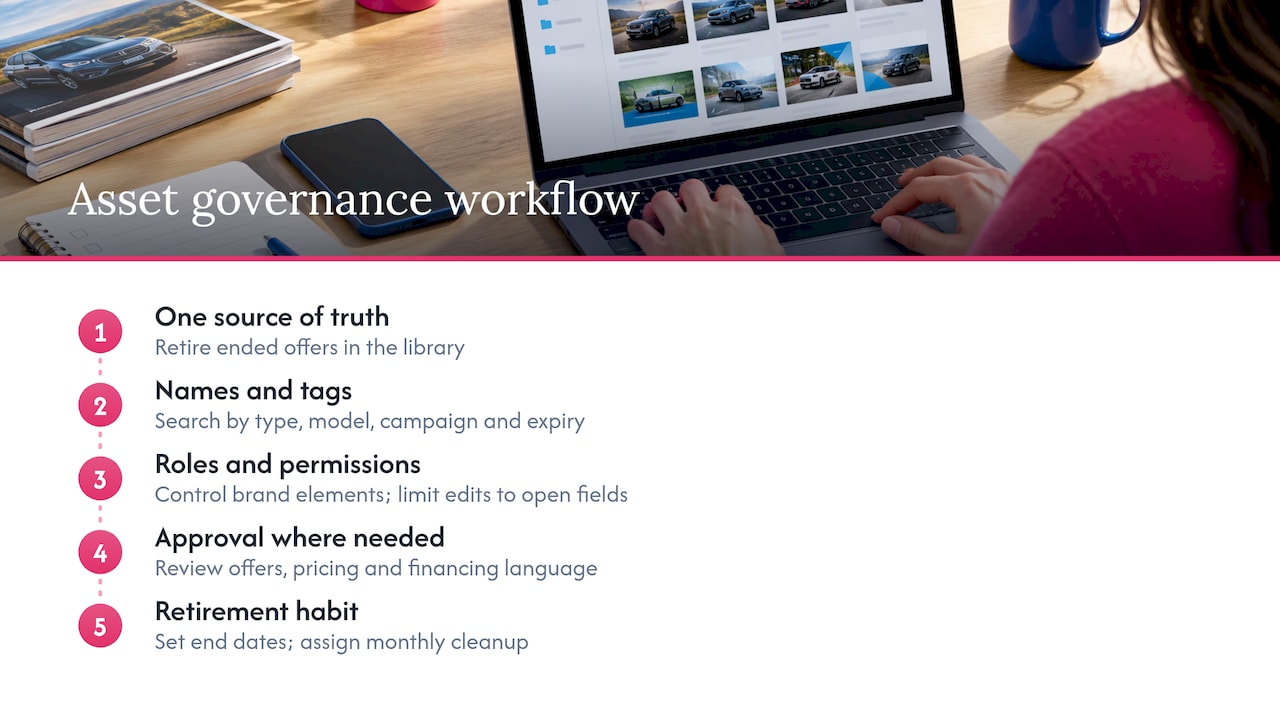
A workable workflow has five parts. None requires a large team.
1. One source of truth. Pick one library. Everything else points to it. When an offer ends, the asset is retired there, not in six inboxes.
2. Consistent names and tags. Name files by type, model, campaign and expiry month, for example “template, SUV, spring-offer, expires-May”. Tags let a salesperson find the right asset by searching, not browsing.
3. Roles and permissions. Corporate or the marketing lead controls brand elements. Dealers and salespeople can edit only the open fields. Our brand governance framework for distributed teams walks through how to set this up over 90 days.
4. An approval step where it matters. Not every post needs review. Offers, pricing and financing language do. Route those through a reviewer, and let low-risk posts such as delivery photos go straight out.
5. A retirement habit. Every offer asset carries an end date. Someone owns the monthly cleanup.
What should you check before sharing an asset?
This is the part dealerships cannot skip. An out-of-date price or a missing disclosure is a legal problem, not just a branding one.
Offer accuracy and who is responsible
NADA’s federal advertising guidance for dealers notes that dealers may be liable for third-party or OEM-controlled advertisements, including those on dealer websites. A national asset arriving from the manufacturer does not move the responsibility off your store. Check the offer, the dates and the fine print against what your store will actually honor.
The general standard is simple. The FTC’s truth-in-advertising principles say ads must be truthful, not misleading, and backed by evidence, and that applies to a short social video as much as to a print ad. Your compliance contact or attorney should confirm the specific disclosures for each offer type, such as pricing, financing and lease terms.
Privacy and data collection
Ads and social campaigns that collect customer information need proper privacy disclosures. NADA’s 2026 guidance points to the FTC Safeguards Rule and various state laws on data collection. If an asset sends people to a form, make sure the form and its privacy language are current.
Usage rights
Confirm that you have the right to use every image, song and font in a shared asset. Manufacturer photography is usually licensed for dealer use under program rules, but a customer’s photo requires the customer’s permission. Keep a note of permissions with the asset, not in someone’s memory.
A pre-share checklist
- Is the offer current, and does it match your store’s actual terms?
- Are the required disclosures present and legible?
- Are logos and brand colors correct?
- Is the vehicle shown the one being advertised?
- Do you have rights to every photo, clip and track?
- Does it carry an expiry date so it can be retired?
How do you know whether assets are working?
Asset programs fail quietly. Files sit in a library and nobody can say whether they help. Track three layers.
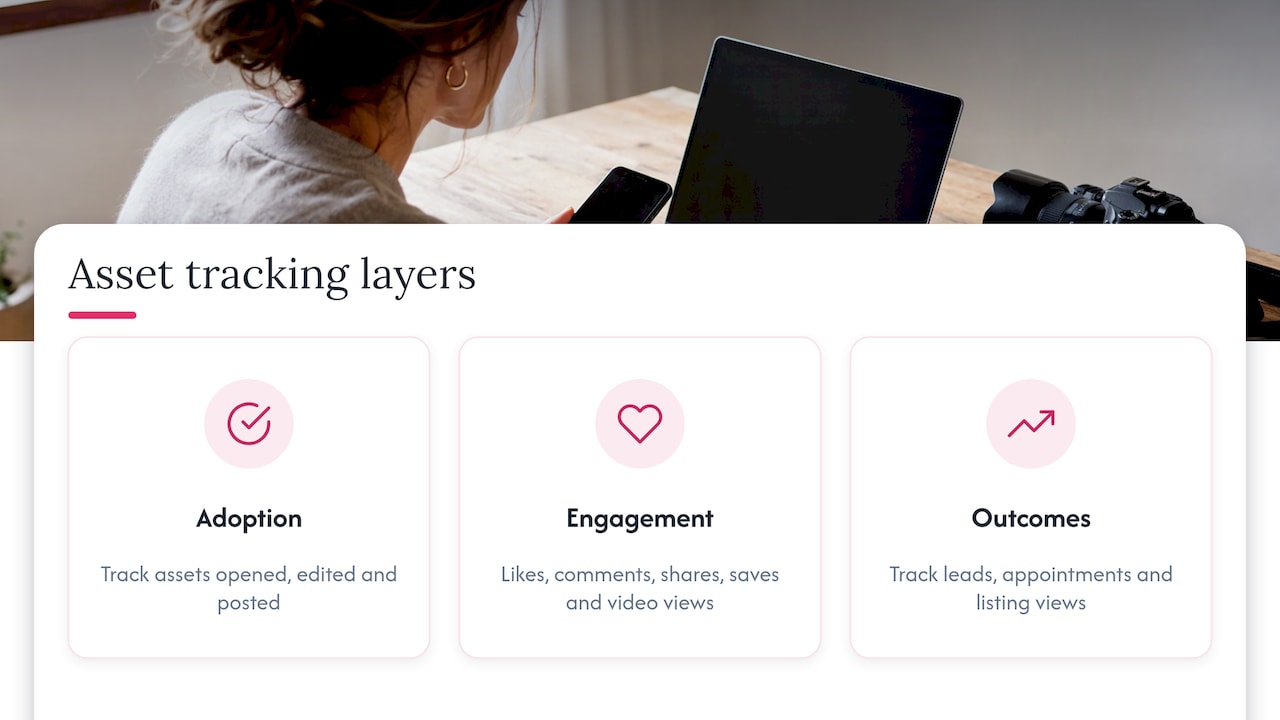
Adoption. Which assets are opened, edited and posted, and by whom? Low adoption of a template usually means it is hard to find, slow to customize or not useful.
Engagement. Likes, comments, shares, saves and video views on the posts made from each asset. Compare templates against each other, and compare stores in the same network.
Business outcomes. Leads, appointments and listing views. Cox Automotive’s data showed that vehicle detail page views per listing were 64.8% higher with 40 or more custom photos. That is one listing-level example of how richer assets can change shopper behavior, and a reminder to measure photo count and video presence against your own results.
Review the numbers monthly. Retire what nobody uses, and make more of what works.
Our perspective
We built Photofy around a problem we see in every distributed team: the brand office creates good content, and the people closest to the customer cannot use it quickly. Salespeople work from their phones. They want something they can customize in a minute and post with confidence.
That is why we put branded content creation, team approvals, asset management and automated publishing in one platform. Our approach is designed to give a brand control over logos, colors and approved layouts, while local reps adapt the photo, the name and the message. Industry-specific template libraries and white-labeling let a manufacturer, a franchise or a direct selling company present everything under its own brand.
For dealers, photo, video and PDF assets belong in the same place, so a salesperson finds the right file, makes it local and shares it without leaving the app. When the process is that simple, people use it, and the brand stays consistent as a result.
Jon
How Photofy supports dealer marketing assets
Photofy is a mobile and desktop social marketing platform, available on iOS, Android and desktop. It offers pre-designed and custom templates, a stock asset library, video stitching, graphic and text overlays, scheduling, analytics and white-label content management, so brand teams and local sellers work from the same approved materials.
Published plans include Small Business at $10.99 per month or $99 per year. Team plans listed on our individual and team plans page are Pro Teams at $13.00 per month per user and Enterprise Teams at $9.00 per month per user. Franchise, dealer network and enterprise setups, including white-label content management, are arranged directly, so see the Photofy pricing page to start the conversation. If you are an agency or brand team weighing a branded setup, our guide to white label branding explains how deployment works.
FAQ
What is the difference between dealer marketing assets and dealer advertising?
Advertising is the message placed in a channel, such as a paid social ad or a listing. Assets are the reusable building blocks behind it: photos, video, templates, copy and brand files. Good assets make every ad faster to produce and more consistent.
Which assets should a small dealership create first?
Start with custom photos and a short walk-around video for each vehicle, plus a few editable social templates and one offer flyer as a PDF. Add brand rules for your logo and colors so everyone uses them the same way. These cover most day-to-day posting.
How often should dealer marketing assets be updated?
Review offer-based assets at least monthly, and retire any whose terms have ended. Evergreen assets such as team photos, brand templates and service tips can run longer, but check them each model year or after any rebrand.
Who is responsible if a manufacturer-supplied ad is wrong?
Not only the manufacturer. NADA guidance says dealers may be liable for ads controlled by third parties or OEMs, so review the offer and disclosures before you post. Ask your compliance advisor or attorney about the specific rules for your state and offer type.
Sources
- Telling Your Value Story Through Photos, Cox Automotive
- Building a Smart Asset Library for America’s Leading Commercial Vehicle Dealer, Element Three
- Federal Advertising Requirements, NADA
- FTC Rules for Dealer Social Media, Ginsburg Law Group