

Brand Consistency Tools for Marketing Teams: A Rollout Guide
Brand consistency tools are the systems and automations that make on-brand output the default across every channel, not something a reviewer catches after the fact. They center on three functions: centralizing approved assets, embedding brand rules into the tools creators already use, and scoring how well real content matches your guidelines. If you’re choosing where to start, prioritize a platform that combines a digital asset library with workflow-embedded compliance checks and measurable scorecards. For teams building template-driven social content specifically, a platform like Photofy pairs locked templates, an asset library, and scheduling into one system worth evaluating first.
Key Takeaways
Brand consistency improves fastest when teams centralize assets, lock templates for high-frequency channels, and embed automated checks directly into workflows instead of reviewing content after it’s published.
| Point | Details |
|---|---|
| Consistency has measurable ROI | A five-dimension brand audit approach can increase revenue by up to 23% through faster recognition and reduced rework. |
| Score five governance dimensions | Track color accuracy, typography, logo usage, imagery, and voice/tone on a 1 to 5 scale per touchpoint. |
| Automate checks before publishing | Compliance platforms can score drafts in real time, catching off-brand tone before a human reviewer does. |
| Roll out in phases | Lock templates and centralize logos in the first three months before expanding automation across every channel. |
| Photofy fits template-driven teams | Photofy centralizes assets and locks templates for franchises, real estate networks, and social-first teams needing scheduling built in. |
Table of Contents
- What Is Brand Consistency, and What Do These Tools Actually Cover?
- Why Brand Consistency Matters More Than Most Teams Admit
- What Elements Do Brand Tools Actually Need to Govern?
- Why Does Brand Consistency Break Down at Scale?
- How Do You Measure Brand Consistency? Metrics and a Sample Scorecard
- Which Tool Category Solves Which KPI?
- What Does It Take to Maintain Consistency at Scale?
- How Do You Roll Out Brand Consistency Tools?
- How Do You Prevent Branding Blunders?
- How Photofy Supports Brand Consistency for Marketing Teams
- Comparing Vendor-Grade Solutions: Strengths and Weaknesses
- What I’ve Learned From Watching These Rollouts Play Out
- Try Photofy for Template-Driven Brand Control
- Sources
What Is Brand Consistency, and What Do These Tools Actually Cover?
Brand consistency means every touchpoint, a Instagram post, a franchise flyer, a sales rep’s email signature, reflects the same visual identity, voice, and messaging rules regardless of who created it. That scope stretches across four dimensions: visual identity (logo, color, typography), voice and tone, messaging (claims, positioning, disclaimers), and templates and assets (the actual files people touch daily).
The category of brand consistency tools spans several distinct functions:
- Digital asset management (DAM) systems that store and permission approved files.
- Brand kits and guideline hubs that document the rules.
- Template and design automation that pre-builds on-brand layouts.
- Compliance and AI validation checks that score content before it publishes.
- Monitoring and analytics tools that track how the brand actually appears in the wild.
- Approval and workflow systems that route content for sign-off.
Why Brand Consistency Matters More Than Most Teams Admit
A five-dimension brand consistency audit that scores color accuracy, typography, logo usage, imagery, and tone across touchpoints can lift revenue by up to 23% through faster recognition and more efficient creative production. That’s not a soft branding benefit. It’s a production-cost argument.
Pro Tip: Track cost-per-creative alongside your compliance score. Teams that centralize assets often cut production time before they see any lift in recognition metrics, so use time-to-publish as your early proof point while revenue data catches up.
Consistent branding pays off in ways marketing leaders can measure directly:
- Faster audience recognition across ads, social, and email.
- Higher trust, which shortens the path from impression to conversion.
- Less rework because creative teams stop reinventing templates for every campaign.
- Clearer positioning when multiple agencies or freelancers touch the same brand.
Tie each of those to a KPI you already track: conversion rate by channel, time-to-publish, and cost-per-creative asset. If those numbers move in the wrong direction, inconsistency is often the hidden cause.
What Elements Do Brand Tools Actually Need to Govern?
Every credible brand consistency tool needs to enforce five governance dimensions, because these are the same five categories that show up repeatedly in audit findings.
- Color and palette: locked hex/RGB values with no manual approximation.
- Typography: approved fonts plus fallback fonts for platforms that block custom type.
- Logo usage: current version only, correct clear space, no stretching or recoloring.
- Imagery and photography style: consistent lighting, cropping, and subject treatment.
- Voice and tone: documented phrasing rules, not just a mood board.
The most common inconsistencies auditors find are color approximation, font substitution, and outdated logo versions. Operational controls fix these at the source: locked templates that cannot be edited outside approved zones, a single approved asset library instead of scattered folders, defined fallback fonts, and export rules that strip unauthorized color adjustments before a file ever leaves the design tool.
Why Does Brand Consistency Break Down at Scale?
Consistency rarely fails because of one bad designer. It fails because of structure: decentralized teams working from different files, multiple agencies or freelancers each interpreting the guidelines their own way, channel constraints like email clients that strip custom fonts, and templates nobody has updated in two years.
- Decentralized regional or franchise teams building assets independently.
- Outside agencies working from outdated brand guidelines.
- Platform limitations that force font or color substitutions.
- Guidelines that exist as a PDF nobody opens after onboarding.
A font substitution in one email template seems minor until it compounds across a hundred sends and starts eroding recognition. Embedding rules into automated workflows, rather than relying on manual review, closes most of that gap before it starts.
How Do You Measure Brand Consistency? Metrics and a Sample Scorecard
Measurement turns brand consistency from a feeling into a number you can report to leadership. A five-dimension audit approach scores color accuracy, typography compliance, logo usage, imagery alignment, and voice/tone on a 1 to 5 scale for each touchpoint, then aggregates those scores into a single dashboard view.
Other metrics worth tracking alongside that scorecard:
- Asset usage/compliance rate: the share of published content built from approved assets.
- Approval time: how long content sits in review before publishing.
- Error rate: the frequency of off-brand elements caught pre versus post publication.
You can gather this through automated scans, manual spot audits, or sampling a percentage of monthly output. The point is consistency, not perfection, so pick a cadence you’ll actually keep.
Which Tool Category Solves Which KPI?
Different tool categories move different numbers, so map the feature to the metric you’re trying to fix before you buy anything.
- DAM/brand hub raises your asset usage and compliance rate by giving everyone one place to find approved files instead of digging through old campaign folders.
- Template and design automation cuts approval time and error rate because the layout is already locked before a creator adds copy or images.
- Brand-compliance and AI validation checks improve message and tone alignment by flagging off-brand language before a human reviewer ever sees the draft. Brand compliance platforms turn static style guides into policies that check content in real time inside the tools creators already use.
- Approval/workflow systems shorten the review cycle by routing content automatically instead of chasing sign-offs over email.
- Monitoring and social listening catches drift after publication, which matters most for high-volume or partner-generated content.
Before selecting, run a quick priority check: team size and content volume dictate how much automation you need, regulatory exposure (financial services, healthcare, franchising) raises the bar on compliance checks, and channel mix determines whether you need deep email/ad platform integration or primarily social scheduling. Also confirm the tool connects to your CMS, ad platforms, and single sign-on setup, and that it keeps an audit log, since that log is what makes accountability provable later.
| Feature Category | Primary KPI Moved | Best Fit For |
|---|---|---|
| DAM/brand hub | Asset usage/compliance rate | Distributed or franchise teams |
| Template/design automation | Approval time, error rate | High-frequency social and email content |
| Compliance/AI checks | Message/tone alignment | Regulated industries, large content volume |
| Approval/workflow systems | Approval time | Multi-stakeholder review chains |
| Monitoring/social listening | Post-publish error detection | Partner and franchise networks |
What Does It Take to Maintain Consistency at Scale?
Scale is where most brand programs quietly fall apart, because the guidelines that worked for five people rarely survive contact with fifty. The fix is operational, not aspirational.
- Centralize every approved asset in one library, not a shared drive with a hundred subfolders.
- Assign a named brand owner who has final say on disputes.
- Embed compliance checks directly into the creation tools your team already uses.
- Use locked templates for any channel that publishes more than once a week.
- Run audits on a fixed schedule instead of waiting for a complaint.
Assign clear roles: a brand owner who sets the rules, a content owner who builds the asset, an approver who signs off, and an agency liaison who briefs outside partners using a standard template. Run monthly spot checks, a deeper quarterly audit, and a full annual review of the guidelines themselves.
Pro Tip: Give your agency liaison a one-page brief template with locked brand fields (colors, fonts, approved logo files) instead of a full guidelines PDF. Agencies skim PDFs. They actually use one-pagers.
How Do You Roll Out Brand Consistency Tools?
A phased rollout gets you quick wins before you ask leadership to fund a bigger platform investment.
- Months 0 to 3: Lock templates for your highest-frequency channels, centralize logos and color tokens in one library, and turn on a single automated pre-publish check.
- Months 3 to 6: Expand automation across remaining channels and connect the tool to your CMS and scheduling systems.
- Months 6 to 12: Run a full audit, review error-rate trends, and update the guidelines based on what the data actually showed you.
Quick wins to prioritize immediately:
- Lock the templates for whatever channel publishes most often.
- Centralize logo files and color tokens before anything else.
- Enable one automated compliance check, even a basic one, before building the whole system.
As teams scale content production, many end up relying on a single overworked approver who catches problems only after they’ve already gone live. Moving that check earlier in the workflow is the single highest-leverage fix in this entire rollout process.
How Do You Prevent Branding Blunders?
Watch for these red flags: visible logo misuse, an off-shade primary color, conflicting product names between channels, missing disclaimers, or a tone shift that feels like a different company wrote it.
- Roll back the offending asset immediately, don’t wait for the next content cycle.
- Reissue the correct locked template to whoever created the error.
- Notify any live campaigns using the same asset.
- Update the guideline document so the mistake has a documented fix.
When a partner or franchisee causes the error, communicate the correction directly and confirm they’re using the current template library, not an old download from six months ago.
How Photofy Supports Brand Consistency for Marketing Teams
Photofy centers its platform around the exact gap most teams struggle with: keeping templates, assets, and scheduling consistent across a distributed team without adding a full-time compliance role. The personal and small-business template library locks layouts while still letting creators customize approved fields, and the built-in asset library keeps logos, colors, and fonts centralized instead of scattered across individual devices.
For larger networks, white-label and enterprise controls let corporate teams distribute on-brand templates to franchise locations or sales reps while retaining oversight of what actually gets published. Real estate networks and franchise brands use Photofy’s real estate marketing solution for exactly this reason: locked templates keep hundreds of agents on-brand without corporate reviewing every single post.
Core value points teams report:
- Faster time-to-post because templates are already brand-approved before a creator opens them.
- Fewer manual reviews needed since the template itself enforces color and logo rules.
- Centralized asset distribution across large or franchised networks.
Comparing Vendor-Grade Solutions: Strengths and Weaknesses
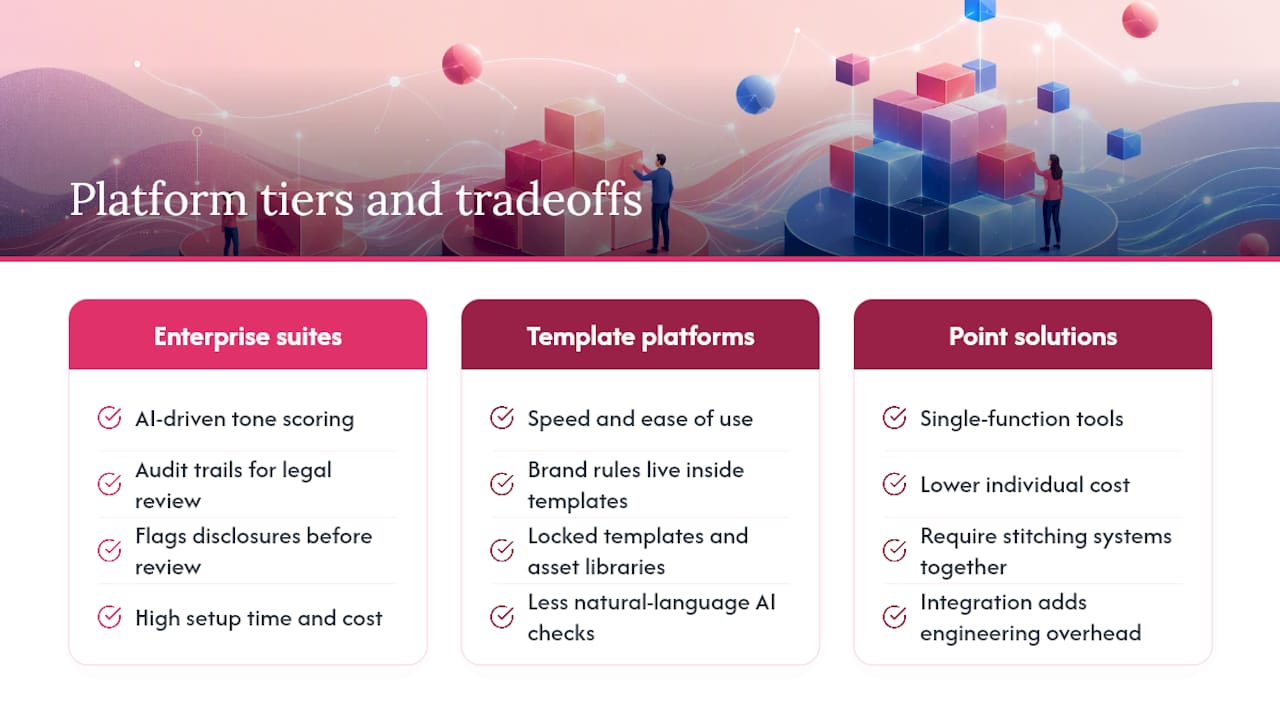
Vendor-grade brand consistency platforms generally split into three tiers, and each tier trades off differently between control, cost, and complexity.
Enterprise brand-compliance suites offer the deepest automation, including AI-driven tone scoring and audit trails that satisfy legal or regulatory review. Brand compliance software in this tier scores drafts against a defined Brand Card and flags missing disclosures before a human ever opens the file. The tradeoff is setup time and cost. These platforms usually need dedicated onboarding and work best for organizations with real regulatory exposure or hundreds of contributors.
Template and social-content platforms prioritize speed and ease of use over deep compliance scoring. They excel at getting distributed teams, franchise networks, sales reps, direct sellers, publishing on-brand content fast, because the brand rules live inside the template itself rather than a separate review layer. Photofy fits this tier, along with the broader category of design-automation tools built for social-first output. The tradeoff is that these platforms lean on locked templates and asset libraries rather than natural-language AI tone checks, which suits teams whose main risk is visual drift, not regulatory language.
Point solutions for a single function, a DAM alone, or a workflow-approval tool alone, cost less individually but require you to stitch multiple systems together. That integration work is real: connecting a standalone DAM to a separate approval tool and a separate scheduling platform adds engineering overhead most marketing teams underestimate.
The right pick depends on what’s actually breaking. If regulatory language is your risk, prioritize a compliance-scoring platform. If visual drift across a distributed network is your risk, prioritize a template-and-asset platform with locked layouts built in.
What I’ve Learned From Watching These Rollouts Play Out
Teams that succeed embed rules into the creation tool itself instead of policing after publication, and they measure compliance from week one rather than waiting for a perfect system. The biggest pitfall isn’t picking the wrong platform. It’s rolling out every feature at once instead of locking your highest-frequency channel first and expanding from there.
Try Photofy for Template-Driven Brand Control
If decentralized teams, franchise locations, or a growing content calendar keep breaking your brand rules, Photofy gives you locked templates, a centralized asset library, and scheduling in one platform, without needing a separate compliance tool bolted on top.
Start with the personal plan to test locked templates and the asset library on a small team, or go straight to enterprise solutions if you’re rolling this out across a franchise network or distributed sales team. Check the pricing page to compare plans, and try uploading your logo, color tokens, and one locked template as your first move.
Sources
- Brand Consistency Audit: Ensure Cohesion Across Channels
- Brand Compliance Platform – Siteimprove
- Brand Compliance Software | DashoContent