
Onboarding Franchisees: A Marketing Plan for the First 90 Days
The best way to onboard franchisees on marketing is to treat it as a managed sequence, not a single training day. Give every new owner a ready-to-use brand package before launch, a localized plan built with them, clear approval rules, and one named person at headquarters who owns the handoff through the first 90 days. Done this way, a new franchisee posts on-brand content from week one instead of guessing what is allowed.
This guide walks through that sequence for U.S. franchisors: what to hand over, when, who owns each step, and how to keep local flexibility without losing brand control.
TL;DR
- Start marketing onboarding before the doors open: brand package, local profiles and a content calendar should be ready by the soft launch.
- Assign one named owner at headquarters for assets, profile setup, approvals, launch content and 90-day reporting.
- Write your marketing rules down, teach them, and make the compliant path faster than creating content from scratch.
- Choose a hybrid model: corporate supplies templates and guardrails, local owners add authentic local material.
- Track launch goals, customer acquisition cost and lifetime value, and audit what matters, not just whether a post went live.
Table of Contents
- Why marketing deserves its own onboarding track
- A realistic timeline for marketing onboarding
- What to hand over before launch
- Building the local marketing plan with each franchisee
- Choosing how much control to keep
- Staying consistent with the FTC Franchise Rule
- Who owns what: one name at headquarters
- A 30/60/90 plan for the first three months
- Audits that check more than whether a post went up
- Our perspective: make the right way the easy way
- Putting it into practice with Photofy
- FAQ
- Sources
Why marketing deserves its own onboarding track
Most franchise onboarding plans cover legal, financial, site and operations work first. Marketing tends to arrive late, as a binder of logos and a link to a shared drive. Yet advertising and training are among the things that most affect a franchisee’s bottom line, which is why the FTC singles out Item 11 of the Franchise Disclosure Document for prospective buyers to examine closely.
There is also a structural reason. Franchisees know their customers and local relationships day to day, while franchisors carry the brand risk and the cost of monitoring. Franchise research on social media control concludes that the strongest design gives local operators controlled flexibility, rather than total central control or unrestricted publishing. Your onboarding is where that balance is set, because it is the first time a franchisee learns what “on brand” means in practice.
A realistic timeline for marketing onboarding
A practical U.S. timeline runs in phases. Treat the weeks below as a planning frame, not a promise, because timing varies with licensing, permitting, construction and industry. That source describes a standard plan of about 12 weeks, while noting that state licensing alone may take 30 to 90 days.
| Phase | Typical window | Marketing focus |
|---|---|---|
| Setup | Weeks 1 to 4 | Brand-compliance rules, territory details, account ownership, access to your content platform |
| Training and branding | Weeks 4 to 8 | Brand training, template practice, approval workflow walkthrough |
| Operational setup | Weeks 6 to 10 | Local profiles, directory listings, photography, first content batch |
| Soft launch | Weeks 10 to 12 | Friends-and-family promotion, review requests, test posts |
| Grand opening and first 90 days | After opening | Launch campaign, weekly check-ins, 30/60/90 reviews |
The timeline is built on the same phases found in the getjobber guide, which is written for home service businesses, so adjust it for your category. A restaurant with a build-out will run longer than a mobile service business.
Build a dependency checklist
Marketing is often blocked by things outside marketing: licensing, insurance, site readiness, software access, staffing and local listings. Track these dependencies in one list and do not promise a grand opening campaign date until they are cleared. A campaign that goes live before the phone number works or the listing is verified wastes the most valuable attention your new location will ever get.
What to hand over before launch
Give each franchisee a complete brand identity package before they start building their local presence. A franchisee onboarding checklist from HubSpot lists the core items: logos, templates, brand guidelines and approved messaging. Add to that what your system specifically needs:
- Approved templates for the content types franchisees will use most: grand opening, promotions, hiring, seasonal posts, team features.
- A stock asset library of approved photos, video and PDFs, tagged so owners can find them without asking.
- Required disclosures and legal language for offers, giveaways and testimonials.
- Customization limits: what can change (local photo, offer details, contact information) and what cannot (logo placement, colors, claims).
- Account ownership rules: who creates, owns and holds credentials for each social profile and listing.
The point of the package is speed. Franchisees who start from the halfway point, with the brand already built for them, spend their first weeks on local relationships rather than design decisions.
Building the local marketing plan with each franchisee
The same checklist recommends that you localize the plan once the brand package is in hand. It covers target-audience analysis, competitive positioning, budget, local contact details, social profiles, directory listings, a content calendar, photography guidance, scheduling instructions, review-response templates and email campaigns.
Do this together in a working session, not as homework. A 60-minute call in weeks 6 to 8 that leaves the franchisee with claimed profiles, a first month of scheduled posts and a list of local partners to approach is worth more than a 40-page PDF.
Start with a content calendar
A calendar turns a blank page into a routine. Plan the first eight weeks around three buckets: brand posts from headquarters, local posts the franchisee creates from your templates, and community posts that only a local owner could write. For a primer on structuring one, see this guide on how to plan a content calendar. If you want ready-made starting points, our free content calendars give new owners a structure to fill in.
Set goals you can measure
The checklist suggests tracking launch goals, marketing ROI, customer acquisition cost and customer lifetime value. Agree on two or three numbers at the soft launch, such as new followers, booked appointments or reviews collected, and review them at 30, 60 and 90 days.
Choosing how much control to keep
The old debate was centralized versus local. Current research points to a middle path. The International Franchise Association’s marketing research report states that 50.4% of respondents use a hybrid marketing governance model. A separate 2025 franchise-marketing report found 48% grant moderate autonomy and 39% full autonomy. These surveys use different samples and definitions, so do not add the figures together. What they share is the direction: few systems run at either extreme.
The lesson for onboarding is to define autonomy explicitly instead of using a vague label. For each of these, write down who decides:
- Channels: which platforms franchisees may open and which stay corporate.
- Content types: which posts need no approval, which need review.
- Approval rights and response times: for example, a stated turnaround so local owners are never stuck waiting.
- Budget authority: what the franchisee controls locally versus the advertising fund.
A content platform is most useful when it makes the compliant path faster than creating unapproved content from scratch. If a franchisee can open a template, swap in a local photo and schedule in two minutes, they have little reason to go off-brand.
Staying consistent with the FTC Franchise Rule
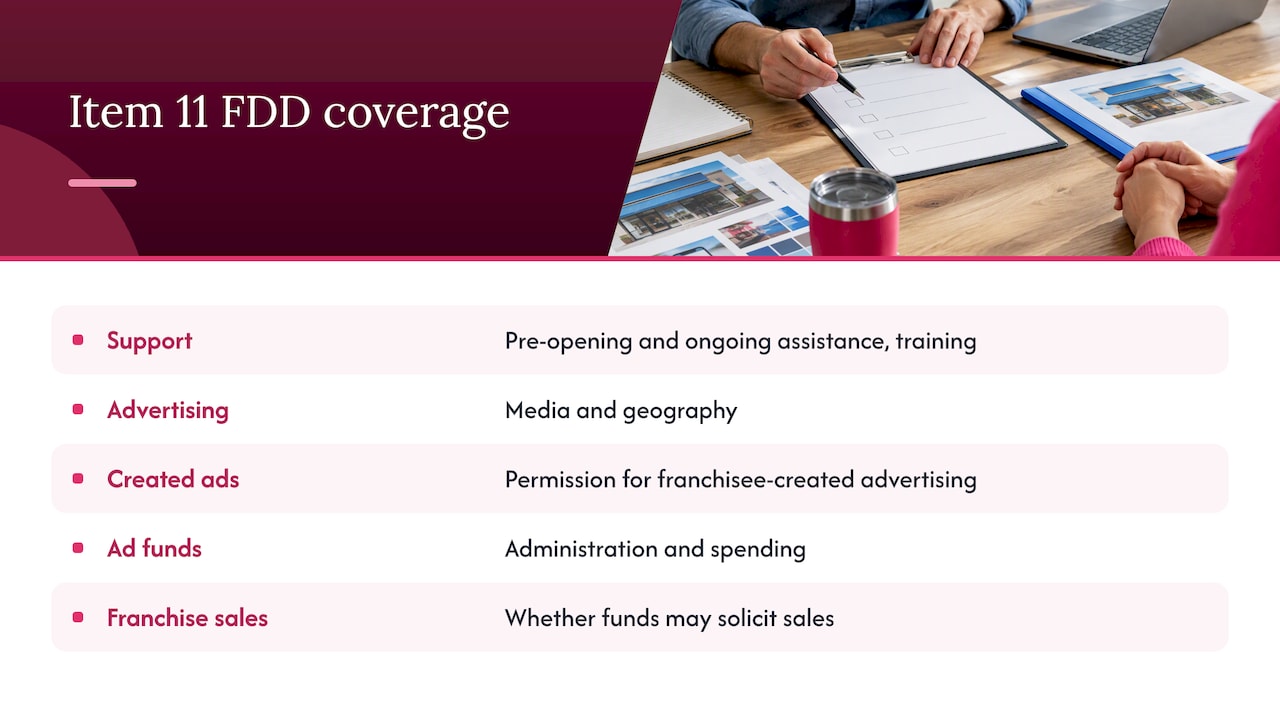
If you are a franchisor, your marketing promises are not only a brand matter. Under the FTC’s Franchise Rule, Item 11 of the FDD covers pre-opening and ongoing assistance, training, advertising media and geography, permission to use franchisee-created advertising, advertising funds, how those funds are administered and spent, and whether they may be used to solicit more franchise sales.
Practically, that means your onboarding should match what the FDD says. Marketing technology should support the governance model already promised in the franchise agreement and FDD, and should not quietly create new restrictions or obligations. A standard cannot be enforced reliably if it was not disclosed, written clearly or taught. If your onboarding adds a new approval step or a new required tool, check it with your franchise attorney before you roll it out.
For franchisees reading this, the FTC advises asking how advertising money is split between administration, national advertising, local or regional advertising and franchise sales, and whether owners have a say in spending. Speak with recent franchisees, not only the sales team.
Who owns what: one name at headquarters
Onboarding works better as a managed sequence with one named corporate contact, milestone owners and weekly check-ins, as Reidel Law Firm explains. Right at Home describes its own formal onboarding schedule in similar terms, treating onboarding as relationship-building as well as task completion.
For marketing, assign an owner for each of these:
- Brand assets and templates
- Local profile and listing setup
- Approvals
- Launch content
- First-90-day reporting
One person can hold several roles in a small system. The rule is that every item has a name next to it.
A 30/60/90 plan for the first three months
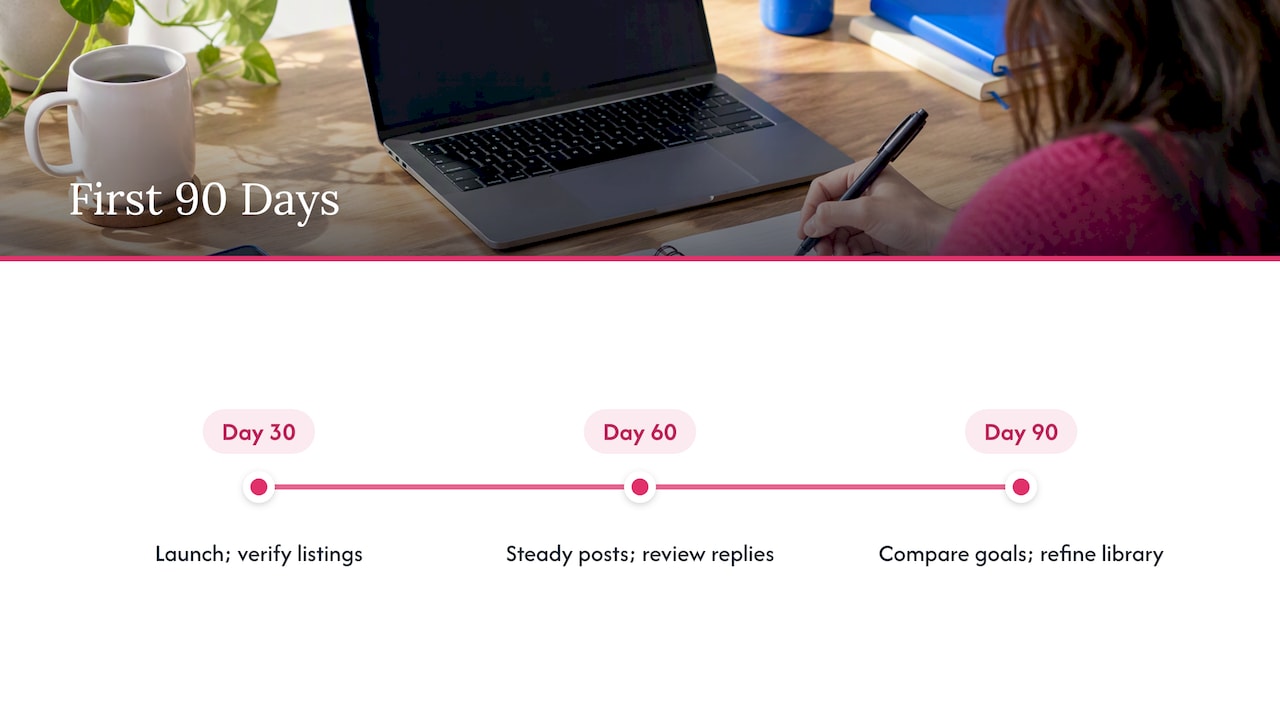
Days 1 to 30: launch and learn
Publish the grand opening content, confirm every profile and listing is live and consistent, and run weekly 20-minute check-ins. Review the first posts together and teach by example. Our 30/60/90 playbook for franchise social media lays out the headquarters side of this rhythm.
Days 31 to 60: build the habit
Shift to a steady cadence. Look at which templates the franchisee uses, which local posts perform and where approvals are slowing things down. Add the first review-response templates in practice, not just in the manual.
Days 61 to 90: review and adjust
Compare results to the launch goals. Decide what to loosen, what to tighten and what to add to the shared library. Capture the best local posts so other franchisees can reuse them. If you want a structured way to document the rules behind all of this, see our 90-day brand governance framework and the 90-day brand compliance checklist.
Audits that check more than whether a post went up
A marketing system works when you document standards in the operations manual, train franchisees to them, audit regularly and enforce in graduated steps. Reidel Law Firm’s compliance guide puts it plainly: franchisees cannot comply with rules they were never taught. It identifies annual review as a common baseline, with more frequent checks for higher-risk areas. Set your cadence with your attorney, following the franchise agreement, your risk profile and applicable law.
For social content, audit these points:
- Brand presentation: logo, colors, fonts, approved claims
- Required disclosures on offers and endorsements
- Account access and ownership
- Asset usage, including licensed photos
- Accuracy of reporting
A documented cure process matters as much as the audit. Spell out how a franchisee is notified, how long they have to fix an issue and what happens next, so enforcement feels fair and predictable.
Our perspective: make the right way the easy way
At Photofy, we see the same pattern in distributed organizations. Headquarters wants brand control. Local owners want to move fast and sound like their community. When the only tools are a locked PDF and an approval email chain, one of those two loses.
We built Photofy to keep both. Branded templates, a shared asset library, team approvals and scheduling sit in one place, available on iOS, Android and desktop, so a local rep can create something compliant in minutes. White-labeling lets enterprise clients present the platform under their own brand, which helps new franchisees feel they are using the system’s own tools from day one.
Our advice for onboarding is simple. Pick a small set of templates and make them excellent before you add more. Give new owners something to publish in their first week. Let the governance rules live inside the workflow, so they are taught by use, not remembered from a manual. Our guide to brand consistency tools for marketing teams goes deeper on rollout.
— Jon
Putting it into practice with Photofy
If you manage a franchise network, Photofy gives you a way to deliver templates, assets and approvals to every location without relying on email. Published pricing includes Pro Teams at $13.00 per month per user and Enterprise Teams at $9.00 per month per user, listed on our plans page. Franchise and enterprise setups, including white-label, are arranged by direct inquiry, so contact us through our pricing page to talk through your network. Owners of a single location can look at our Small Business plan, at $10.99 per month or $99 per year.
FAQ
How early should marketing onboarding start?
Begin in the first four weeks after signing, with brand rules, account ownership and platform access. Local profiles and the content calendar follow in weeks 6 to 10. Final timing depends on licensing, build-out and other dependencies, so track them before you fix a launch date.
What should be in a franchisee’s marketing starter kit?
Logos, templates, brand guidelines and approved messaging are the core. Add a tagged asset library, required disclosures, customization limits and account ownership rules. Then localize with a content calendar, photography guidance, scheduling instructions and review-response templates.
How much marketing freedom should franchisees have?
Most systems land in the middle. Define autonomy by channel, content type, approval rights and budget authority, so everyone knows the limits. Check the final rules against your FDD and franchise agreement with a franchise attorney.
How do you measure whether marketing onboarding worked?
Agree on launch goals at the soft launch, then review them at 30, 60 and 90 days. Useful measures include marketing ROI, customer acquisition cost and customer lifetime value, alongside simple local numbers such as reviews and bookings.
Sources
- Franchise Onboarding Process, getjobber
- Franchisee Onboarding Checklist, HubSpot
- 16 CFR Part 436, eCFR
- Franchise Fundamentals: the Franchise Disclosure Document, FTC
- Marketing research report, International Franchise Association
- A typology of social media control in franchising
- Franchisee Onboarding guide, Reidel Law Firm
- Franchise Compliance Program, Reidel Law Firm
- RightStart onboarding, Right at Home