

Build a Brand Governance Framework in 90 Days for Distributed Teams
A brand governance framework is the operational system of people, processes, tools, and decision rights that keeps every piece of content on-brand, no matter who creates it or where. The core components are guidelines, digital asset management, tiered approval workflows, training, measurement, and now AI policy. Done well, it delivers reliable brand consistency at scale, across every channel and every team member who touches your brand.
TL;DR:
- Proper ownership of brand guidelines is essential; without a designated brand owner, governance gaps quickly develop.
- Interactive, web-based guidelines, combined with a structured digital asset management system, ensure users access current assets and avoid version confusion.
- Tiered approval workflows tailored to asset risk levels streamline processes and reduce delays, especially for high-stakes content.
- Regular measurement through compliance scorecards and brand sweeps helps identify gaps, refine policies, and maintain consistent brand execution.
- AI governance must be integrated into existing workflows by defining clear input, prompt, and content restrictions to prevent tone and factual drift.
Table of Contents
- What Is a Brand Governance Framework and Why It Matters
- Core Components Every Brand Governance Model Needs
- Who Owns the Brand: Hub-and-Spoke, Councils, and RACI
- The Technology Stack Behind Effective Brand Governance
- A 90-Day Rollout Plan for Brand Governance
- How to Measure Governance: Scorecards and the Brand Sweep
- Setting Guardrails for AI-Generated Brand Content
- Governance in Action: Three Short Examples
- What I’ve Learned Running Brand Governance Programs
- Put Your Governance Framework Into Practice with Photofy
- Sources
What Is a Brand Governance Framework and Why It Matters
Most companies think they have brand governance because they have a PDF. They don’t. A style guide document sitting in a shared drive is not sufficient to constitute a system. Real governance requires ownership, workflows, and tools that make compliance the path of least resistance, not an extra chore layered onto someone’s already-full week.
The business case is straightforward. Consistent brand execution protects the equity you have spent years building, reduces legal exposure from off-brand claims or misused assets, and shortens time-to-market because teams stop waiting on ad hoc approvals. When sales, marketing, and local franchise teams pull in different directions, the damage shows up directly in the customer experience, which is why Harvard Business Review points to sales-marketing alignment as a measurable driver of brand consistency, not just an internal nicety.
Governance fails in predictable ways. Watch for these patterns inside your own organization:
- Static PDFs that get downloaded once and never opened again
- No single owner accountable for brand decisions, so exceptions pile up unanswered
- Local teams building their own workarounds because the “official” process is too slow
- Fragmented tools where templates live in one place, approvals happen in email, and final assets get buried in someone’s desktop folder
Pro Tip: If you can’t name the person who owns your brand guidelines right now, that’s your first governance gap to close, before you touch a single template.
Practitioners who study why governance frameworks collapse consistently point to the same root cause: leaders mistake the guidelines document for the governance system itself, and they treat local teams as the problem instead of designing a process that actually enables them, according to Elements Brand Management. Fix the ownership gap first. Everything else in this article builds on top of it.
Core Components Every Brand Governance Model Needs
A brand governance framework interlocks five components. Miss one, and the others start to strain.
- Interactive brand guidelines. Skip the static PDF. Live, web-based guidelines with linked assets and version history mean your team is always looking at the current standard, not a stale export from 18 months ago, an approach Frontify recommends specifically because it removes the version-control confusion that static documents create.
- Digital asset management (DAM). A DAM needs real taxonomy, permission tiers, and expiry dates on time-sensitive assets, with a clear source-of-truth rule so nobody edits an outdated logo file by mistake.
- Tiered approval workflows. Not every asset carries the same risk. A national ad campaign needs legal and executive sign-off; a local Instagram Story using an approved template should not need the same friction.
- Training and brand champions. Guidelines only work if people actually use them. Naming brand champions inside regional or franchise teams gives adoption a human face instead of a mandate from corporate.
- AI governance. Generative tools now sit inside the content pipeline whether you planned for them or not, which makes AI policy a foundational piece of any modern brand management strategy rather than an afterthought, a point BrandLife makes central to how governance frameworks now operate.
Who Owns the Brand: Hub-and-Spoke, Councils, and RACI
Centralize the decisions that protect brand equity. Decentralize the execution that lets local teams move fast. That is the entire logic behind the hub-and-spoke model.
The hub owns the non-negotiables: logo usage, color palette, typography, tone of voice, and legal or regulatory claims. Spokes, meaning regional offices, franchise locations, or product teams, get freedom to adapt messaging, imagery, and channel mix within those locked parameters. Structuring governance this way, with a central brand function and a cross-functional council reviewing exceptions, is what lets a distributed organization scale without either chaos or gridlock, as Atin Studio lays out in its operational model.
A brand council should include:
- Brand or marketing lead (chair) — owns final decisions on brand standards
- Legal or compliance representative — flags regulatory risk before it ships
- Sales leadership — surfaces where field teams are working around the guidelines
- Design or creative lead — maintains the template library and asset quality
- Regional or franchise representative — brings ground-level context to exception requests
Meet quarterly at minimum, with an async channel for urgent exceptions. A simple RACI clears up most confusion fast: for a new social template, the brand lead is Accountable, the design team is Responsible, legal is Consulted on any claims, and regional managers are Informed once it publishes.
Pro Tip: Frame every governance conversation around enablement, not enforcement. “Here’s a faster way to get your asset approved” lands very differently than “you broke the rules again.”
The Technology Stack Behind Effective Brand Governance
Governance lives or dies on infrastructure. Guidelines and councils set the rules; the tech stack is what makes following them easier than not.
DAM hygiene comes first. That means consistent file naming, complete metadata tagging, permission tiers by role, and automated expiry so outdated or licensed-with-a-deadline assets don’t linger and get reused by accident.
Template libraries need a deliberate split between locked and unlocked layers. The Atin Studio framework calls this the operational sweet spot: it makes the compliant version of a template also the fastest one to produce, so nobody’s tempted to build a version from scratch. Ship templates for your top three recurring use cases first, typically a social post, an email header, and a local promotional flyer.
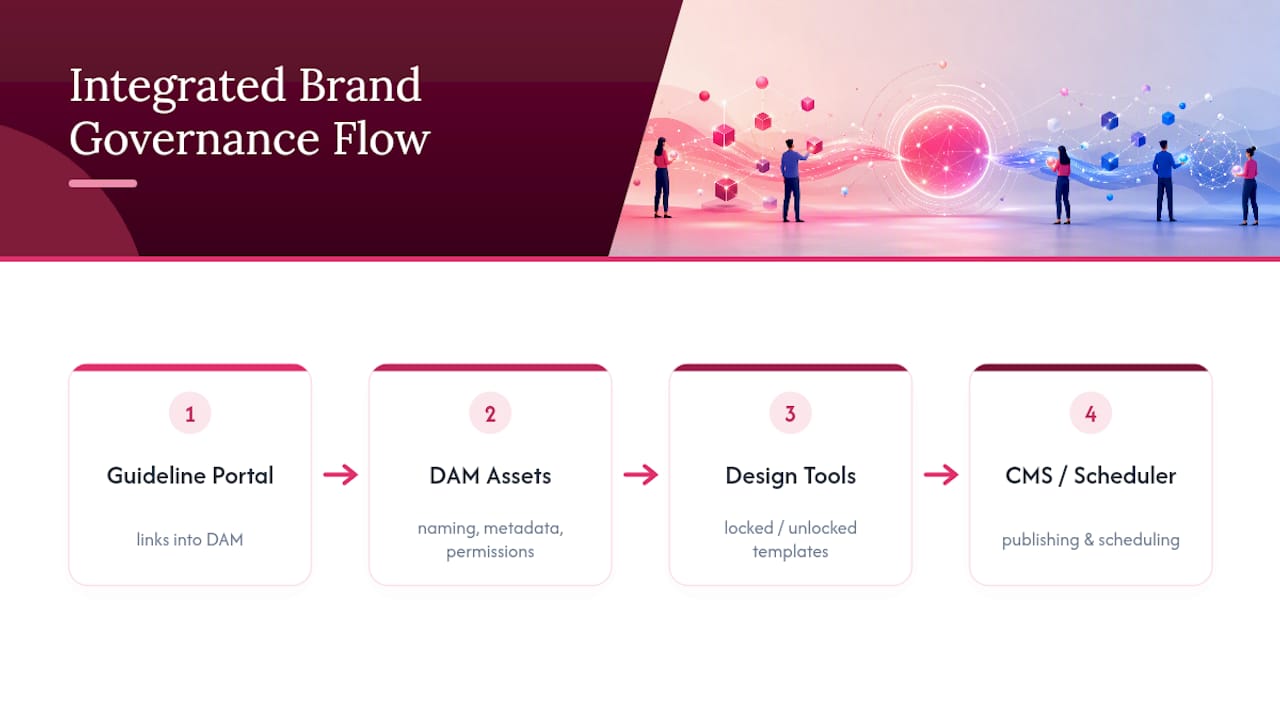
The stack itself needs to talk to itself. A guideline portal that links directly into your DAM, which connects to whatever design tools your team actually uses, which feeds into your CMS or scheduling workflow, closes the gaps where brand drift usually creeps in. Every handoff between disconnected tools is a chance for someone to grab the wrong file version. Frontify makes the case that searchable, integrated brand centers reduce exactly this kind of version confusion. A rollout guide built around consolidated tooling, rather than five disconnected point solutions, is worth building into your plan from day one.
A 90-Day Rollout Plan for Brand Governance
Governance stalls when it’s treated as a someday project. A phased, dated plan forces momentum.
Phase 0 (before day one): Audit existing assets across every channel and team. Catalogue where off-brand creative is coming from and why. Flag two or three quick wins you can fix immediately to build early buy-in.
- Days 0 to 30: Publish the baseline. Launch interactive guidelines covering your non-negotiables, and ship a template library for your top three use cases. Go/no-go: guidelines are live and at least one template is in active use by a pilot team.
- Days 30 to 60: Operationalize. Implement DAM hygiene (naming, metadata, permissions), set tiered approval workflows, and train an initial cohort of brand champions. Go/no-go: DAM adoption above baseline and first approval-SLA data collected.
- Days 60 to 90: Expand and measure. Widen rollout to additional teams or regions, run your first brand sweep, and publish an initial compliance scorecard. Go/no-go: scorecard published and at least one policy gap identified and corrected.
| Phase | Timeframe | Primary deliverable |
|---|---|---|
| Phase 0 | Pre-launch | Asset audit and quick-win list |
| Phase 1 | Days 0-30 | Baseline guidelines and top-3 templates |
| Phase 2 | Days 30-60 | DAM hygiene, approvals, champion training |
| Phase 3 | Days 60-90 | Expanded rollout, first brand sweep, scorecard |
This pacing mirrors what BrandLife recommends for organizations trying to avoid the stall-out that kills most governance initiatives before they ever produce measurable results.
How to Measure Governance: Scorecards and the Brand Sweep
You can’t manage what you don’t measure, and brand governance without KPIs is just an opinion with extra paperwork.
Track these consistently:
- Compliance rate: percentage of published assets that pass a brand audit without correction
- Approval SLA: average time from submission to sign-off, by tier
- Asset adoption: percentage of new content built from approved templates versus built from scratch
- Exception rate: how often teams request deviations from the guidelines, and why
- DAM search success: whether people find the right asset on the first search, a proxy for taxonomy health
Build a compliance scorecard quarterly at minimum; some organizations run it monthly during the first year. A well-run quarterly brand sweep, where the brand council actually reviews a sample of published assets, feeds directly back into guideline updates, closing the loop between what the rules say and what teams are actually shipping. One brand-consulting analysis frames consistent measurement as the difference between brand consistency as an aspiration and brand consistency as a business result you can point to.
Setting Guardrails for AI-Generated Brand Content
Generative tools can produce a social caption or a product image in seconds, which is exactly why they need explicit rules before your team adopts them at scale, not after.
A workable AI policy covers:
- Approved inputs: which brand assets and copy examples can feed a prompt, and which are off-limits
- Prompt rules: required brand terms, banned phrases, tone constraints
- Sensitive claims: any output touching pricing, health, legal, or financial claims requires human review, no exceptions
- Prohibited content: categories the tool should never generate, regardless of how the prompt is phrased
Set human-in-the-loop thresholds by risk level. Low-risk internal drafts might auto-publish through an approved template; anything customer-facing or claims-adjacent routes through the same tiered approval workflow you already use for human-made content. BrandLife treats prompt governance and human review thresholds as necessary guardrails against tone and factual drift, not optional extras layered on top of a “real” governance program.
Pro Tip: Don’t build a separate AI approval track. Fold AI-generated content into your existing tiered workflow. A second parallel process is exactly the kind of tool fragmentation that undermines governance in the first place.
Governance in Action: Three Short Examples
Abstract frameworks convince nobody. Here’s what the tactics above look like once applied.
- A regional retail brand rebuilt its template library with locked logo and color layers, and off-brand local creative dropped noticeably within two quarters because the compliant option had become the fast option.
- A multi-location service business started publishing a quarterly compliance scorecard and discovered one region accounted for most exception requests, which redirected training resources exactly where they were needed instead of spreading effort evenly.
- A franchise network updated its interactive guidelines to explicitly cover a seasonal promotion format that kept triggering local exception requests every year. The recurring workaround simply stopped once the standard guideline addressed it directly.
What I’ve Learned Running Brand Governance Programs
The biggest pitfall isn’t resistance from local teams. It’s leadership assuming a guidelines document equals a governance program. Documents don’t enforce anything; workflows and ownership do. The second pitfall is over-locking templates so tightly that teams can’t do their jobs, which just pushes them back into workarounds you were trying to eliminate.
Tools matter more than most leaders admit. A platform like Photofy, with a real template and asset library plus white-label controls for enterprise and franchise clients, removes the excuse for going off-script because the on-brand option is also the easiest one.
Your 30-day checklist: name a brand owner, audit your top five recurring content types, build locked templates for those five, identify three brand champions, and schedule your first council meeting.
— Jon
Put Your Governance Framework Into Practice with Photofy
A framework only works once it’s easy to run day to day, and that’s where Photofy earns its place in the stack. Instead of asking every team member to interpret a style guide correctly, Photofy gives them pre-built, locked templates and a shared asset library, so the on-brand version of any post is also the fastest one to produce.
For franchise networks, direct selling organizations, and enterprise brands managing distributed teams, Photofy’s white-label enterprise features let corporate lock down logos, colors, and claims while local teams still customize the 20% that should stay flexible: local offers, imagery, and calls-to-action. That’s the hub-and-spoke model from an earlier section, built directly into the software rather than left to policy documents nobody rereads.
If you’re ready to move from a governance plan on paper to one running in production, start by exploring Photofy’s core platform or reviewing the brand consistency rollout guide for a practical next step your team can act on this week.
Sources
- Is your sales team aligned with your brand? — HBR
- What should your company’s brand governance framework look like? — Frontify
- Brand Governance: The Operational Framework for Consistency at Scale — Atin Studio
- Brand Governance Guide: Frameworks, Tools & Rollout — BrandLife