

Distributed Marketing: A Playbook for Brand Control at Scale
Distributed marketing is the practice of a central team creating approved brand assets while local teams, franchisees, or affiliates customize and publish that content for their own markets. The immediate takeaway for marketing leaders: your job isn’t to choose between centralized control and local freedom. It’s to decide, deliberately, how much of each you need for every campaign type.
Start here:
- Audit which campaigns actually require local customization versus which ones don’t.
- Pick one pilot cohort (a region, a franchise group, a product line) to test your governance model before rolling it out company-wide.
- Treat this as a people-and-process decision first, technology second.
Key Takeaways
Distributed marketing works when central teams lock brand-critical assets while giving local teams just enough editable freedom to stay relevant and fast.
| Point | Details |
|---|---|
| Pick a continuum position | Match governance to regulatory risk and where the customer relationship actually lives, not a fixed policy. |
| Lock templates, not creativity | Editable fields prevent blank-canvas paralysis while brand-critical elements stay fixed. |
| Pilot before scaling | Test with a cooperative, mid-sized cohort and measure adoption and compliance before wider rollout. |
| Track five core KPIs | Local conversion, time-to-launch, asset reuse, compliance incidents, and pipeline contribution show real progress. |
| Photofy handles the platform layer | Templates, asset library, scheduling, analytics, and white-labeling map directly to the rollout checklist above. |
Table of Contents
- What Is Distributed Marketing and How Does the Workflow Run?
- What Business Benefits Does Distributed Marketing Deliver?
- What Features Should a Distributed Marketing Platform Have?
- How Do You Decide Between Central and Local Control?
- How Do You Launch a Distributed Marketing Program?
- What KPIs Prove Distributed Marketing Is Working?
- What Goes Wrong With Distributed Marketing Rollouts?
- How Does Photofy Support Distributed Marketing Programs?
- Get Local Teams Publishing On Brand, Faster
- Frequently Asked Questions
- Sources
What Is Distributed Marketing and How Does the Workflow Run?
A typical distributed marketing workflow moves in one direction and reports back in the other. Central marketing builds the asset library, brand guidelines, and templates. Local teams pull from that library, swap in their store name, hours, or regional offer, and publish through their own channels. Performance data then flows back up so corporate can see what’s working where.
Gartner frames this as a spectrum rather than a switch. Brands pick a point on the distributed marketing continuum that matches how much autonomy local teams need against how much risk central marketing can tolerate. Three common stops on that continuum:
- Do It Myself: Local teams build their own content with light brand oversight, typically fine for low-risk, low-visibility channels.
- Do It With Me: Corporate provides locked templates with a handful of editable fields, the most common setup for franchise and multi-location brands.
- Do It For Me: Central marketing produces and schedules everything, reserved for high-risk categories like regulated financial or healthcare messaging.
Picture this as a hub-and-spoke diagram: one hub (brand assets, rules, analytics) feeding dozens or hundreds of spokes (local execution), with a thin return line carrying performance data back to the hub.
What Business Benefits Does Distributed Marketing Deliver?
The core payoff is faster local execution without sacrificing brand consistency. When done well, distributed marketing shortens time-to-market, cuts creative rework, and gives local teams messaging that actually resonates in their market instead of generic corporate copy. It’s also a compliance safeguard: locked templates and approval steps stop a well-meaning local manager from publishing something that puts the brand at legal risk.
Enterprise brands managing many locations or partners need this kind of structure because manual oversight simply doesn’t scale, a point MarCom’s guide to distributed marketing makes directly. Automating the distribution layer, rather than emailing files back and forth, is what actually reduces manual work and keeps local teams from improvising off-brand creative, according to Acquia’s breakdown of the model.
Who cares about which benefit:
- Brand teams care about consistency and fewer off-message assets in the wild.
- Legal and compliance care about audit trails and locked disclaimers.
- Local managers care about speed. They want a campaign live in hours, not weeks.
- Sales leadership cares about pipeline contribution from local activity that’s actually trackable.
What Features Should a Distributed Marketing Platform Have?
The nonnegotiables are a centralized digital asset management (DAM) system, templates with locked and editable regions, built-in approval workflows, an editor simple enough for non-marketers, automation that pushes content to local channels, and reporting that rolls performance up to corporate. Distributed marketing platforms, sometimes called through-channel marketing automation tools, bundle these functions specifically to manage compliance and spend across dozens or hundreds of local users at once.
Each feature protects something specific:
- Centralized DAM: one source of truth so nobody’s working from an outdated logo or expired offer.
- Locked templates with editable fields: brand-critical elements stay fixed while local details flex.
- Approval workflows: a checkpoint before anything goes live, without corporate having to build every asset itself.
- Local editor usability: if it’s clunky, adoption dies. This is the single most common reason rollouts stall.
- Automation and integrations: connects the DAM to social scheduling, CRM, and ad platforms so content moves without manual handoffs.
- Reporting and attribution: shows which local markets are converting and which need more support.
Pro Tip: Test the local editor with someone who has zero marketing background before you buy. If a store manager can’t publish a compliant post in under two minutes, your adoption problem starts on day one, not month six.
How Do You Decide Between Central and Local Control?
Match your governance model to two variables: regulatory risk and where the customer relationship actually lives. High-risk, highly regulated categories lean toward central control. Hyperlocal businesses where the customer trusts the local rep more than the logo lean toward local autonomy.
Decision criteria worth mapping out before you build anything:
- Regulatory exposure: finance, healthcare, and insurance content usually needs Do It For Me.
- Local market variation: if pricing, inventory, or offers genuinely differ by region, local teams need editable fields, not a one-size template.
- Local team capability: a franchise network with dedicated marketers can handle more autonomy than one staffed by generalists.
- Campaign velocity: time-sensitive local promotions (a weather event, a flash sale) need faster approval paths than annual brand campaigns.
A simple governance matrix helps: a regulated product launch sits at Do It For Me, a seasonal local promotion sits at Do It With Me, and a store manager’s community event post can sit at Do It Myself with basic brand guardrails.
How Do You Launch a Distributed Marketing Program?
The short version: assess, pilot, template, train, measure, then scale. Here’s the six-step path in order.
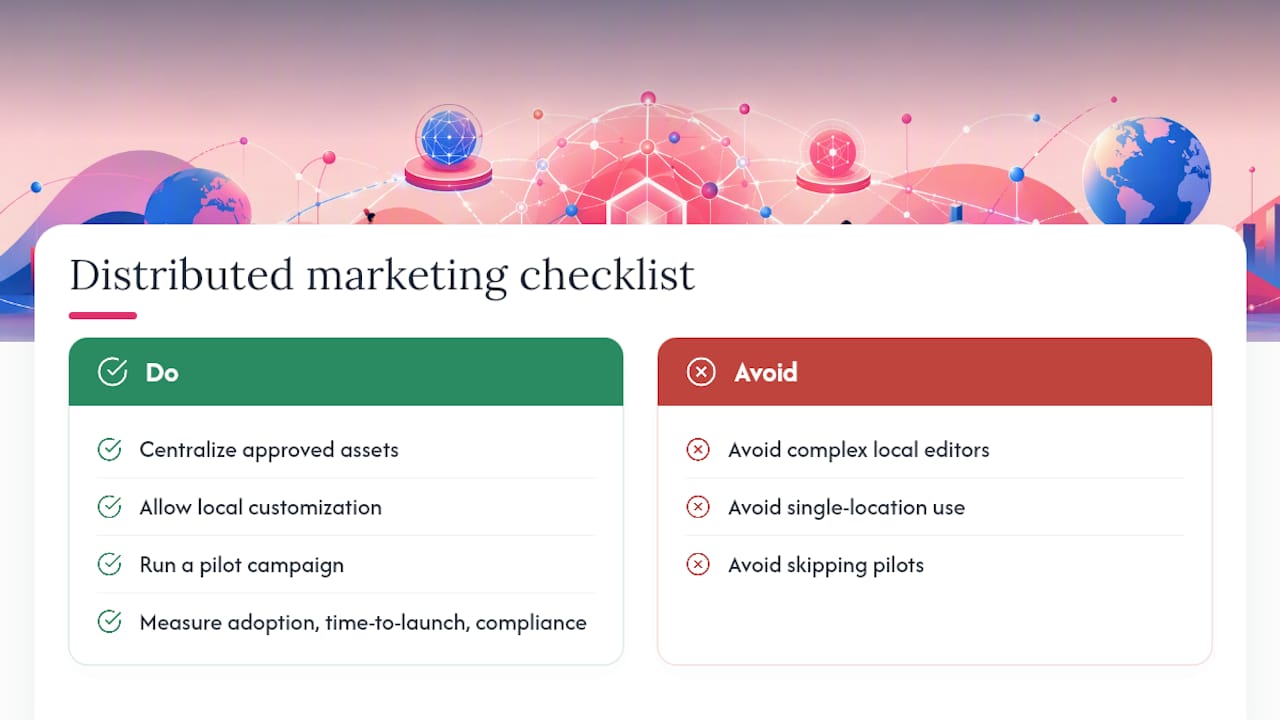
- Assess your current state. Map how local teams currently create content and where brand risk already exists. Marketing ops usually owns this.
- Select a pilot cohort. Choose one region or franchise group that’s cooperative and mid-sized, not your biggest or most difficult market. Success here should look like faster local publishing with zero compliance incidents.
- Build locked templates with editable fields. Salesforce’s own get-started guidance recommends exposing only a handful of fields, not a blank canvas, to prevent local teams from freezing up or going off-script.
- Train local users. Not a one-hour webinar. Recurring, role-specific training with real examples from their own market.
- Measure the pilot. Track adoption rate, time-to-launch, and any compliance flags before deciding what to fix.
- Scale with adjustments. Roll out cohort by cohort, refining templates based on what the pilot actually revealed.
Pro Tip: Pick a pilot group that wants to succeed, not the region with the biggest revenue. A cooperative pilot surfaces real friction points faster than a skeptical one ever will.
What KPIs Prove Distributed Marketing Is Working?
Track local conversion rate, time-to-launch per campaign, asset reuse rate, compliance incidents, and contribution to pipeline. These five numbers tell you whether the program is actually working, not just whether it’s being used.
Design your dashboards in two layers: a rolled-up view for executives showing aggregate performance, and a local view each market can see for its own results. Rolling everything into one number hides which markets need help.
- Attribution gets messy fast when dozens of local teams are running similar campaigns simultaneously.
- A practical fix is UTM discipline baked into templates so local variations still tag back to the parent campaign.
- Partner tools built for cross-channel attribution, like the tracking approaches covered in PHENYX’s guide to ad tracking, can help untangle which local touch actually drove the conversion.
What Goes Wrong With Distributed Marketing Rollouts?
The most common failure modes are low adoption, local teams bypassing controls with their own off-brand content, and measurement gaps that make ROI impossible to prove. Salesforce’s own research on distributed marketing points to technical friction among non-marketer affiliates and inconsistent compliance as the two biggest recurring problems.
Practical fixes, paired to the problem:
- Low adoption: simplify the local editor and run in-market training, not just a launch email.
- Bypassed controls: lock brand-critical fields in templates so there’s nothing to improvise around.
- Measurement gaps: standardize UTM and reporting fields inside every template before launch, not after.
Pro Tip: Treat the local editor as an enabler, not a policing tool. The moment local teams feel watched instead of supported, they’ll find a workaround, and you’ll lose visibility entirely.
How Does Photofy Support Distributed Marketing Programs?
Photofy gives central teams a way to put brand-safe templates, a shared asset library, scheduling, and analytics into the hands of local users without losing oversight. The platform’s white-labeling option lets enterprise brands keep their own look and feel across every local instance, which matters when you’re managing dozens of franchise locations or independent sales reps under one brand umbrella.
Picture a regional real estate office pulling a locked listing template from a shared library, swapping in local property details, and publishing straight to its own social accounts, all without touching the brand’s core design. Photofy’s Real Estate Marketing Solution is built around exactly that kind of localized, on-brand execution.
A hub-and-spoke setup where corporate supplies locked master templates and local teams edit only a few approved fields prevents the “blank canvas” problem entirely. Local teams don’t stall trying to build from scratch, and brand integrity holds because the risky parts of the template were never editable to begin with.
- Centralized asset library keeps every local team working from the same current materials.
- Scheduling and analytics let corporate see performance without micromanaging every post.
The rule that actually matters here
Design for guided freedom: lock the fields that carry brand or legal risk, and unlock the ones that carry local relevance. Everything else is a distraction. Get the people and process right before you touch the tech, because the best platform can’t fix a governance model nobody agreed on.

Get Local Teams Publishing On Brand, Faster
Photofy gives central marketing teams the locked templates, shared asset library, and scheduling tools this whole checklist is built around, so local teams stop waiting on design requests and start publishing approved content the same day.

Map that against the six-step rollout above: your pilot cohort gets a template library on day one, your training step has a genuinely simple editor to teach instead of a clunky one, and your measurement step gets built-in analytics instead of a spreadsheet stitched together by hand. Enterprise brands managing many locations can layer on white-labeling through Photofy’s Enterprise Solutions to keep every local instance visually consistent with the parent brand. If you manage a franchise network, direct-selling team, or multi-location business and you’re ready to see how this fits your own rollout, check Photofy’s pricing tiers and start with a plan sized to your pilot group.
Frequently Asked Questions
What is distributed marketing in simple terms?
It’s a model where a central team creates approved brand assets and local teams, franchisees, or partners customize and publish them for their own market, keeping the brand consistent while messaging stays locally relevant.
How is distributed marketing different from regular marketing automation?
Standard marketing automation usually runs one campaign to one audience from one team. Distributed marketing automation pushes brand-approved content out to many independent local teams who each execute it in their own channel and market.
Do small businesses need distributed marketing software?
Only if you manage multiple locations, franchisees, or a distributed sales network. A single-location business rarely needs the governance layer this model is built for.
What’s the biggest risk in a distributed marketing rollout?
Low adoption because the local editing tool feels complicated or restrictive. If local teams find the system harder than just doing their own thing, they’ll route around it.
How long does a typical pilot take before scaling?
Most brands run a pilot for a typical campaign cycle, long enough to measure adoption, time-to-launch, and compliance incidents before deciding what to fix ahead of a wider rollout.