

90 Day Content Governance for Marketing: Secure Brand and Trace AI
Content governance for marketing is the set of rules, roles, and review steps that guide how content gets created, approved, and published across every channel your team uses. Done well, it gives you scalable brand consistency and lower compliance risk without slowing your team down. Your first move should be simple: start an owner inventory this week, listing who creates, approves, and publishes each type of content you produce.
TL;DR:
- Clear ownership of content types and risk-based approval workflows prevent bottlenecks and ensure critical content receives proper review before publication.
- Asset management tools with tagging, version history, and access controls are essential to enforce governance rules and track AI-generated content provenance.
- Implementing a 90-day rollout, starting with content inventory and pilot testing templates, enables a manageable way to establish effective governance without long delays.
- Regular quarterly audits of approval times, content revisions, and compliance flags help maintain standards, identify bottlenecks, and adapt policies as needed.
- Governance should prioritize strict control over legal, pricing, and brand identity content, while allowing decentralized flexibility for local teams to adapt non-critical creative details.
Table of Contents
- What content governance covers and why it matters
- Core pillars of a marketing content governance framework
- Roles, responsibilities, and approval workflows that scale
- Tools, metadata, and provenance: what to require from your tech stack
- A practical implementation roadmap
- Metrics, audits, and keeping governance current
- Building a brand governance framework in 90 days: what it looks like in practice
- When to tighten governance and when to let go
- How Photofy helps teams enforce brand-consistent content governance
- Sources
- FAQ
What content governance covers and why it matters
Content governance spans the full lifecycle of your marketing content: planning, creation, review, approval, publishing, and eventual retirement or updates. It benefits everyone who touches that content, from social media coordinators to legal reviewers to franchise partners producing local posts. The core objectives are consistent: protect the brand, improve customer experience, stay compliant, and keep your team efficient as content volume grows.
Budget pressure is pushing this to the top of the priority list. Gartner’s 2025 CMO spend survey found that 59% of CMOs report insufficient budget to execute their strategy, which is why more teams are turning to AI tools to stretch existing resources further. That shift brings new governance drivers you need to plan for:
- Accessibility requirements now apply to nearly every digital asset you publish.
- AI-generated content introduces provenance and disclosure questions your policies may not yet cover.
- Distributed authors, whether regional teams or franchise partners, multiply your brand-consistency risk with every new contributor.
Core pillars of a marketing content governance framework
A workable framework rests on a handful of pillars you can document in plain language rather than a dense policy manual.
- Policies and standards: Write down your voice, tone, and visual identity rules. A one-page brand standards sheet works better than a 40-page manual nobody reads.
- Roles and ownership: Assign a named owner to each content type. A blog owner and a social owner are not interchangeable.
- Workflows and approvals: Map who reviews what, and in what order, before anything goes live.
- Taxonomy and metadata: Standardize naming conventions and tags so content is searchable and reusable across teams.
- Accessibility and legal: Build compliance checks into the workflow rather than treating them as an afterthought.
- Tooling and provenance: Choose systems that track versions, log who changed what, and flag AI-assisted content.
- Exceptions and escalation: Define how urgent or unusual content gets fast-tracked without bypassing oversight entirely.
For each pillar, create one simple artifact: a checklist, a template, or a short policy page. That’s enough to start.
Pro Tip: Document every exception you grant, even informal ones. A short log prevents your governance model from quietly eroding as more people ask for shortcuts.
Roles, responsibilities, and approval workflows that scale
Clear roles keep governance from becoming a bottleneck. Most teams need five functions, though one person can hold more than one role in a small organization.
- Content owner: Sets the strategy and standards for a content category and has final say on direction.
- Steward: Maintains templates, assets, and taxonomy day to day.
- Reviewer: Checks drafts against brand and quality standards before approval.
- Legal or compliance reviewer: Signs off only on higher-risk content, such as claims about pricing, health, or regulated products.
- Publisher: Executes the final release across channels.
Not every post needs every role in the loop. Use risk-based gating: routine social posts might only need a steward’s check, while anything touching legal claims or paid advertising routes through compliance. A simple RACI-lite chart, listing who is responsible, accountable, consulted, and informed for each content type, keeps handoffs clear and prevents work from stalling in someone’s inbox.
Tools, metadata, and provenance: what to require from your tech stack
Your tech stack should do more than store files. Look for an asset library, reusable templates, metadata tagging, version history, access controls, and built-in approval routing. Without these, governance rules exist on paper but not in practice.
- An asset library with search and tagging so teams reuse approved images and graphics instead of recreating them.
- Version history that shows who edited what and when.
- Access controls that limit who can publish versus who can only draft.
- Approval routing built into the platform, not managed through separate email chains.
Provenance matters more now that generative AI is part of many content workflows. NIST’s report on digital content transparency outlines provenance tracking and watermarking methods that help document where content originated and reduce the risk of unlabeled synthetic content circulating under your brand.
AI systems used in your content workflow should be inventoried, not assumed. The NIST AI Risk Management Framework’s Generative AI Profile recommends documenting data provenance, defining clear roles, and scheduling periodic reviews of any AI system in production. For marketing teams, that means knowing which tools generate copy or images, labeling that content internally, and revisiting those tools’ outputs on a set schedule rather than leaving them unchecked.
A practical implementation roadmap
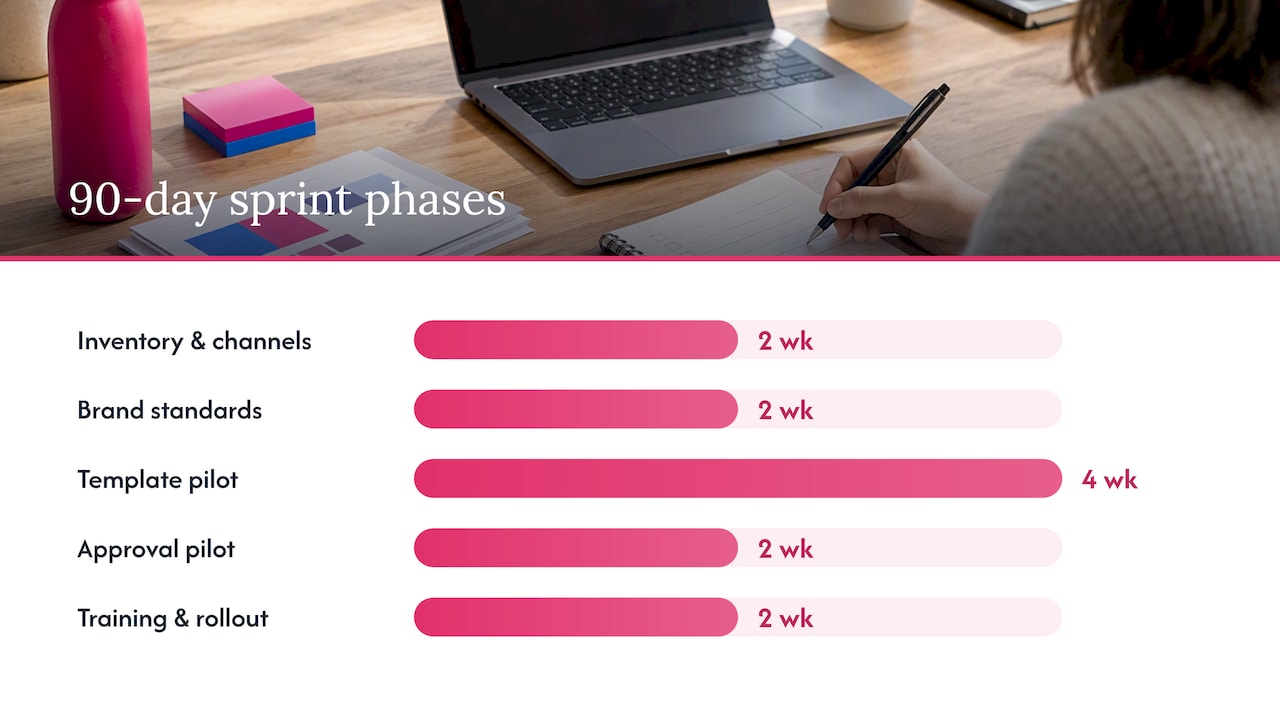
You don’t need a year-long project to get governance working. A 90-day sprint gets the essentials in place.
- Weeks 1 to 2: Inventory content owners and current publishing channels.
- Weeks 3 to 4: Set baseline brand standards and document them in one accessible location.
- Weeks 5 to 8: Pilot two or three approved templates with one team before rolling out further.
- Weeks 9 to 10: Run an approval workflow pilot, tracking where bottlenecks appear.
- Weeks 11 to 12: Train the wider team and gather feedback before full rollout.
Over the following 6 to 12 months, add automation, integrate governance checks into your CMS or scheduling tools, review policies quarterly, and vet any new vendor for how it handles provenance and access control. When resources are tight, prioritize by risk and impact: fix the workflow gaps most likely to cause a brand or compliance problem first, and leave lower-stakes polish for later.
Pro Tip: Pilot with one enthusiastic team rather than mandating change across the whole organization at once. Early wins build the case for broader adoption.
Metrics, audits, and keeping governance current
Governance needs upkeep, or it quietly decays. A small, defensible set of metrics keeps you honest about whether it’s working.
- Track approval turnaround time to catch workflow bottlenecks early.
- Monitor the rate of content revisions requested after publication, a signal of standards gaps.
- Log accessibility and compliance flags caught before versus after publishing.
- Review brand consistency scores across channels on a quarterly basis.
Run a lightweight audit every quarter: sample recent content against your standards checklist, confirm role assignments are still accurate, and check that AI-assisted content is properly labeled. When something does go wrong, whether a compliance flag or a brand misstep, treat the review as a chance to update your governance artifacts rather than just fixing the single incident.
Building a brand governance framework in 90 days: what it looks like in practice
A small team of three to five people, spanning content, design, and compliance, can run this playbook without dedicated headcount. The 90-day brand governance framework mirrors the roadmap above: inventory, baseline, pilot, train. Distributed teams and franchise networks tend to see the fastest wins when templates and approval steps are standardized early.

When to tighten governance and when to let go
Governance should scale with risk, not with fear. Centralize control over anything touching legal claims, pricing, or your core visual identity. Decentralize the rest: let regional or local teams adapt captions, timing, and small creative choices to their audience. Bring skeptical stakeholders in early by showing them a working pilot, not just a policy document. People buy into rules they helped shape.
— Jon
How Photofy helps teams enforce brand-consistent content governance
A social marketing platform maps directly onto the pillars you just read about. Pre-designed templates and an asset library provide standards without slowing the people creating content. Built-in approval workflows handle the reviewer and publisher roles, and white-labeling lets enterprises and franchise organizations maintain brand integrity while local reps still create timely, compliant content.

Before you run a pilot, define your scope: pick one team, set two or three success metrics like approval turnaround or template adoption, and confirm sign-off from your brand and compliance leads. From there, review Photofy’s enterprise options or check current pricing to see which plan fits your team’s size and governance needs.
Sources
- Artificial Intelligence Risk Management Framework: Generative Artificial Intelligence Profile
- Gartner 2025 CMO spend survey reveals marketing budgets have flatlined
FAQ
What is content governance in marketing?
Content governance in marketing is the framework of policies, roles, and approval workflows that guide how content is created, reviewed, and published. It exists to keep messaging consistent, reduce compliance risk, and help teams move faster with clear standards rather than case-by-case decisions.
What are the core pillars of governance?
Common pillars include policies and standards, roles and ownership, workflows and approvals, taxonomy and metadata, accessibility and legal compliance, tooling and provenance, and a clear exceptions process. Definitions vary slightly by organization, but most workable frameworks cover these same areas.
What tools support content governance and data oversight?
Effective governance tools typically include an asset library, template management, version history, access controls, and approval routing built into your content platform. Categories of AI content tools also matter here, since provenance and metadata features vary widely between vendors.
What are the four P’s of governance?
Definitions of the four P’s vary across industries, and no single version applies specifically to marketing content governance. Focus instead on the core elements that do apply directly: policies, ownership roles, workflows, and provenance tracking.
How often should a governance framework be reviewed?
A quarterly audit cycle works well for most marketing teams, checking role assignments, content samples, and AI labeling practices against your documented standards. Treat any compliance incident as an additional trigger to update your governance artifacts immediately rather than waiting for the next scheduled review.