

Co-Op Marketing Compliance: A Practical Guide for Brands
Co-op marketing compliance means meeting two sets of rules at once: the law that applies to any advertising, and the program rules your manufacturer, franchisor or brand partner sets for shared content and reimbursement. Get both right and your ads run with confidence and your claims get paid. Miss either one and you risk a denied claim, a contract dispute or, for the sponsor, legal exposure. This guide shows you what each side requires and how to build a simple process around it.
TL;DR
- Co-op advertising is covered by federal rules on fair treatment of competing customers, truthful advertising, endorsement disclosures, email and privacy, plus the sponsor’s own program terms.
- The most common reason claims are denied is running an ad without the required pre-approval.
- Keep proof of performance for every placement: the ad itself, the date, the outlet, the cost and the invoice.
- Locked templates and a clear review step let local partners publish quickly without altering logos, disclaimers or legal language.
- Build the workflow once, then reuse it for every campaign and every partner.
Table of Contents
- What co-op marketing compliance actually covers
- The U.S. rules that can apply
- What sponsors typically require
- Build an approval workflow that does not slow people down
- The records you need for a clean claim
- Mistakes that cost you the claim
- Our perspective on co-op compliance
- Put compliant content in your partners’ hands
- Frequently asked questions
- Sources
What co-op marketing compliance actually covers
Co-op advertising is cost sharing. A manufacturer or brand contributes to the advertising its dealers, retailers or franchisees run locally, usually on specific, pre-approved placements. A general advertising allowance can be a flat payment for loosely defined promotion, but a co-op allowance is tied to defined placements and proof that they ran. That tie is what makes compliance central: the money follows the rules.
Ordinary advertising compliance asks whether an ad is truthful and properly disclosed. Co-op compliance asks that, and then three more questions:
- Did the ad follow the sponsor’s brand standards and use approved materials?
- Did the placement fall within the media types the program covers?
- Can you prove it ran, when it ran and what it cost?
The sponsor has its own question as well: are we offering the same support to every competing partner on fair terms? That is where federal antitrust rules come in.
The U.S. rules that can apply
No single law is called “co-op marketing law.” Several apply depending on what you publish and who you send it to.
Equal treatment of competing customers
For manufacturers and other sponsors, the key rules are sections 2(d) and 2(e) of the Robinson-Patman Act. The FTC’s guides in 16 CFR Part 240 help businesses comply with them. They apply in certain circumstances to promotional services and facilities, including cooperative advertising and displays used mainly to promote resale. The core idea is proportionally equal terms: allowances or services should be available to competing customers on terms that are proportional to their purchases. If you are a sponsor, document how your allowance formula works and apply it consistently. If you are a dealer or franchisee, you will rarely be the one liable, but knowing the principle explains why programs are strict about eligibility and formulas.
Truthful, substantiated advertising
Under FTC standards, advertising must be truthful and not misleading, and advertisers must substantiate their claims, as the FTC explains in its .com Disclosures guidance. In co-op work this matters because a claim in a shared template travels to hundreds of local pages. If the national claim is not substantiated, every partner who posts it inherits the problem. Review claims, prices, “best” statements and before-and-after language once at the template level, not post by post.
Endorsements, testimonials and material connections
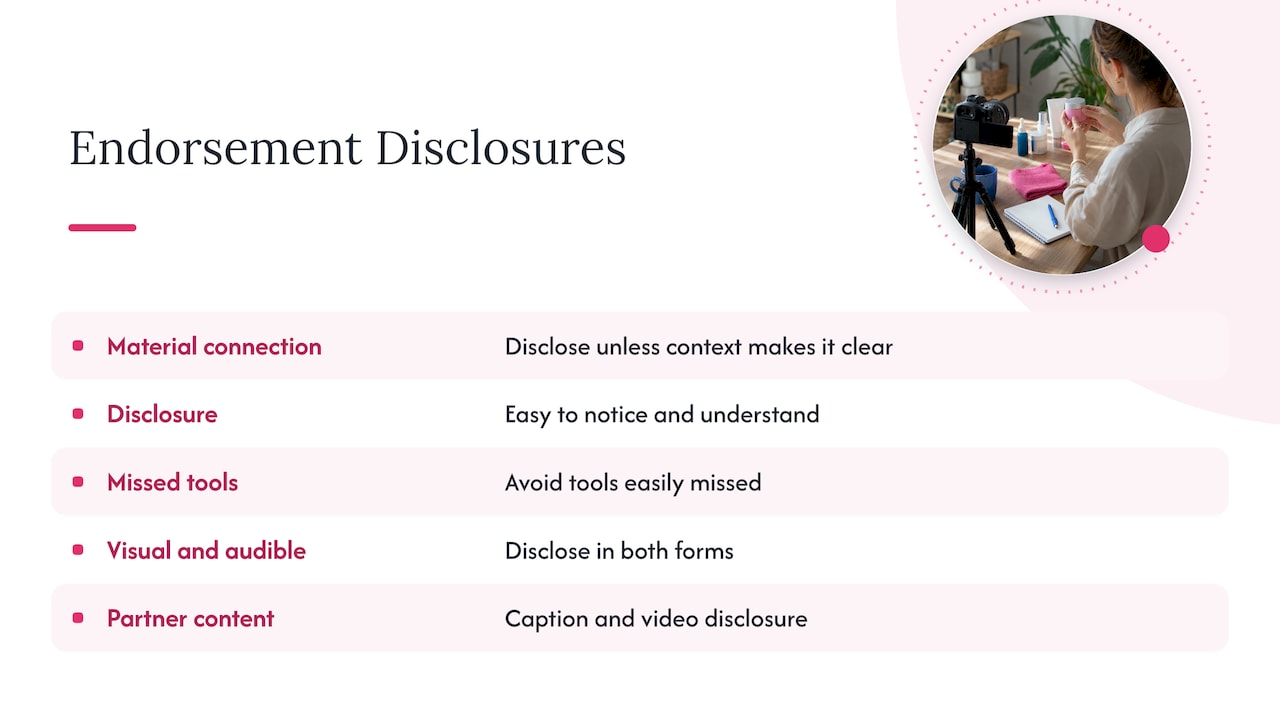
Co-marketing that involves testimonials, reviews or endorsements must follow the FTC Endorsement Guides, and material connections must be clearly disclosed. The FTC’s position is that a material connection between an endorser and a marketer should be clearly and conspicuously disclosed unless the context already makes it clear. Its warning letter guidance adds that disclosures must be easy to notice and understand, should avoid tools that are easily missed, and, when an endorsement is made in both visual and audible form, should appear in both.
In practice, that means a partner who posts a customer story or a creator collaboration should add the disclosure in the caption and on the video itself where it applies. If your program leans on referrals or creators, these word of mouth strategies show how recommendation-driven marketing works, and the same disclosure habits apply to every one of them. For paid creator partnerships specifically, this look at influencer marketing and brand visibility is a good companion for planning what to ask of creators.
Email and shared customer data
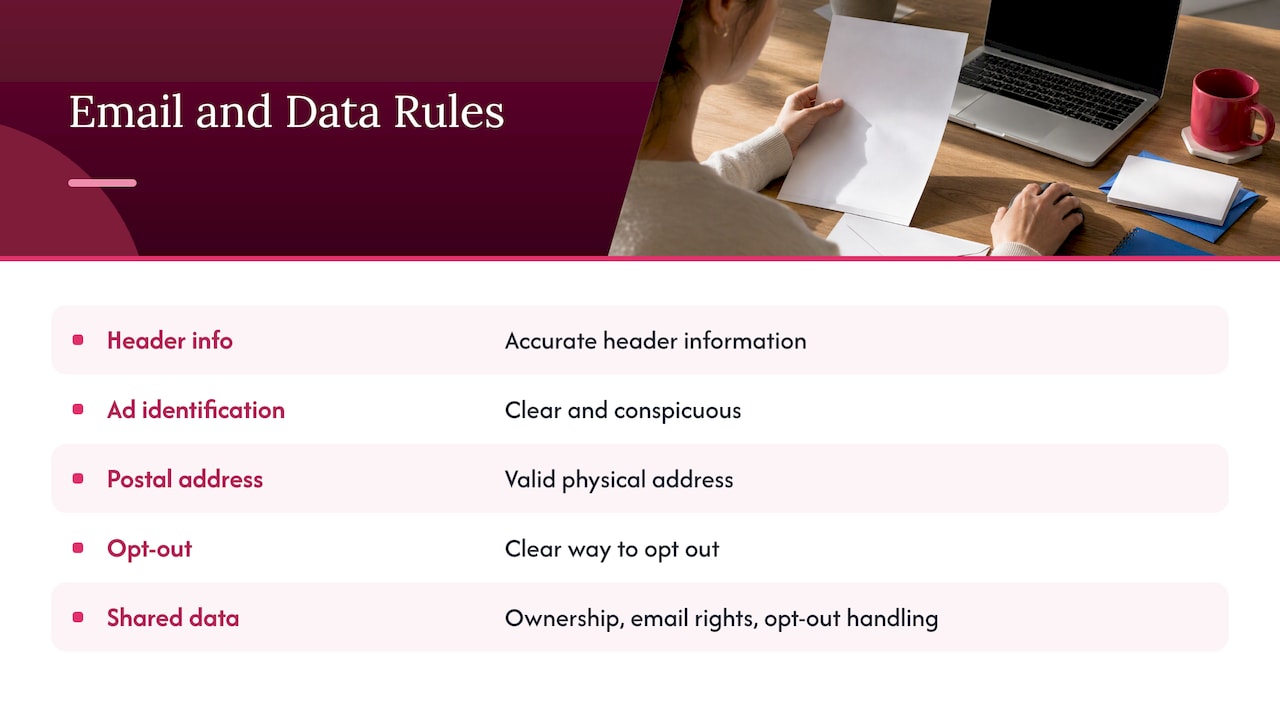
When a campaign includes joint commercial email, CAN-SPAM applies. The FTC’s compliance guide says messages need accurate header information, clear and conspicuous identification as an ad, a valid physical postal address and a clear way to opt out. If partners exchange customer lists or lead data, privacy laws such as the CCPA and other state laws can apply as well. Decide in writing who owns the data, who may email it and how opt-outs are honored across both brands. If your tracking and consent setup also needs attention, this walkthrough of server-side tracking and consent wiring explains how consent choices connect to analytics.
For a deeper checklist on the rules that apply to direct sales social posts, see our FTC-ready cadence and templates for direct sales sellers.
What sponsors typically require
The legal layer is the same for everyone. The program layer differs by brand, so read your own guidelines first. Published examples show the usual pattern.
- Pre-approval. One HVAC manufacturer’s co-op guidelines require dealers seeking co-op funds to get authorization before running locally produced ads, while current ad-kit materials need no prior approval.
- Brand standards. The same program requires co-op ads to follow its brand guidelines, and ads or displays showing competitive items are non-qualified.
- Eligible media. Programs list which channels count. Digital, print, radio and television are often treated differently.
- Claim windows. Deadlines are strict. One consumer products manufacturer, for example, requires claims within 60 days of campaign completion.
If you run a dealer, franchise or distributor network, the safest approach is to supply approved content instead of policing what people create from scratch. Content in the ad kit passes without a separate review, so partners have a reason to use it. Our guide to same-day publishing of dealer social media templates covers that approach for automotive networks, and the franchisee onboarding marketing plan shows how to introduce it in the first 90 days.
Build an approval workflow that does not slow people down
Co-marketing materials are typically reviewed and authorized before they go live, with brand and legal reviews and partner revisions as needed. The challenge is doing this without making local partners wait days. A workable process looks like this.
- Write the rules down. Put logo use, required disclaimers, prohibited claims, eligible media and deadlines on one page that partners can find quickly.
- Lock what must not change. Master templates with locked layers for logos, disclaimers and legal language help protect brand integrity while letting partners edit headlines, photos and local details.
- Separate pre-approved from custom. Approved templates publish directly. Anything built from scratch goes to review before it runs, which is exactly what most programs require for claim eligibility.
- Set a review turnaround. Tell partners how long brand and legal review takes, and keep to it.
- Record the decision. Save who approved what, and when, next to the final asset.
- Update in one place. When a claim, price or disclosure changes, change the template, so no partner keeps posting an old version.
The same logic sits behind a 90 day brand compliance checklist for marketing teams and a 90 day content governance plan. Both are useful if you want to formalize ownership of these steps.
For sponsors that fund local marketing through market development funds, the through-channel marketing guide explains how to connect approvals, funds and CRM data so claims can be reconciled more easily.
The records you need for a clean claim
Reimbursement generally requires proof that the ad ran, met brand standards and fell within eligible media. The documentation varies by media type. Typical examples include:
| Media | Common proof of performance |
|---|---|
| Full page showing the publication name and date (a tear sheet), plus the invoice | |
| Digital and social | Screenshots showing the ad and date, engagement metrics, platform invoice |
| Radio and TV | Broadcast affidavit, schedule and invoice |
Claim forms usually ask for the ad date, the media outlet, the total cost and the media type. Many manufacturers accept claims through digital portals for invoices, proof-of-performance files and claim forms, and keeping your submission records and portal confirmation receipts helps resolve disputes during audits. Reimbursement itself may arrive as a check, a credit memo or an account credit, so confirm which your program uses before you budget around it.
A few habits make this easy:
- Take a screenshot of every social ad or post the day it goes live, with the date visible.
- Save the approved version of the creative alongside the final published one.
- Store invoices in a shared folder named by campaign and month.
- Note the program year and the deadline when you start the campaign, not when you finish it.
A tidy social media asset library with metadata makes it much easier to match each published asset to its approval and its claim.
Mistakes that cost you the claim
The most common cause of claim denial is skipping required pre-approval, according to one co-op allowance reference. Creative that does not follow the guidelines can also be rejected, and unequal allowances create antitrust risk for the sponsor. Here is how to avoid the usual problems.
- Running first, asking later. Get the approval or use pre-approved materials. Retroactive approval is rarely offered.
- Altering locked elements. Moving a logo, trimming a disclaimer or adding a competitor’s product can make an ad non-qualified.
- Missing the window. Most programs allow one resubmission for a correctable issue, but the original claim deadline still applies. Submit early so you have room to fix errors.
- Thin proof. A screenshot without a date, or an invoice without the ad, is the easiest claim to reject.
- Missing disclosures. A testimonial or creator post with no clear connection disclosure creates a legal issue separate from the claim.
- Treating partners differently by habit. If you are a sponsor, apply the same formula to all competing partners and write it down.
If your case involves a specific contract dispute or a possible antitrust question, talk to an attorney who handles advertising or distribution agreements. A good program counsel can review your allowance formula and your partner agreement once, and you can reuse that work for years.
Our perspective on co-op compliance
Most compliance problems we see are not caused by bad intent. They happen because local partners are busy, the rules live in a PDF nobody opens, and the fastest way to post is to build something from scratch.
We believe the answer is to make the compliant path the easy path. When a dealer, franchisee or rep can open a branded template, change the photo and the local details, and publish in minutes, they have little reason to go off-brand. Locked logos, locked disclaimers and approved layouts do the policing for you, and the brand team keeps visibility without becoming a bottleneck.
That is why we built Photofy around branded content creation, team approvals, asset management and publishing in one place. Our white-label option lets enterprise organizations present the platform under their own brand, and industry-specific template libraries leave room for local customization. Your partners get speed, and you get consistency you can point to when a claim or an audit comes up.
Start with the rules, turn them into templates, and let your partners publish with confidence.
Jon
Put compliant content in your partners’ hands
If you manage content for a team, franchise or dealer network, Photofy gives you branded templates, an asset library, scheduling and analytics on iOS, Android and desktop. Small Business plans are listed at $10.99 per month or $99 per year on our Small Business page, and individual plans start at $11.95 per month on the Individual Plans page. Team plans are listed at $13.00 per month per user for Pro Teams and $9.00 per month per user for Enterprise Teams. Franchise and enterprise needs are handled by inquiry, so see the pricing page for your options.

You can also explore the full platform on the Photofy home page and see how it supports consistent branding across your whole network.
Frequently asked questions
Is co-op marketing regulated by federal law?
Yes, in several ways. Sponsors should follow the FTC’s guides on promotional allowances and services under the Robinson-Patman Act, found in 16 CFR Part 240. Every participant must also follow FTC truth-in-advertising and endorsement rules, and CAN-SPAM when sending commercial email. Your program agreement adds its own contractual requirements on top.
What is the most common reason a co-op claim is denied?
Running an ad without the required pre-approval is the most common cause. Non-compliant creative, ineligible media and late submissions follow. Check your sponsor’s guidelines before you buy any placement, and use approved templates whenever you can.
What proof do I need to submit a co-op claim?
You generally need proof the ad ran plus an invoice. That can be a print tear sheet, a dated digital screenshot with engagement metrics, or a broadcast affidavit and schedule. Claim forms usually ask for the ad date, outlet, total cost and media type, so collect these when the ad goes live.
Do I need to disclose partnerships in co-op social posts?
Yes, when a material connection exists between an endorser and the marketer and the context does not already make it clear. Place the disclosure where viewers will notice it, and on both the visual and audio parts of a video if the endorsement uses both. Build the wording into your templates so partners do not have to remember it.
How can I make approvals faster for local partners?
Give them pre-approved templates with locked logos and legal text, and reserve manual review for custom creative. Publish a clear turnaround time for reviews and keep a record of every approval. This keeps partners moving while protecting your brand and their reimbursement.
Sources
- eCFR: 16 CFR Part 240, Guides for Advertising Allowances and Other Merchandising Payments and Services
- FTC: .com Disclosures
- FTC: Warning Letter on endorsement disclosures
- FTC: CAN-SPAM Act Compliance Guide for Business
- Sprintlaw: Co-Marketing Agreement, FTC, State Law and Contract Issues
- Vistaar: Co-Op Advertising Allowance
- Bryant: Co-op Guidelines
- Dalen Products: Co-Op Advertising Guidelines
- Legal Clarity: Cooperative Advertising, How It Works, Rules and Compliance
- Moxo: Partner marketing approval
- Pedowitz Group: How to co-brand marketing assets with partners
- Siift: Word of mouth marketing strategies
- Baby Love Growth: Influencer marketing and brand visibility