

Pick Content Pillars for Small Business in 30 Minutes
Content pillars are the three to five core themes that organize everything you post, so every piece of content ties back to a business goal instead of existing as a random idea. For most small businesses, three pillars is the right starting point: Authority (what you know), Proof (results you’ve delivered), and Offer (what you sell). Once you name your three pillars, the rest of this guide walks you through choosing, scheduling, and measuring them.
TL;DR:
- Most small businesses should focus on a three-pillar system: Authority, Proof, and Offer, to maintain consistency and drive leads effectively.
- Each pillar should directly support a stage in the customer journey: awareness, consideration, or decision, ensuring content is purposeful and results-oriented.
- Creating a schedule with predictable rotation and batch production can improve content consistency without overloading the team.
- Tracking three to four key metrics monthly, such as engagement, clicks, and conversions, helps measure each pillar’s impact on business goals.
- Avoid overcomplicating the system by adding more pillars than the team can reliably produce, as fewer consistent themes outperform sporadic, broader content.
Table of Contents
- What Are Content Pillars for Small Business, and Why Do They Matter?
- Content Pillar Examples You Can Copy Today
- How to Choose Your Pillars in Under 30 Minutes
- Turning Pillars Into a Content Calendar
- How to Measure Whether Your Pillars Are Actually Working
- Common Pillar Mistakes and a Weekly Checklist
- Ready-to-Use Templates and 30 Starter Ideas
- Speeding Up Pillar Execution With a Visual Content Platform
- Why a Simple Pillar System Beats a Complicated One
- Try Photofy to Put Your Pillars Into Action
- Sources
- FAQ
What Are Content Pillars for Small Business, and Why Do They Matter?
Content pillars are recurring themes, usually three to five, that give structure to what you post so nothing gets published without a purpose. Think of them as the categories your content lives inside. Instead of asking “what should I post today?” you ask “what’s my next Authority post?” and the decision gets faster and more consistent.
This is different from a single post idea or a content series. A post idea is one piece of content. A series (like “Client Wins Wednesday”) is a recurring format. A pillar is bigger than both. It’s the theme that a dozen different post ideas and several formats can live under. Your “Authority” pillar might include how-to videos, quick tips, myth-busting carousels, and FAQ answers, all different formats, all serving the same purpose: proving you know your field.
Small businesses that skip this step tend to post reactively. They see a trend, jump on it, then go quiet for two weeks because nothing else feels worth posting. Pillars fix that by giving you a standing menu of content types to pull from. According to The Owner’s Playbook, each pillar should be able to hold dozens of post ideas and map to a stage of your lead funnel, which means you never run dry, and you never post something disconnected from a business outcome.
That funnel connection is the part most guides skip past too quickly. Every pillar should correspond to a stage in how a stranger becomes a customer. Content Pillars: A Simple Marketing Strategy for Small Businesses frames it as a progression: awareness content educates people who don’t know you yet, consideration content builds authority and shows proof once they’re paying attention, and decision content makes the offer once they’re ready to buy. A pillar with no clear funnel stage is usually a pillar that sounds nice but doesn’t sell.

Here’s the practical payoff. Consistency compounds. A local bakery posting “behind the scenes” content every Monday, “customer favorites” every Wednesday, and a “weekly special” every Friday isn’t more talented than a competitor posting whenever inspiration strikes. It just has a system. Followers learn the rhythm, algorithms reward the consistency, and the bakery’s team stops staring at a blank content calendar every Sunday night wondering what to make.
Pillars also make delegation possible. If you ever hand off content creation to an employee, a freelancer, or a marketing platform, a defined pillar system means they know the boundaries. Without it, every piece of content requires your personal sign-off because there’s no framework to follow.
Content Pillar Examples You Can Copy Today
You don’t need to invent your pillars from scratch. Most small businesses succeed with one of two models: a lean three-pillar system or a slightly broader five-pillar version for businesses with more product lines or audience segments.
The three-pillar model (Authority, Proof, Offer) is widely recommended as the fastest way for service businesses to sustain consistency and drive leads, because it maps directly onto how people decide to hire someone: they want to know you’re credible, they want to see it’s worked for others, and eventually they need to know what to buy and how.
Here’s what five post ideas look like under each pillar for a hypothetical bookkeeping firm:
Authority (you know your stuff)
- A 60-second video explaining one tax deduction most owners miss
- A carousel post: “3 signs your books need a cleanup”
- A myth-busting post: “No, you don’t need to keep every paper receipt”
- A quick answer to a common client question, reused as an Instagram caption
- A blog post on a seasonal filing deadline, teased on social
Proof (it’s worked for others)
- A before/after snapshot of a client’s messy spreadsheet versus a clean dashboard
- A short client testimonial clip (with permission)
- A case study post: “How we saved a retail client $4,200 in missed deductions”
- A screenshot of a five-star review with a one-line reaction
- A “day in the life” post showing your process on a real client file
Offer (what you sell and how to start)
- A direct post about your onboarding package with pricing tiers
- A limited-time offer for new clients signing before tax season
- A simple explainer: “Here’s what working with us actually looks like”
- A comparison post: DIY bookkeeping versus hiring it out
- A clear call-to-action post: “Book a free 15-minute consult this week”
If your business has multiple services, locations, or audience segments, a five-pillar model gives you more room without losing focus. A common expansion adds Community (behind-the-scenes, team, local involvement) and Education (deeper how-to content, not just quick tips) alongside Authority, Proof, and Offer. Use five pillars only if you can realistically produce content across all of them. A five-pillar system that only gets fed from two pillars isn’t a five-pillar system, it’s a three-pillar system with two dead branches.
Format matters as much as theme; understanding how pillar pages and cluster content boost SEO can help you structure your content effectively using a content cluster strategy. On Instagram and TikTok, Authority content usually performs best as short video or carousel. On email, Proof content works well as a monthly case study or a client spotlight. On a blog, Offer content becomes comparison pages or FAQ posts that double as SEO assets, an approach that also strengthens topical authority when pillar pages link out to supporting posts.
How to Choose Your Pillars in Under 30 Minutes
You don’t need a marketing degree or a strategy session with an agency to pick your pillars. You need about half an hour, a notepad, and honest answers to four questions.
-
Name your top business goal and your audience. Are you trying to book more consultations, sell more product, or build an email list? Write down your single biggest goal for the next 90 days, along with a one-sentence description of who you’re trying to reach. Every pillar you choose next has to serve that goal and that person, not a vague idea of “engagement.”
-
Audit your existing content and customer questions. Pull up your last 20 to 30 posts, or your email inbox, or your FAQ page, and look for repeated themes. What do customers ask you before they buy? What questions come up in every sales call? Content audits and simple customer-question inventories are one of the fastest ways to confirm a pillar idea actually has demand behind it, instead of just sounding good on paper.
-
Run a capacity check. For each candidate pillar, try to list ten post ideas in five minutes. If you’re stuck at three or four, that pillar is probably too narrow or too far from your actual expertise. Cut it. A pillar you can’t feed consistently will quietly disappear from your calendar within a month anyway, so it’s better to know now.
-
Finalize your pillars and write a one-sentence purpose for each. Once you’ve landed on three (or five, if capacity supports it), write a single sentence for each: “This pillar exists to [do what] for [which audience].” If you can’t finish that sentence cleanly, the pillar isn’t ready yet.
Starting small and doing it well beats spreading yourself across too many neglected pillars. A bakery with three pillars posted consistently will outperform a competitor with six pillars posted sporadically, every time. Fewer, sustained themes build more recognition than a long list nobody has time to maintain.
Turning Pillars Into a Content Calendar
Pillars only earn their keep once they’re scheduled. Here are two starter schedules that work for a small team posting three times a week, the volume most small businesses can sustain without burning out.
Schedule A: Straight rotation. Monday is Authority, Wednesday is Proof, Friday is Offer. Simple, predictable, and easy for anyone on your team to follow without a meeting.
Schedule B: Rotation with repurposing. Post new content twice a week (say, Authority on Monday and Proof on Thursday), then use the third slot to repurpose one of those two pieces into a different format, an Instagram carousel becomes a Facebook text post, or a video gets cut into three short clips for Offer-adjacent retargeting. Batching production and repurposing long-form assets into shorter formats is one of the biggest time savers available to a small team, because you’re creating once and publishing multiple times.
Platform choice should follow format strength, not habit. A few pairings that consistently work:
- Instagram and TikTok favor short video and carousels for Authority and Proof content.
- Facebook and LinkedIn reward slightly longer captions and community-style posts, good for Proof and Community pillars.
- Email is the strongest home for a monthly case study or a client spotlight (Proof), since it doesn’t compete with an algorithm.
- A blog is where Offer content becomes a comparison page or FAQ post that keeps working for you in search long after the social post has scrolled away.
For downloadable calendar templates that already have the pillar rotation built in, a ready-made structure saves the setup time most small teams underestimate.
On content mix, two ratios come up constantly, and they solve different problems. The 80/20 rule keeps roughly 15 to 20 percent of your content promotional (Offer) and the rest focused on value or proof, which keeps your feed from feeling like a constant sales pitch. The 70/20/10 rule splits further: 70 percent proven content types you know perform, 20 percent adaptations of what’s worked elsewhere, and 10 percent experimental formats or ideas you haven’t tried. Small teams with limited testing bandwidth should lean on 80/20 for simplicity. Teams with a bit more room to experiment can layer in 70/20/10 to keep finding new formats without abandoning what already works.
How to Measure Whether Your Pillars Are Actually Working
You don’t need enterprise analytics software to know if your pillars are paying off. You need three or four numbers, tracked monthly, tied directly to what each pillar is supposed to accomplish.
Match your KPIs to pillar function instead of tracking everything equally. Awareness-stage pillars like Authority should be judged on engagement and reach, how many people saw it and interacted with it. Consideration-stage pillars like Proof should be judged on clicks and lead-form starts, since that’s the behavior that shows genuine interest. Decision-stage pillars like Offer should be judged on leads generated and actual conversions, the metric that ties directly to revenue. Salesforce’s small business marketing guidance makes this same point: measure what maps to the goal, not vanity numbers that look good but don’t move the business forward.
A monthly reporting cadence is enough for most small teams. Weekly tracking creates noise, since social performance fluctuates too much day to day to draw conclusions, and quarterly tracking is too slow to catch a pillar that’s quietly failing. Once a month, pull three numbers per pillar (engagement rate, click count, and leads or sales attributed) into a single page and compare them against the previous month. You’re not looking for perfection, you’re looking for direction: up, flat, or down.
Set your first-month benchmarks based on your own baseline, not an industry average pulled from a blog post. Your “good” engagement rate depends on your following size, your niche, and your platform, comparing your Instagram numbers to a stranger’s LinkedIn numbers tells you nothing useful.
Drop any metric you’re not going to act on. If you’re never going to change your posting behavior based on impressions, stop tracking impressions. Keep the report to a handful of numbers you’ll actually look at, not a dashboard you build once and never open again. A social media reporting template built around pillar goals rather than platform defaults makes this monthly check faster.
Pro Tip: Don’t expect one post to get full credit for a sale. Most customers see several pieces of pillar content, an Authority video, a Proof testimonial, then an Offer post, before they convert. Track the pillar mix that shows up in the weeks before a sale, not just the last post someone clicked.
Common Pillar Mistakes and a Weekly Checklist
The most common failure isn’t picking bad pillars, it’s picking good ones and then abandoning the system within six weeks. A few patterns show up again and again in small business accounts.
Mistake: choosing pillars that sound impressive but have no funnel purpose. A pillar like “Inspiration” or “Fun Facts” might generate likes, but if it doesn’t move someone toward awareness, consideration, or decision, it’s just noise. Fix it by asking which funnel stage the pillar serves, if you can’t answer, cut it or reshape it.
Mistake: letting one pillar dominate because it’s easiest to create. Offer content is often the fastest to produce, so it’s tempting to lean on it. But an account that’s mostly promotional loses trust fast. Rebalance toward the 80/20 mix if your feed starts feeling like an ad wall.
Mistake: never revisiting the pillars after the initial setup. Pillars aren’t permanent. A pillar that made sense when you launched a product line six months ago might be irrelevant now. Review pillar performance quarterly, not just monthly metrics, but whether the theme still matches your current goals and audience.
Mistake: too many pillars for your actual production capacity. Five pillars sound thorough until you realize you can only reliably create content for two of them. Trim back to what you can sustain, three consistent pillars beat five neglected ones.
A short weekly checklist keeps the system honest:
- Did each pillar get at least one piece of content this week?
- Does the upcoming week’s schedule roughly follow your 80/20 or 70/20/10 mix?
- Is any pillar’s content starting to repeat itself word-for-word from last month?
- Are this month’s KPI numbers trending up, flat, or down per pillar?
- Has anything changed in the business (new product, new goal, new audience) that a pillar should reflect?
Know when to retire a pillar. If a pillar has produced flat or declining engagement for two straight months despite genuine effort, and it doesn’t connect to a current business goal, it’s time to replace it rather than keep forcing content into it.
Ready-to-Use Templates and 30 Starter Ideas
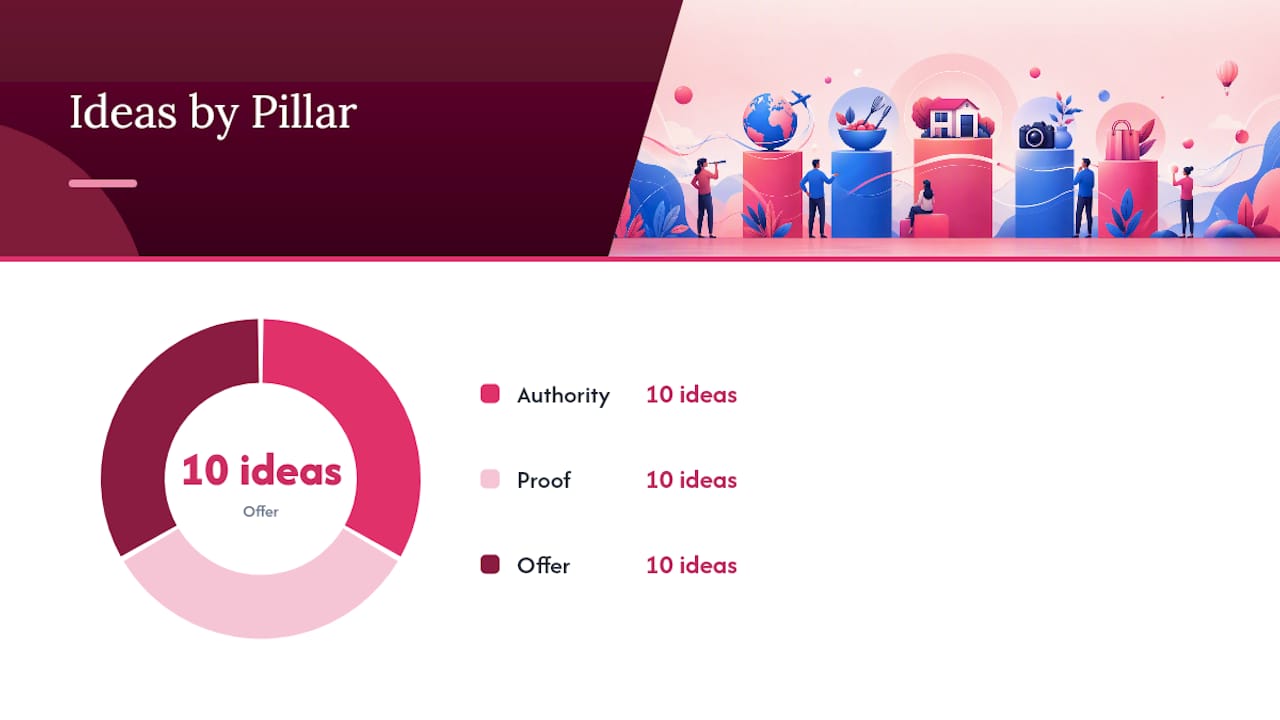
Here are thirty ideas split evenly across the three-pillar model (Authority, Proof, Offer), ten per pillar, written generically enough to adapt to almost any small business.
Authority (educate and build credibility)
- Answer your most-asked customer question in under 60 seconds
- Bust a common myth in your industry
- Share a quick tip that took you years to learn
- Explain one term your customers often misunderstand
- Break down your process in three simple steps
- React to an industry trend or news item
- Compare two approaches and explain which you recommend
- Share a mistake you see customers make often
- Post a checklist related to your service
- Answer a question pulled directly from a past client email
Proof (build trust through results)
- Share a client testimonial with a specific result
- Post a before-and-after visual
- Highlight a review with a short personal reaction
- Walk through a real case study, numbers included
- Show a behind-the-scenes clip of you delivering the work
- Share a milestone (years in business, clients served, units sold)
- Repost a client’s tag or mention with thanks
- Share a “day in the life” showing your actual process
- Post a comparison of results before and after working with you
- Share an unexpected win a client didn’t expect
Offer (make it easy to buy)
- Explain exactly what’s included in your main package
- Announce a limited-time promotion or seasonal deal
- Post a simple pricing breakdown
- Share a direct call-to-action to book or buy
- Explain your onboarding process step by step
- Compare DIY versus hiring you out
- Highlight a bundle or add-on customers often miss
- Answer “how do I get started” in one post
- Share urgency around a deadline (enrollment closing, stock limited)
- Post a plain-language FAQ about buying from you
For planning, a simple spreadsheet with these columns covers everything a small team needs: Pillar, Topic, Format, Hook, Visual Asset, CTA, Publish Date, and Repurpose Path. That last column matters most, it’s where you note how today’s video becomes tomorrow’s carousel and next week’s email spotlight.
Batch your creation instead of making content daily. Block two hours once a week, pick five to seven ideas from your pillar lists, and shoot or write them in one sitting. You’ll notice the second and third pieces come faster once you’re already in the mindset for that pillar. Ready-made calendar examples can shortcut the spreadsheet-building step if you’d rather start batching today than build a template from scratch.
Speeding Up Pillar Execution With a Visual Content Platform
Once your pillars and calendar exist on paper, the bottleneck becomes production, actually designing and publishing the content on schedule. This is where a platform built for social content creation earns its place in the workflow.
Some social content platforms support the tasks that eat up small-team hours: pre-designed templates adapted per pillar, stock asset libraries to avoid searching for images late at night, and scheduling tools to queue a week of pillar-rotated posts in one sitting. Platforms designed for teams managing content across multiple locations or members may include governance features to help keep posts on-brand without requiring personal approval of each one.
A basic mini workflow looks like this: pick the pillar for the day, choose a template that matches the format (carousel for Authority, testimonial layout for Proof, promo template for Offer), apply your brand colors and logo, then schedule it alongside the rest of the week’s rotation. What used to take an hour per post shrinks to minutes once the templates and asset library are already set up around your specific pillars.
Why a Simple Pillar System Beats a Complicated One
Most small businesses fail at content not because they lack ideas, but because they build a system too complicated to maintain past the first busy month. A three-pillar structure survives vacations, slow seasons, and the inevitable weeks when you have zero creative energy, because the decision of “what to post” is already made. You’re just filling in the theme you already committed to.
The coaching tip I give most often: pick your weakest pillar, the one you keep skipping, and ask honestly whether it serves a real funnel stage or just sounds good in a strategy doc. Usually it’s the latter, and cutting it frees up more consistency than adding a fourth pillar ever would.
— Jon
Try Photofy to Put Your Pillars Into Action
Photofy gives you a faster path from “we picked our pillars” to “we’re actually posting them,” which is where most small business content plans quietly stall out. Instead of hunting for templates, resizing graphics, and manually tracking what’s been posted where, you get pre-designed templates organized by use case, a built-in asset library, and scheduling tools that keep your Authority, Proof, and Offer rotation running without daily manual work.
For businesses managing more than one person creating content, white-label brand controls keep every post consistent no matter who’s designing it. Photofy’s Small Business plan starts at $10.99 per month (or $99 per year), built for exactly this kind of pillar-driven, multi-post-per-week workflow. If you want to see how it fits your specific pillar system, check current pricing and plan details and start with a trial before committing.
Sources
These sources back the core claims made throughout this guide:
- Content Pillars for Small Businesses — Marketing Guide | The Owner’s Playbook
- Content pillars for small business: pick 3 that work | VV Rapid
- How to build content pillars | Ahrefs
- Content marketing for small business | Salesforce
FAQ
What are five content pillars?
A five-pillar model typically expands the core three (Authority, Proof, Offer) with two additional themes like Community and Education, giving businesses with broader audiences or multiple product lines more room without losing focus.
Can you give an example of a content pillar?
“Authority” is a common pillar example: content that proves you know your field, such as quick tips, myth-busting posts, or how-to videos, none of which directly sell but all of which build trust before an offer is made.
What are the pillars of marketing content strategy?
Rather than a fixed universal list, most small businesses build their pillars around three functional roles: Authority (educate), Proof (build trust), and Offer (convert), with Community or Education added if capacity allows.
What is the 70/20/10 rule in content marketing?
It’s a content mix guideline: 70 percent proven content types you know perform well, 20 percent adaptations of formats that have worked elsewhere, and 10 percent experimental or untested ideas, useful for teams with some room to test new formats.
How many content pillars should a small business use?
Three pillars is the recommended starting point for most small businesses, since it’s the fastest structure to sustain consistently; five works only if your team can realistically produce content across all five themes every month.