

Distributor Content Sharing: How to Give Your Network Content That Stays On Brand
Distributor content sharing means giving the people who sell for you, whether distributors, dealers, franchisees or direct sellers, ready-to-use photos, videos and PDFs they can post under their own name without breaking your brand rules. The approach that works is one shared library, templates that lock what must not change and open what can, a clear approval path, and a simple way to see what gets used. Photofy puts those pieces on one platform for iOS, Android and desktop, so your network creates quickly and you keep control.
This guide shows what to share, how to set it up in six steps, and how to tell whether it is working.
TL;DR
- Distributor content sharing is not the same as general content distribution: you are equipping a sales network to publish for you, not publishing through your own channels.
- Share a defined set: product images, video, catalogs and sell sheets, social-ready templates, and approved copy.
- Lock logos, colors and required disclaimers in templates, and let reps change names, photos, offers and local details.
- Decide who approves what, when assets expire and who checks compliance before the first asset goes out.
- Track usage by asset and by partner so you can retire what nobody uses and replace what is outdated.
Table of Contents
- What distributor content sharing actually means
- What companies share with distributors, dealers and franchisees
- Why sharing content without a system goes wrong
- Six steps to set up distributor content sharing
- How to measure whether it is working
- Who needs this most
- Photofy plans for sharing content
- Our perspective
- Questions about sharing content with distributors
- Sources
What distributor content sharing actually means
General content distribution is the work of publishing and promoting your content across owned, earned and paid channels so it reaches buyers. As Infuse’s glossary notes, where and how often an asset appears largely shapes its reach and engagement. That is the topic most articles on this subject cover.
Distributor content sharing is narrower and, for a company with a sales network, more valuable. Your distributors, dealers, franchisees or direct sellers are the ones who put content in front of local buyers. You hand them the material, and they publish it. The question is no longer “which channel?” but “how do I let hundreds of people post for my brand and still sound like one company?”
That shifts the work toward three things: what you hand over, how much freedom people get to adapt it, and how you know what happened afterward.
What companies share with distributors, dealers and franchisees
Real programs show how wide the range is. A few published examples:
- Wave Armor’s 2022 co-op marketing guidelines give U.S. distributors and dealers product articles, annually refreshed lifestyle and product images, a video library, catalogs and sell sheets. Custom ads need pre-approval before a campaign begins.
- Matco Tools’ franchise marketing page says the company prints over 500,000 sales flyers every few weeks for its U.S. mobile-store distributors, plus a catalog, point-of-purchase displays and signage.
- Partner.Co’s business launch kit offers Brand Partners a hub of sales sheets, brochures, promotional videos, professional photography and social media shareables, with templates sellers can personalize with their name, title and photos.
The pattern is the same across industries. Print and PDF material still matters, but the social-ready layer is what your network now asks for: a photo they can post today, a short video with their name on it, a branded graphic with their local offer.
For automotive brands, that bundle is usually photo, video and PDF: model imagery, a walkaround clip and a spec sheet or incentive flyer. Our guide to automotive social media templates for dealers and OEMs covers that case, and dealer marketing assets: what to build, share and track lists the asset types in more detail.
Why sharing content without a system goes wrong
Emailing a zip file or pointing reps at a shared folder works for ten people. At a hundred, the same problems keep appearing. TechBullion’s analysis of channel marketing platforms describes partners using outdated logos and mismatched pricing sheets, unapproved graphics, reps emailing old PDFs, and regional teams recreating assets they cannot find. It also makes a useful point: channel marketing teams own the brand experience but rarely control the last mile, because the partner is the one who posts.
The fix is not more rules in a handbook. It is a setup where the right file is the easiest file to find, and the compliant version is the easiest one to publish.
Six steps to set up distributor content sharing
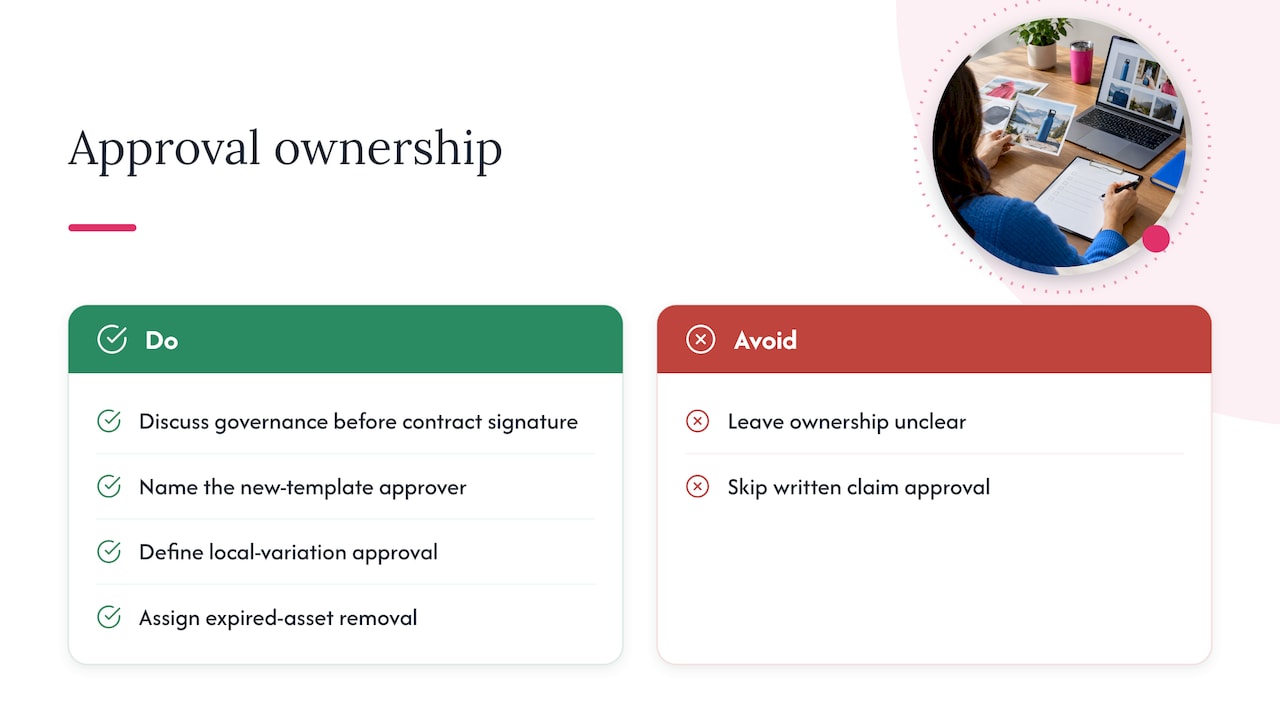
1. Decide who owns approval before you upload anything
The same TechBullion piece recommends holding a governance conversation before contract signature: who approves templates, how expiration dates are set and who monitors compliance. Do it at the start. Unclear ownership slows everything later.
Write down three answers. Who signs off on new templates? Who can approve a local variation? Who removes an asset when a promotion or product ends? If your industry has claim rules, such as direct selling, the approval step is not optional. Mannatech’s U.S. policies, for example, require Associates to use only company-produced sales aids or materials submitted and approved in writing, with changes resubmitted for separate approval.
Our content approval workflow guide shows how to tier approvals by risk, so a seasonal photo post does not wait in the same queue as a claim-heavy product ad. For the compliance side, see the co-op marketing compliance guide.
2. Build one searchable library
One place, not five. Tag every asset with product line, campaign, format, region and expiry date, so a rep can find the right image in seconds instead of rebuilding it. TechBullion lists centralized, searchable libraries with metadata, role-based permissions and version control that retires outdated files among the capabilities channel teams should look for.
Our metadata-first asset library checklist walks through the setup in five steps. If you also publish a lot of your own web content alongside partner material, an AI content marketing platform can help plan and publish that side, while the partner library stays focused on what your network posts.
Photofy includes a stock asset library alongside pre-designed and custom templates, so your team works from one source rather than a mix of folders and inboxes.
3. Turn assets into templates, not just files
A file invites editing in whatever tool the rep has. A template invites the right edit. Build templates where the logo, color palette, fonts and legal lines are fixed, and where name, photo, headline, offer and local details are open.
A simple way to decide what to lock:
| Element | Lock it | Let reps change it |
|---|---|---|
| Logo and brand colors | Yes | No |
| Required disclaimers | Yes | No |
| Product imagery | Usually | Choice from approved set |
| Rep name, title, photo | No | Yes |
| Local offer or event | No | Yes, within approval rules |
| Caption wording | Suggested copy | Light personalization |
Photofy offers pre-designed and custom templates, graphic and text overlays, and video stitching, which lets a rep combine clips into a short branded video without a separate editing tool. Industry-specific template libraries and white-labeling are part of how we aim to give you consistency with room for local customization. Our article on how photography templates enhance brand consistency explains the logic in more depth.
4. Make approvals fast for the people posting
A reps’ main reason for going around your system is speed. If approval takes a week, they will post something of their own that afternoon. Keep the path short: pre-approved templates need no further sign-off, local variations go through a lightweight review, and anything with regulated claims gets the full check.
Photofy is designed to bring branded content creation, team approvals, asset management and automated publishing into one platform, so a rep can create, get sign-off and schedule without switching tools. Use our brand compliance checklist and templates as a starting point for what reviewers should check, and the 90 day content governance guide to put roles and review dates on a calendar.
5. Make it easy to post, not just to download
Sharing is only complete when the content is published. Your network should be able to open a template on a phone, add a photo, and post or schedule in minutes. This is where a mobile-first tool matters: dealers and direct sellers work from phones, between customers.
If you sell through direct selling, our guides on direct sales marketing with social media content and engaging social content for direct sales show what reps tend to post and how to support them.
6. Track usage and retire what does not work
The last step closes the loop. You want to see which assets are used, by whom, and what results they produce. TechBullion lists usage and performance analytics by partner and asset as a core capability, and integration with CRM, partner portals and marketing automation as the way to connect it to sales.
Photofy includes scheduling and analytics, so you can see how shared content performs rather than guessing. For larger channel programs that connect content to market development funds and CRM, see through-channel marketing in six steps.
How to measure whether it is working
Start with four simple measures:
- Adoption: the share of your network that logs in and publishes each month.
- Asset use: which assets are posted most, and which are never touched.
- Compliance: how many posts needed correction or removal.
- Time and cost saved: hours or agency fees avoided because reps no longer request custom work.
The last one can be large. A 2011 Hospitality Technology report said Marriott’s BrandWorks portal produced 18,500 documents that year and saved Marriott and its owners an estimated $9.2 million in agency costs, based on an average of $500 per piece of outside marketing support. User logins rose 186% over the prior two years. The figures are from one hotel brand and one year, so treat them as an illustration of how to calculate savings: count the pieces your network creates itself, multiply by what an outside request would have cost, and compare.
Review these numbers monthly at first. A library nobody uses is a signal to fix search and tags, not to add more assets.
Who needs this most
The setup scales to different sizes, with different needs:
- Small businesses and freelancers need ready templates and an easy way to post consistently without a designer.
- Direct selling companies need brand control and approved materials for a large independent field.
- Franchises need local owners to promote their own location with brand-safe content.
- Car manufacturers and dealers need photo, video and PDF content that reaches each dealership’s sales team.
- Enterprises need one platform for content management across teams and regions, with white-labeling when the platform should carry their own brand.
Photofy plans for sharing content
Photofy offers plans for individuals, small businesses, teams and enterprises. The published prices are:
- Small Business: $10.99 per month or $99 per year.
- Individual Plans: $11.95 per month, $29.97 per quarter or $99.95 per year.
- Pro Teams: $13.00 per month per user.
- Enterprise Teams: $9.00 per month per user.
Franchise and enterprise programs, including white-label content management, are arranged through direct inquiry. You can see the options on the pricing page, or start at photofy.com to see how templates, the asset library, approvals and scheduling work together for your network.
Our perspective
Most brands think of content sharing as a delivery problem: get the files to the field. We see it as a trust problem. Your network needs to trust that what they post is correct, and you need to trust that what they post is on brand.
That is why we built Photofy around templates rather than folders. When the logo, colors and required language are built in, a rep can personalize and post without asking permission each time. When approvals, the asset library and publishing live in one place, the compliant path is also the fastest one.
Distributed organizations get the best results when local reps feel empowered, not policed. Give them tailored, user-friendly tools, keep the guardrails in the template, and your brand shows up consistently in every market you sell in.
Jon
Questions about sharing content with distributors
What is the difference between content distribution and distributor content sharing?
Content distribution is the broad practice of publishing and promoting content across owned, earned and paid channels. Distributor content sharing is the part where your sales partners, dealers or franchisees publish your approved material under their own names. The focus is on templates, approvals and tracking rather than on channel strategy.
What content should I share with distributors first?
Start with what reps ask for most: current product photos, a short video, a sell sheet or catalog, and a few social templates they can personalize. Published programs such as Wave Armor’s and Partner.Co’s follow this pattern. Add seasonal and campaign assets once the first set is easy to find and use.
How do I let reps customize content without losing brand consistency?
Use templates that lock logos, colors and required disclaimers and leave names, photos, local offers and captions open. Pre-approve the template once, then route only unusual changes through review. This keeps the approval queue short and the brand intact.
How often should shared assets be updated?
Set an expiry date when you upload each asset and review the library on a regular schedule, such as monthly or quarterly. Product images may refresh annually, as in some co-op programs, while promotions expire when the offer ends. Retire outdated files so reps cannot find them.
How do I know if my distributors are using the content?
Track logins, posts and asset use by partner. If a template is never used, change it or remove it. If a region posts little, look at training and ease of access before blaming motivation.
Sources
- What is Content Distribution?
- Wave Armor 2022 Co-op Marketing Program and Advertising Guidelines
- Matco Tools Franchise Marketing System
- Partner.Co Business Launch Kit
- Mannatech United States Policies and Procedures
- Digital Asset Management Platform Selection Criteria for B2B Channel Marketing Teams
- Marriott Saves Estimated $9.2 Million in Marketing Costs