Content Ideas for Franchises: 25 Posts That Work Locally
The best content ideas for franchises balance two things: the brand story that headquarters controls and the local proof that only your location can show. Post only national campaigns and you look generic. Post only local snapshots and the brand drifts. Below you will find 25 ideas sorted by purpose, a simple content split, a four-week plan, and the compliance points to cover before anyone hits publish.
TL;DR
- Split your content between brand, customized and purely local posts. A 70/20/10 mix is a common starting point, and 40/30/30 is another.
- Local proof wins trust: team spotlights, customer stories, community events and real photos of your own location.
- Google Business Profile updates take about 15 minutes a week and are among the highest-return local tasks.
- Reviews, testimonials and earnings claims fall under FTC rules, so train franchisees before they post.
- Give locations templates and an approved asset library so local posts stay on brand without slowing anyone down.
Table of Contents
- Why do franchises need a different content plan?
- How should you split brand content and local content?
- What are the best brand-level content ideas?
- What local content ideas build trust for one location?
- Which ideas help you get found in local search?
- What does a four-week local content plan look like?
- How do you keep AI-assisted content human?
- What compliance rules should franchisees know before posting?
- What we think: consistency is a system, not a rulebook
- How can Photofy help your franchise post consistently?
- What budget should local content get?
- FAQ
- Sources
Why do franchises need a different content plan?
A single-location business decides what to post and posts it. A franchise has to do that across dozens or hundreds of owners, each with a different schedule, skill level and local audience. The result is usually one of two problems: locations that post nothing, or locations that post off-brand material.
The stakes are real. The 2025 AFMR findings reported by Franchising.com show that 76% of consumers trust businesses they perceive as local, yet only 34% believe franchises offer better customer service than local businesses. That is the gap your content has to close. Your customers want to see a neighbor, not a logo.
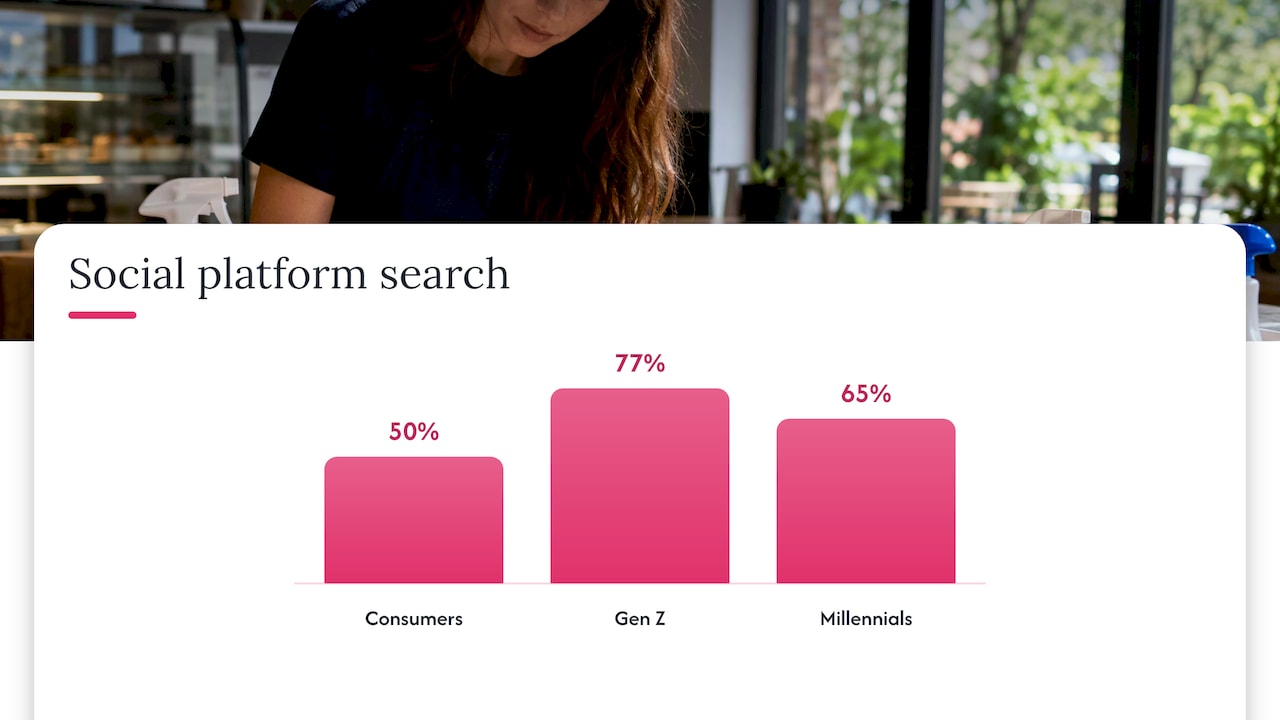
The same report notes that 50% of consumers use social platforms such as Instagram, TikTok, YouTube and Reddit to search for local businesses. That rises to 77% for Gen Z and 65% for Millennials. If your location has no recent, visible content, a large share of your future customers will never find a reason to choose you.
How should you split brand content and local content?
Before you pick ideas, decide who creates what. Experts commonly recommend an allocation model, and two frameworks come up often:
| Model | Corporate content | Customized local | Fully local |
|---|---|---|---|
| 70/20/10 | 70%, provided by HQ for consistency | 20%, corporate templates adapted locally | 10%, authentic content about the team and community |
| 40/30/30 | 40% corporate content | 30% evergreen local content | 30% real-time community engagement |
The first model suits newer systems or heavily regulated categories, where consistency matters most. The second suits mature franchisees who know their market and have the time to engage. You do not need to treat either as law. Start with one, review it after a quarter, and adjust.
Whatever the ratio, decide on four to six content pillars that every location posts about. Common pillars include customer stories, team spotlights, community involvement, behind-the-scenes operations, educational tips and promotional offers. Pillars give a busy owner a shortcut: instead of asking “what should I post?”, they ask “which pillar is due this week?”
What are the best brand-level content ideas?
These are the posts headquarters should build once and distribute. Locations then subscribe to them or adapt them in a few taps.
- Seasonal and holiday campaigns. Build them early so every location has the creative before the season starts.
- New product or service launches. One master asset set, with space for the local address and offer.
- Brand story and values. Why the company exists, told in a short video or carousel.
- Explainer videos. A 30 to 60 second walkthrough of how your service works.
- Evergreen FAQs. The five questions every new customer asks, answered visually.
- National promotions. Use one template with an editable field for location and dates.
- Founder or leadership messages. Short, human and not overproduced.
- Franchisee success stories. Useful for customers and for recruiting. Read the earnings-claim warning below before you use any numbers.
The point of these ideas is leverage. HQ does the creative work once, and each owner spends minutes instead of hours.
What local content ideas build trust for one location?
This is where franchisees earn their market. None of these can be made at headquarters.
- Team spotlights. Introduce a staff member, how long they have worked there and what they love about the job.
- Behind-the-scenes clips. Opening routines, prep work, a technician arriving at a job.
- Customer stories. Real customers, with written permission, in their own words.
- Before and after shots. Powerful for service, fitness, restoration and home categories.
- Community involvement. Charity drives, school events, local fairs.
- Youth sports and school sponsorships. QSR Pro describes a $300 to $500 seasonal Little League banner as the kind of local move that can beat digital ad spending on margin for a restaurant, since fixed overhead is already covered. Photograph it and post it.
- Neighborhood guides. Your favorite nearby coffee shop, park or event, with a tag.
- Local weather or seasonal tips. A plumber posting a freeze warning, a landscaper posting a fall checklist.
- Real location photos. Photos of the actual storefront or studio help customers know what to expect, and they are better than stock shots.
- Local milestone posts. Anniversaries, hiring announcements, award wins.
- Live Q&A or a live walkthrough. Low production, high honesty.
- Customer shout-outs. Tagged stories, review highlights and comments can all become posts.
A useful exercise: for each pillar, list two local ideas that only your location could post. If an idea would work for any city, it belongs in the brand column.
Which ideas help you get found in local search?
Social posts are only one surface. QSR Pro calls Google Business Profile optimization the highest-return asset for local franchises in 2026. The most active operators post weekly updates with limited-time offers or behind-the-scenes content, which takes about 15 minutes a week.
- Weekly Google Business Profile update. One offer, one photo, one line of text.
- Question-and-answer posts. Consumers increasingly use voice assistants and answer engines. Marketing leaders interviewed by 1851 Franchise say brands should give clear, conversational answers to local questions instead of chasing keywords alone. A post titled “What should I do if my basement floods tonight?” fits that.
- Review responses turned into content. Thank a customer publicly, then feature the story, with their consent.
- Seasonal service reminders. Time them to your climate and customer calendar.
- Local event tie-ins. Post before, during and after a community event you attend.
Reviews matter here too. The AFMR data says 90% of brands now actively monitor online reviews, up from 75% in 2024, and reviews act as a primary discovery engine for 50% of consumers. If you watch them, you can mine them for content ideas.
What does a four-week local content plan look like?
Here is a simple plan for one location posting three times a week. Adjust it for your category.
| Week | Monday | Wednesday | Friday |
|---|---|---|---|
| 1 | Brand campaign post from HQ | Team spotlight | Customer story |
| 2 | Educational tip, HQ template with local touch | Behind-the-scenes clip | Community photo |
| 3 | Brand promotion with local offer | Neighborhood guide | Before and after |
| 4 | Evergreen FAQ | Live Q&A or walkthrough | Local event recap |
This plan lands near a 60/40 split between brand and local content, which is one of the allocations experts mention. Add one weekly Google Business Profile update on top.
If you would rather not build the grid from scratch, our free social media content calendars give you a starting point. For a rollout approach across a network, see our 30/60/90 playbook for franchise social media.
How do you keep AI-assisted content human?
Most franchisees are short on time, so AI drafting tools are tempting. Use them for speed, not for voice. The marketing leaders quoted by 1851 Franchise describe the 2025 and 2026 shift as moving toward authentic connection, with AI used to amplify a human voice rather than replace it.
In practice, let a tool draft captions or outlines, then add the detail only you know: the customer’s first name with permission, the street the event is on, the joke your team tells. If you want to explore how teams approach this, read about AI-driven brand building online. A caption that mentions your actual neighborhood beats a polished caption that could belong to anyone.
What compliance rules should franchisees know before posting?
This is the part many owners skip, and it can cost the most. Check with your franchise attorney for your specific system, but these are the main points.
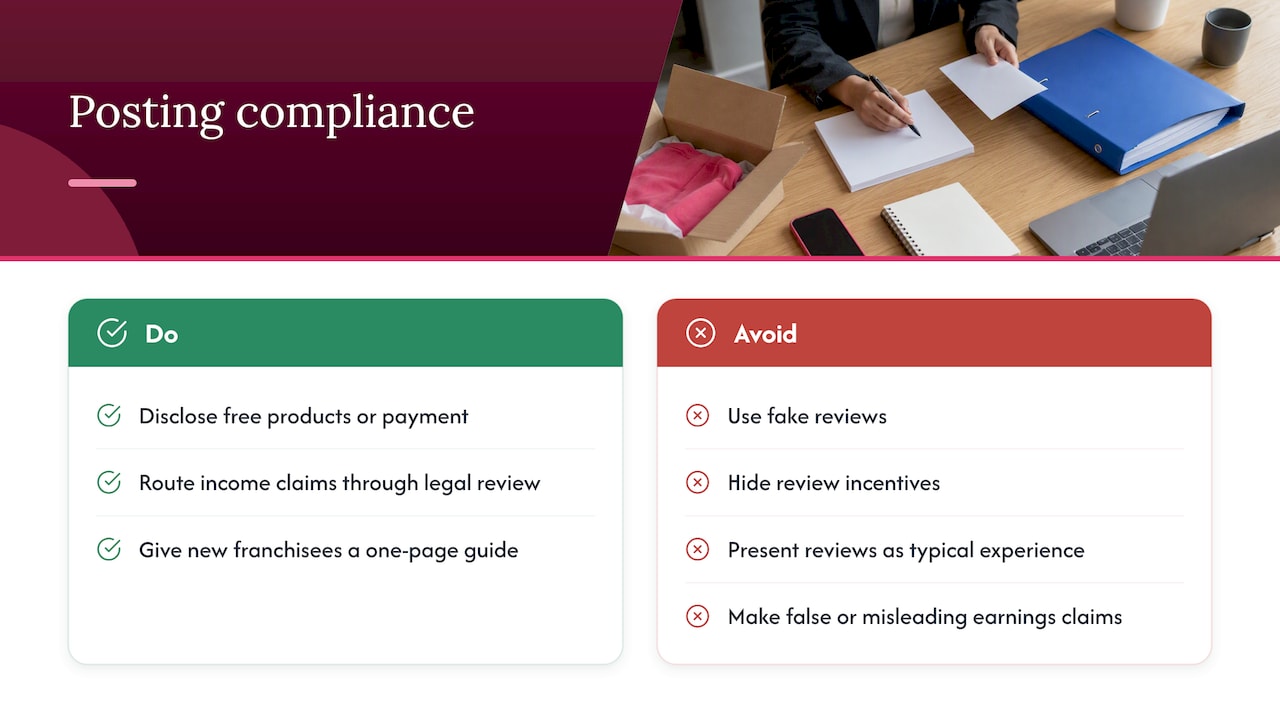
Reviews and testimonials. The Federal Trade Commission treats online reviews and testimonials like traditional ads. Its materials say it is deceptive to make false or misleading claims about earnings for a money-making opportunity. Reviews are also problematic when they are fake, incentivized without disclosure, or presented as the typical experience. If a customer or influencer received a free product or payment, say so clearly.
Earnings claims. If you are a franchisor, a “top franchisee made X” post is not harmless. FTC staff explain that indirect earnings claims made through general media are covered by the Franchise Rule. Such claims need a reasonable basis and specific disclosures. Sharing a journalist’s article about your franchisees’ income can, in some situations, make the claims your own. Route any income or success-story content through legal review.
Training. Give every new franchisee a one-page guide on disclosures, permissions for customer photos and what not to say about earnings. A short checklist beats a long manual nobody opens.
What we think: consistency is a system, not a rulebook
We work with distributed teams every day, and the pattern is consistent. Brands rarely fail because their franchisees lack ideas. They fail because posting is slower than it should be. When a location owner has to hunt for a logo file, wait for approval on a flyer and then resize it for three platforms, the post does not happen.
So we believe the answer is to remove friction while keeping control. That means pre-designed templates that locations can customize, an organized asset library, team approvals where needed and scheduling in the same place. It also means white-label options for larger organizations that want the platform to carry their own brand. We built Photofy around this idea: brand control and local freedom should not be a trade-off.
We also believe a playbook is a living system. Scorpion’s franchise marketing research says brands that fail to review performance monthly report lower overall success. Look at what your locations post, which templates they use and which posts get saved or shared, then adjust the library every month. If you only change one thing this quarter, make it that.
— Jon
How can Photofy help your franchise post consistently?
Phofy is a social marketing platform on iOS, Android and desktop. It offers pre-designed and custom templates, a stock asset library, video stitching, graphic and text overlays, scheduling and analytics. For franchise and enterprise organizations, it adds white-label content management so headquarters can share approved photos, video and PDFs with every location.
Published pricing on our plans page lists Pro Teams at $13.00 per month per user and Enterprise Teams at $9.00 per month per user. Small Business plans are $10.99 per month or $99 per year on our small business page. Franchise and enterprise programs are arranged by inquiry, so see our pricing page or start at photofy.com to talk with us about your network. To organize assets before rolling out, our metadata-first asset library checklist walks through five setup steps.
What budget should local content get?
Content ideas cost little, but time and paid amplification do not. According to 2026 industry data cited by Franchising.com, national funds typically take 4 to 5% of gross sales while local store marketing budgets run 1 to 2%. National funds handle large brand campaigns, while local budgets drive traffic to individual units. In 2025, digital advertising took about 42% of franchise marketing budgets, with social media taking another 22%.
For a franchisee, the takeaway is not to outspend headquarters. It is to spend where headquarters cannot: the sponsorship, the community event, the boosted post that features your own team. Speed matters too. Scorpion’s research links responding to leads within 30 minutes to stronger growth in high-performing systems, so make sure the content you publish has someone ready to answer the replies and messages it generates.
FAQ
How often should a franchise location post on social media?
Three posts a week is a realistic target for most owners, plus one Google Business Profile update. Consistency matters more than volume. If three feels heavy, start with two and use scheduled posts to batch the work in one sitting.
What is the right mix of corporate and local content?
Common starting points are 70/20/10 (corporate, customized, local) or 40/30/30 (corporate, evergreen local, real-time engagement). Newer or more regulated systems lean toward more corporate content. Review the mix quarterly and move toward what your results support.
Can franchisees use customer reviews in their posts?
Yes, with care. Get permission, never edit a review to change its meaning, and disclose any incentive or material connection. Do not present one standout result as what the typical customer can expect. Ask your franchise attorney if you are unsure.
What content should a franchisor never post?
Avoid earnings or income claims without legal review. The FTC Franchise Rule applies to claims made through social posts, websites and media coverage you circulate. Success stories about customers are generally simpler than stories about franchisee profits.
Sources
- From Differentiator to Driver: 2025 AFMR Findings (Franchising.com)
- Franchise Social Media Marketing: Strategy for Multi-Location Brands (Salesoptima Digital)
- Social Media Marketing for Franchises: Brand Consistency Guide (Salesoptima Digital)
- Local Store Marketing That Actually Works (QSR Pro)
- 6 Social Media Best Practices for Franchises (Uberall)
- PuroClean VP of Marketing Alex Pericchi (1851 Franchise)
- What Every Franchise Brand Needs in Its Marketing Playbook (Scorpion)
- Sample Cover Letter for Penalty Offenses Concerning Money-Making Opportunities (FTC)
- Informal Staff Advisory Opinion 04-2 (FTC)