

Before You Scale Social Media Localization, Adapt Your Top 3 Posts
Social media localization means adapting your captions, visuals, tone, hashtags, and timing so each post feels native to the audience reading it, not just translated into their language. The first step is simple: research which platforms matter most in your target markets, then adapt your top three performing posts for language and tone before building anything new. Pew Research finds that platform use varies widely by age and market, and we’ve watched that variation shape which posts actually land.
TL;DR:
- CSA Research found that 76% of online shoppers prefer product information in their native language, supporting a localized content test rather than a full rollout.
- Across 37 countries, median platform use was 69% for Facebook, 51% for Instagram, 40% for TikTok, and 18% for X, with variation by market.
- Translate product specifications and legal disclaimers accurately, but recreate humor, wordplay, and campaign taglines when literal wording would confuse or lose its effect.
- Pilot the top three post types in one region, then compare engagement, clicks, and conversions with its pretest baseline and content in a comparable region.
- Route health, financial, and comparative claims through local legal review before publication, and check each market’s privacy, consent, and sponsored content disclosure rules.
Table of Contents
- What social media localization covers
- Why it matters: business case and key statistics
- Platform choice and audience research: prioritize networks and formats
- Translation vs transcreation: a decision checklist
- Localization tactics: copy, visuals, timing, targeting, hashtags and community signals
- Operational workflow: assets, templates, approvals and governance
- Measurement and KPIs for localized social content
- Legal and compliance considerations in social media localization
- Three pragmatic rules for teams that must scale
- Making localized visuals easier to produce and govern
- FAQ
- Sources
What social media localization covers
Translation swaps words from one language to another. Transcreation recreates the message so the emotional impact lands the same way, even if the words change completely. Localization goes further still: it adjusts language, visuals, cultural references, and platform mechanics so content feels like it was made for that specific audience, not adapted for them.
For social teams, that scope touches more than captions. A properly localized post treats each of these as a decision point:
- Captions and copy, including tone, formality, and idioms.
- Visuals, stickers, filters, and on-image text overlays.
- Calls to action and the verbs you use to prompt engagement.
- Hashtags and trending terms specific to the local conversation.
- Pinned posts and profile bios that set first impressions.
- Guidance for user-generated content so local creators stay on-brand.
Metadata, link destinations, and platform-specific formats count too. A Story format that performs well in one market might be a poor fit where a different platform dominates, so the technical shape of the post is part of localization, not a separate task.
Why it matters: business case and key statistics
The financial case for localization is direct. 76% of online shoppers prefer product information in their native language, and a meaningful share won’t buy from a site that doesn’t offer it, according to CSA Research. That preference extends naturally to social content: a caption that sounds native builds trust faster than one that reads as translated.
Localized posts tend to earn stronger engagement because they remove the small frictions, an awkward phrase, an unfamiliar reference, that make a reader scroll past. Comments in the local language, native slang, and locally relevant visuals all signal that a brand understands its audience rather than broadcasting at it.
You don’t need a full rollout to test this. Pick one region or one audience segment, localize a handful of posts, and compare performance against your standard content before committing a larger budget.
Platform choice and audience research: prioritize networks and formats
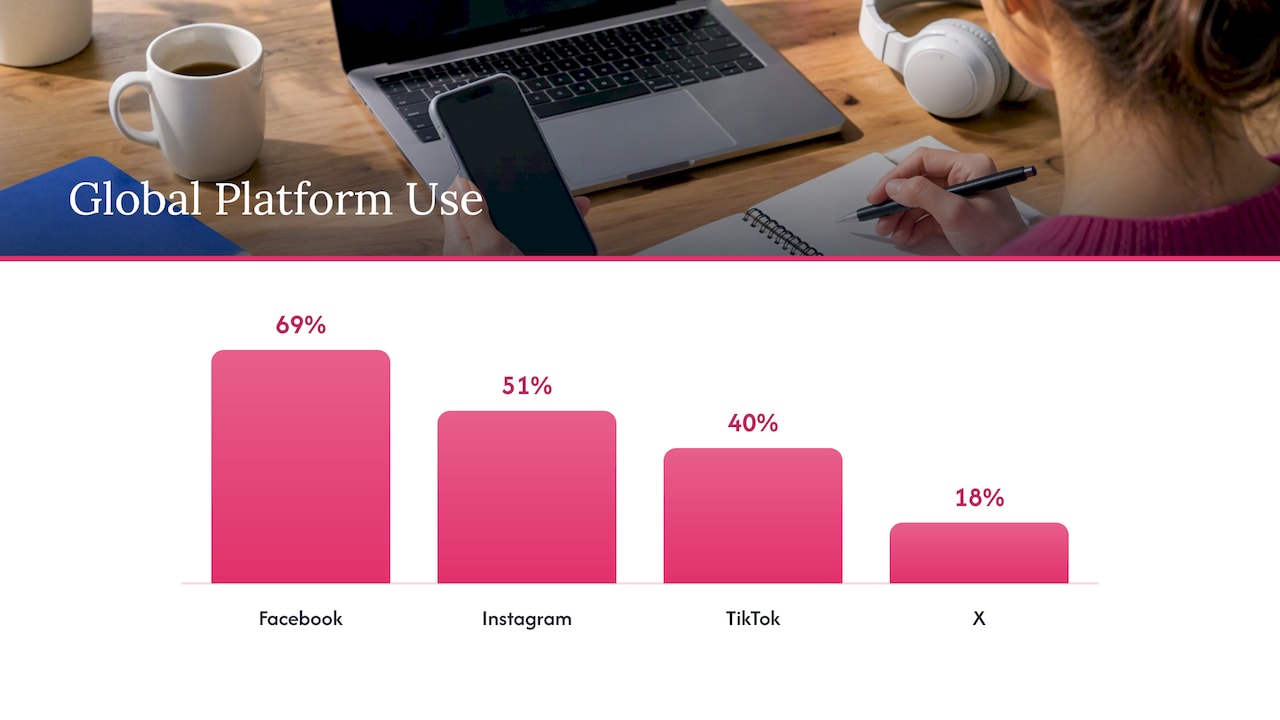
Not every platform deserves equal investment in every market. Pew Research reports that YouTube and Facebook remain the most-used platforms among U.S. adults, with Instagram reaching about half of adults and TikTok at 37%, while platform use shifts by age group. Globally, the pattern changes further: across 37 countries, median platform-use shares put Facebook at 69%, Instagram at 51%, TikTok at 40%, and X at 18%, with real variation market to market.
A quick mapping exercise keeps this manageable:
- List your target audience segments by region or language group.
- Match each segment to the platforms where they’re actually active.
- Pair each platform with the format that performs best there, short video, Stories, or carousel posts.
Watch for daily use rates, growth trends, and age or language skew within each market. A platform that dominates one region may barely register in another, and your localization budget should follow the data, not assumptions.
Translation vs transcreation: a decision checklist
Some content can be translated word for word. Other content needs to be rebuilt from the idea up. The difference usually comes down to a few factors: whether the claim is legally regulated, whether the original relies on humor or idiom, how sensitive the message is to brand voice, and how complex the creative concept is.
A short checklist helps brief writers and reviewers make the call quickly:
- Flag any regulated claims, pricing, or legal disclaimers first; these need precise translation, not creative reinterpretation.
- Identify humor, wordplay, or cultural references; these almost always require transcreation to land correctly.
- Check brand voice guidelines against the local tone; adjust for formality or informality as needed.
Product specs and legal disclaimers are classic translation cases. Campaign taglines and humor-driven captions are classic transcreation cases, since a literal translation would likely fall flat or confuse the reader.
Localization tactics: copy, visuals, timing, targeting, hashtags and community signals
Language choices matter beyond word-for-word accuracy. Use local spellings and regional vocabulary, match the formality register your audience expects, and consider bilingual captions where your audience mixes languages naturally. Emoji use varies by culture too, so check what reads as friendly versus odd in a specific market.
Visual choices carry just as much weight. Colors, models, and product framing all carry cultural associations, and text overlays need local-language treatment rather than a translated sticker slapped over the original image.
Timing matters at the calendar level. Local holidays, weekday versus weekend behavior, and posting windows all shift by region, so schedule with local time zones in mind rather than publishing everything from a single master calendar. Our scheduling guide walks through picking tools that handle multiple time zones cleanly, and a content calendar guide from Baby Love Growth offers useful planning structure for teams building out a localized calendar.
Metadata deserves its own attention: research local hashtags and trending terms rather than translating your home-market tags, and watch for regional meme or sticker trends that signal cultural fluency.
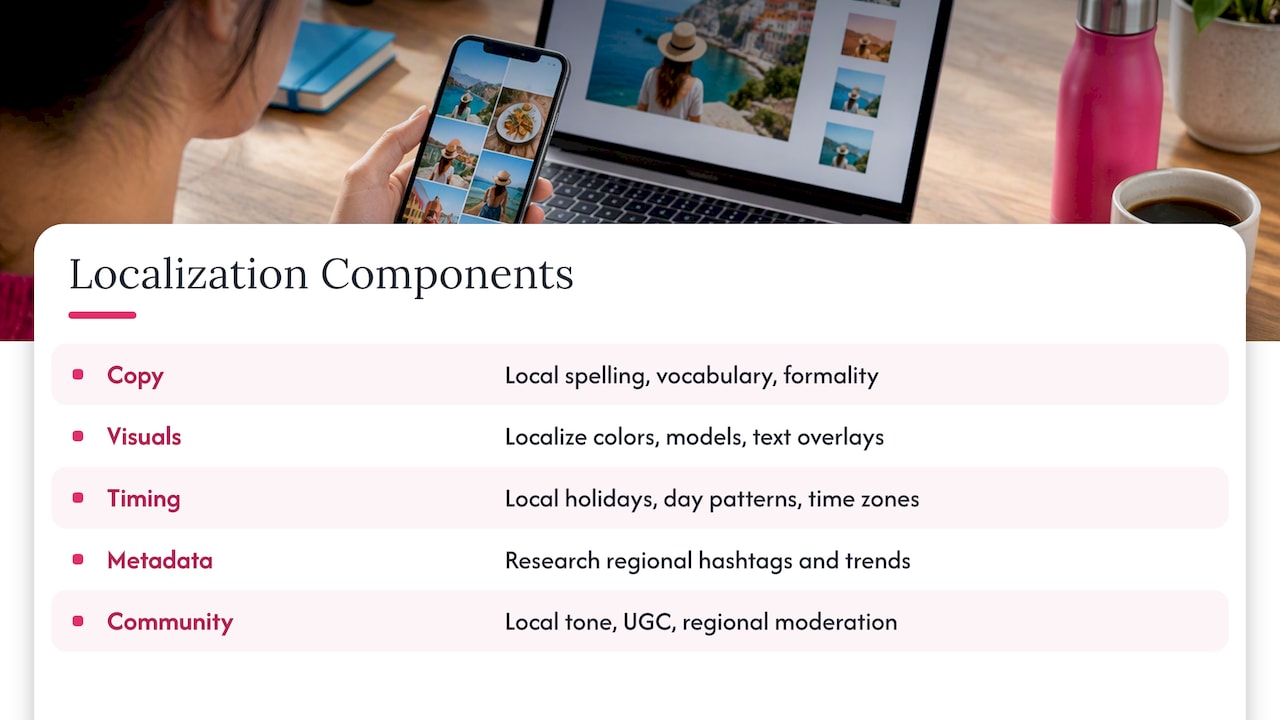
Community management rounds it out. Solicit user-generated content with locally appropriate language, match your response tone to local norms, and set moderation guidelines that account for regional sensitivities.
Pro Tip: Build one flexible visual template with swappable text and image layers so you can localize it for multiple markets without starting from scratch each time.
Operational workflow: assets, templates, approvals and governance
Scaling localization without chaos starts with an asset-library-first approach: tag every asset with metadata like market, language, and campaign so teams can find and reuse what already exists instead of recreating it. A metadata-first asset library makes this searchable rather than scattered across folders.
Templates should use text placeholders and modular layers so a local team can swap copy and imagery without touching the underlying design. That keeps brand elements locked while giving local flexibility where it counts.
Clear roles keep the workflow moving:
- A local creator who understands the market and audience.
- A translator or transcreator who adapts language and tone.
- A central approver who checks brand consistency and sets turnaround expectations.
A short governance checklist, confirming logo placement, color usage, and approved claims, catches drift before it reaches the feed. Our brand governance framework outlines a setup for distributed teams managing this at scale.
Measurement and KPIs for localized social content
Track engagement rate, follower growth, click-through rate, and conversion lift separately for each locale rather than blending them into one global number. That separation is what reveals whether localization is actually moving the needle.
- Run a simple market-split test: localize content in one region while keeping a comparable region on standard content.
- Compare performance against a pre-pilot baseline rather than against unrelated markets.
- Report on a consistent cadence so trends, not single-post spikes, drive decisions.
Our reporting guide and templates offer a starting structure for building this into a regular cycle.
Legal and compliance considerations in social media localization
Advertising standards differ by market, and a claim that’s acceptable in one country can trigger regulatory action in another. Health, financial, and comparative advertising claims are especially sensitive, so legal review should happen before a transcreated post goes live, not after.
Data privacy rules also shift by region. Collecting user data through localized campaigns, contests, or UGC solicitations means checking what consent and disclosure requirements apply wherever that content runs. A caption inviting followers to tag their location or submit personal photos carries different obligations depending on local privacy law.
Disclosure requirements for sponsored or branded content vary too, and a disclosure that satisfies one market’s rules may not satisfy another’s. Keep a market-by-market reference for required disclosures, claim restrictions, and consent language, and route any localized ad copy through legal or compliance review before launch. Treating this step as part of the approval workflow, rather than an afterthought, keeps a fast-moving localization program from creating regulatory exposure down the line.
Three pragmatic rules for teams that must scale
Start by researching platforms, then localize only your top three performing post types first. Centralize your assets and metadata so local teams adapt existing work instead of rebuilding from scratch. Pilot one region, measure the lift, then scale the approach that actually worked.
— Jon
Making localized visuals easier to produce and govern
Building locale-ready templates by hand, market by market, is where most localization programs slow down. We built Photofy to help teams create branded, local-ready visuals and templates once and distribute them across markets and channels without each local team starting from a blank page.
Our platform combines a searchable asset library, modular templates with swappable text and image layers, and approval controls that keep brand governance intact even as local reps customize content for their market. For small businesses, current prices are on our pricing page, and teams managing multiple markets can review Individual and Enterprise options to find the right fit. Check out Photofy to see how a template-first workflow speeds up localized content production without sacrificing consistency.
FAQ
What is a localization strategy?
A localization strategy is a plan for adapting content, language, visuals, and messaging so it resonates with a specific regional or cultural audience rather than simply translating the original version. It typically includes platform research, content adaptation guidelines, and a workflow for approvals and measurement.
What is the 5-5-5 rule for social media?
Definitions of this concept vary across marketing sources, and there’s no single authoritative standard tied to localization specifically. A common informal version suggests engaging with posts, commenting on accounts, and sharing content regularly, but this isn’t a localization framework.
What does “social media localization” mean?
Social media localization means adapting captions, visuals, hashtags, timing, and tone so a post feels native to a specific regional or language audience rather than simply translated. It covers everything from word choice to platform selection based on where your audience actually spends time, as shown in Pew Research’s platform-use data.
Can AI do localization?
AI tools can speed up draft translation and help generate starting points for transcreation, but cultural nuance, humor, and brand voice still need human review before publishing. Teams typically use AI for first drafts and rely on local reviewers or transcreators to catch tone and context issues AI tends to miss.
Why should we invest in localized content instead of one global version?
Localized content tends to build trust faster because it removes friction like unfamiliar phrasing or irrelevant visuals. CSA Research found that 76% of online shoppers prefer product information in their native language, which supports testing localized content against a single global version.