

White Label Branding for Agencies: Choose and Deploy
If you need a rebrandable social-marketing platform for your agency, franchise, or enterprise brand, pick a solution with enterprise-grade white-label controls, multi-tenant account management, and built-in analytics, like Photofy. That combination gives you brand consistency across every client or location, workflows that scale past a handful of accounts, and proof of ROI you can put in front of a client or a CFO.
Here’s why that combination matters more than any single feature:
- Brand consistency controls keep every dashboard, template, and export looking like your company built it, not a vendor.
- Multi-tenant workflows let one admin manage dozens of client or franchise accounts without recreating permissions each time.
- Measurable ROI through analytics and attribution shows clients or leadership exactly what the platform is producing.
Your next step: ask any vendor you’re evaluating for a live demo that includes single sign-on setup and a branded-template pilot on your own account. If they can’t show you that in the first call, keep looking.
Key Takeaways
A white-label social-marketing platform succeeds when it combines deep branding controls, multi-tenant management, and measurable analytics under a contract that guarantees data ownership and support response times.
| Point | Details |
|---|---|
| Define your scope first | Confirm the platform means a rebrandable SaaS tool, not private-label retail goods, before evaluating vendors. |
| Rank criteria before calls | Prioritize white-label depth, deployment options, and multi-tenant permissions ahead of price. |
| Demand contract clarity | Require explicit data ownership, export rights, and a numeric uptime SLA in writing. |
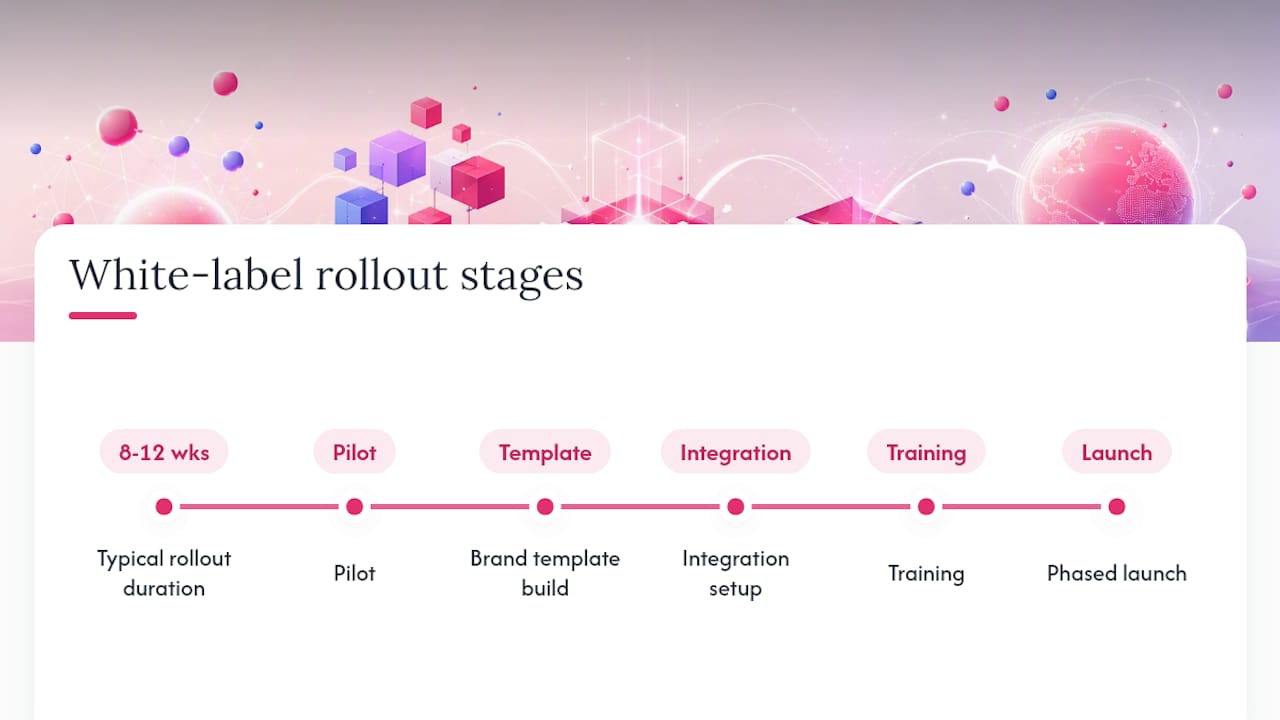
| Plan an 8 to 12 week rollout | Move through pilot, template build, integrations, training, and phased launch in order. |
| Consider Photofy for deployment | Photofy offers branded templates, multi-tenant management, and enterprise onboarding across iOS, Android, and desktop. |
Table of Contents
- What Does White Label Branding Mean for Social Platforms?
- How Do You Evaluate and Select a White-Label Platform?
- What’s the Implementation Timeline for a White-Label Rollout?
- Which Industries Use White-Label Platforms and What Results Do They Get?
- What Security and Governance Should You Require?
- How Photofy Delivers Rebrandable Social Marketing at Scale
- Frequently Asked Questions
- Sources
What Does White Label Branding Mean for Social Platforms?
White label branding, in this context, means licensing a SaaS platform and presenting it entirely under your own name, logo, and domain, so your clients or franchisees never see the underlying vendor. This is distinct from white label in retail, where one factory makes a product that many brands resell. Here, you’re relabeling software, not merchandise, and the stakes are different: your reputation rides on uptime, data handling, and how convincingly the platform disappears behind your identity.
A platform built for this needs to deliver on a specific set of capabilities:
- Custom-branded dashboards and login screens with your logo, colors, and domain
- White-label reporting that clients can view without ever seeing the vendor’s name
- An asset library and template system your teams can populate with brand-approved content
- Multi-tenant account management so one admin oversees many client or location accounts
- Scheduling and workflow tools for content approval and publishing
- Analytics and attribution tied to campaign performance
- Branded mobile apps, not just a web portal with your logo slapped on top
- API and integration support for connecting to the tools you already run
Delivery usually comes in one of four forms: a hosted cloud platform on your custom domain, a subdomain portal under the vendor’s infrastructure, a fully branded mobile app, or an API-embedded layer inside your existing product. White-label social solutions commonly bundle these into one package rather than making you assemble them piece by piece.
How Do You Evaluate and Select a White-Label Platform?
Ranking your criteria before you take a single sales call saves you from being sold on features you’ll never use. Work through this order:
- White-label depth. Can you rebrand the mobile app, not just the web dashboard?
- Deployment options. Does it run on cloud, mobile, and desktop, or just one of the three?
- Multi-tenant management and permissions. Can you set granular roles per client or franchise location?
- Templates and asset library. Is content pre-built for your industry, or are you starting from a blank canvas?
- Workflow and scheduling. Does content approval fit your team’s actual process, or does it force a new one?
- Analytics and attribution. Can you tie posts to leads, not just impressions?
- Support and SLA. Is there a named contact, or a ticket queue?
- Pricing and licensing. Does the model match how you bill your own clients?
Bring these questions into every vendor call:
- “Can we white-label the mobile app icon and splash screen, or only the web interface?”
- “Who owns the content and data we upload, and can we export everything if we leave?”
- “What are the exact API rate limits, and what happens when we exceed them?”
- “What’s your uptime guarantee, and what’s the penalty if you miss it?”
- “What security certifications do you hold, and can we see the audit report?”
- “How do you handle platform detection when clients post at volume across many accounts?”
Watch for these red flags during evaluation:
- No explicit data ownership clause in the contract
- Branding limited to a logo swap, with vendor names still buried in emails or footers
- No real isolation between tenant accounts, meaning one client’s data could leak into another’s view
- A vague SLA with no numeric uptime commitment
- No stated plan for handling mass-posting detection issues as you scale
Pro Tip: Print your ranked criteria list and bring it into every vendor call. Score each vendor live on a scale of 1 to 5 per criterion. It turns a subjective sales pitch into a comparable, defensible decision.
What’s the Implementation Timeline for a White-Label Rollout?
Most agency and franchise rollouts move through seven phases, and skipping any one of them is where projects stall:
- Pilot with a single client or location to validate the platform fits your workflow.
- Build brand templates so every account starts from approved assets.
- Configure single sign-on and set user roles across your team.
- Connect platform integrations.
- Train account managers and content creators on the actual tools they’ll use daily.
- Launch to your full client or franchise base in stages, not all at once.
- Measure results and adjust templates or workflows based on what’s actually getting used.
Your integration checklist should cover single sign-on through OAuth or SAML, your CMS, your CRM, Google Analytics 4 for attribution, ad platform connections, file storage or a digital asset management system, content approval tools, and any APIs or webhooks your stack already depends on.
Pricing models vary enough that procurement needs to understand each before signing:
| Model | How it works | Best fit |
|---|---|---|
| Per-seat | Pay per user account | Small teams with stable headcount |
| Per-branded-instance | Pay per rebranded deployment | Agencies serving multiple distinct client brands |
| Per-tenant | Pay per managed sub-account | Franchises with many locations under one brand |
| Revenue-share resale | Vendor takes a cut of what you charge clients | Agencies building a white-label resale business |
| Enterprise/custom contract | Negotiated terms and volume pricing | Large franchises or multi-brand enterprises |
A realistic timeline for a mid-size agency or franchise rollout runs 8 to 12 weeks: weeks 1 to 2 for pilot setup, weeks 3 to 5 for brand template build and SSO configuration, weeks 6 to 8 for integrations and training, and weeks 9 to 12 for phased launch and initial measurement.
Which Industries Use White-Label Platforms and What Results Do They Get?
Agencies use white-label platforms to resell social management under their own name, turning a service line into recurring revenue without hiring a development team. Franchises use them to keep every location’s content on-brand, which matters when a single off-message post from one location can affect how customers see every other location. Enterprise brands with multiple sub-brands use them to give each division creative flexibility without losing central control over logos, colors, and messaging.
Photofy’s Real Estate Marketing Solution packages templates, workflows, and reporting specifically for real estate teams, giving agents branded, ready-to-post content without a design department. The Wine and Design partnership with Photofy shows how a multi-location creative franchise used branded content tools to keep dozens of studios visually consistent.
A franchise network with 40 locations doesn’t need 40 different design processes. It needs one brand-approved template system that every location can use without a single off-brand post going out.
Track these outcomes to know if the rollout is working: hours saved per week on creative production, client or franchisee retention over two to three renewal cycles, and improvement in attribution accuracy tied to campaign performance.
What Security and Governance Should You Require?
Before signing, confirm the contract explicitly states data ownership, export rights, an uptime SLA with a real number attached, defined support response times, and a documented roadmap or upgrade policy. Vague language here becomes expensive later, usually right when you need the answer most.

On the technical side, expect role-based access control, real isolation between tenant accounts, encryption at rest and in transit, audit logs you can pull on demand, and SOC or ISO attestations where the vendor has them. Photofy’s enterprise offering includes dedicated onboarding and support built for exactly this kind of scrutiny.
Support expectations matter as much as the technical specs: a named onboarding contact, a clear escalation path when something breaks, a stated update cadence, and proactive incident communication instead of silence during an outage.
Pro Tip: Ask for the vendor’s jurisdiction and any industry-specific compliance requirements in writing before you sign. Verbal assurances during a sales call don’t hold up when a client asks you to prove it.
Build vs. buy: when white label actually wins
Building in-house only wins once your posting volume, brand count, and engineering budget can absorb years of ongoing maintenance most teams underestimate. Below that scale, buying a proven white-label platform gets you to market faster and cheaper.
How Photofy Delivers Rebrandable Social Marketing at Scale
Photofy gives your agency, franchise, or enterprise team a fully rebrandable platform without the multi-year build cycle that in-house development demands. You get pre-designed and custom templates, a stock asset library, video stitching, and white-label content management built to keep every team on-brand, available across iOS, Android, and desktop.
Three things matter most to the teams we work with:
- Brand consistency across every account, template, and export, so clients never see a vendor name that isn’t yours.
- Scale through multi-tenant management, letting one admin oversee client or franchise accounts without rebuilding permissions each time.
- Rapid onboarding with dedicated enterprise support that gets your team live in weeks, not quarters.
If you’re evaluating platforms right now, request a demo through Photofy’s enterprise page and ask specifically for a branded-template pilot on your own account before you commit. You can also review current plans on the Photofy pricing page to see which licensing model fits your rollout.
Frequently Asked Questions
What is white label branding in software?
White label branding in software means licensing a platform built by one company and presenting it entirely under your own name, logo, and domain, so your customers never see the original vendor.
What’s the difference between white label vs. private label?
White label lets multiple companies rebrand and sell the same underlying product, while private label typically means one company commissions a product built exclusively for them. In social-marketing software, “white label” almost always describes the rebrandable SaaS model.
How does co-branding differ from white label?
Co-branding displays both the vendor’s and your brand together, while white label branding removes the vendor’s identity entirely, so the platform appears to be yours alone.
How long does white label platform implementation typically take?
Most agency or franchise rollouts take 8 to 12 weeks, moving through a pilot, brand template build, integration setup, training, and phased launch.
What pricing model should agencies expect for white label services?
Expect per-seat, per-branded-instance, per-tenant, revenue-share resale, or custom enterprise contracts, depending on how many brands or locations you’re managing.
Can I white-label a mobile app, not just a web dashboard?
Some vendors, including Photofy, support branded mobile experiences alongside web and desktop, so confirm this specifically during evaluation since many platforms only rebrand the browser interface.
Sources
- 7 Powerful Benefits of White Label Solutions for Your Social Media Requirements – ExxarDigital