

90 Day Brand Compliance Checklist and Templates for Marketing Teams
A brand compliance checklist is a single source of truth for visual, verbal, legal, and operational rules, paired with clear approval steps. Use the checklist framework below and assign a named owner today. That one move, before you buy software or write a single policy, is what separates programs that hold up under scale from ones that quietly drift off-brand within a quarter.
TL;DR:
- A brand compliance checklist must cover visual identity, verbal voice, operational controls, and legal disclosures to prevent costly branding and legal errors.
- Skipping proper checks increases the risk of trust erosion, legal fines, and operational waste due to off-brand or non-compliant assets going live.
- Building an effective compliance program involves defining standards, centralizing assets, assigning owners, and establishing role-based access and AI governance rules.
- Regular monitoring through daily spot checks, monthly audits, and quarterly reviews, combined with KPI tracking, is essential for maintaining consistency at scale.
- Centralized tools like Photofy integrate templates, approval workflows, and asset management, making compliance easier, especially for distributed teams and franchise networks.
Table of Contents
- What Does a Brand Compliance Checklist Actually Cover?
- Why Skipping a Compliance Checklist Costs More Than You Think
- How Do You Build a Brand Compliance Program Step by Step?
- A Ready-to-Use Brand Compliance Checklist Template
- What Legal and Social Media Rules Belong on the Checklist?
- How Often Should You Audit Brand Compliance?
- Which Tools and Workflows Actually Reduce Compliance Friction?
- A 90-Day Plan to Roll Out Your Brand Compliance Program
- How Photofy Helps Teams Stay On-Brand at Scale
- What Brand Managers Consistently Get Wrong First
- Centralize Your Brand Standards With Photofy
- Sources
- FAQ
What Does a Brand Compliance Checklist Actually Cover?
A working checklist spans four zones, and skipping any one of them creates a gap someone will eventually exploit or accidentally break.
Visual identity covers logo lockups, clear space, approved color values, typography, and photography rules. If a regional sales rep can stretch your logo or swap in an off-palette blue, that rule belongs on the list.
Verbal identity governs voice, tone, and the exact phrases you allow or forbid. This includes banned terms, approved claims, and required disclosure language, especially in regulated categories like health, finance, or direct selling.
Operational controls keep the system running: which templates are current, who can edit a master asset, and how versioning prevents someone from pulling last year’s brochure out of a shared drive.
Legal and disclosure items round it out: FTC endorsement language, required legal footers, data collection notices, and industry-specific claim restrictions.
- Logo usage, spacing, and color values
- Tone of voice and banned or restricted terms
- Template version control and asset expiration dates
- Access permissions by role
- Required disclosures and legal disclaimers
Why Skipping a Compliance Checklist Costs More Than You Think
Inconsistent branding erodes trust faster than most marketing leaders assume, and the damage compounds across every channel where a customer encounters a mismatched logo, an off-tone caption, or an outdated price sheet. Rebuilding that trust takes far longer than preventing the drift in the first place.
The legal exposure is concrete, not theoretical. Common 2026 marketing compliance risks include data privacy violations under laws like GDPR and CCPA, improper advertising disclosures under FTC guidelines, intellectual property infringement, and AI-generated content published without human review.
The real cost isn’t the fine. It’s the rework: pulling assets, retraining a distributed sales force, and reissuing corrected materials across dozens of local pages, often while a regulator or a customer complaint is still active.
Operational waste stacks on top of that. Every off-brand asset that gets caught after publishing costs someone time to flag it, someone else to fix it, and a third person to confirm it’s actually gone. A checklist front-loads that cost into five minutes of review instead of three days of cleanup.
How Do You Build a Brand Compliance Program Step by Step?
Most teams don’t need more brand guidelines. They need a system that turns guidelines into repeatable habits. Here’s the sequence that works:
- Define your standards and build Brand Cards. Condense your visual, verbal, and legal rules into a short reference document per brand or product line. Recommended practice is to score drafts against this card before a human ever sees them, which makes “on-brand” the default rather than a last-minute catch, according to Dasho’s compliance framework.
- Centralize assets in one workspace. Scattered folders and outdated shared drives are where stale logos and expired disclaimers live longest. One workspace, one version, no exceptions.
- Map content types to approval workflows. A social caption doesn’t need the same review chain as a paid ad with a health claim. Match the workflow weight to the actual risk.
- Name an owner and a backup approver for every workflow. Approval bottlenecks are almost always a staffing gap, not a process failure. Multiple industry sources recommend naming both a primary and backup approver so review never stalls when one person is out.
- Set role-based access and audit trails. Poor access control, including failure to revoke permissions when someone changes roles, is a recurring failure point that undermines otherwise solid programs, according to UC Santa Barbara’s social media security protocols.
- Write AI governance rules now, not later. Specify which tools are approved, what prompts are off-limits, and require human sign-off before anything AI-assisted publishes. AI flagging tools help you scale, but they need a human checkpoint, per Hootsuite’s 2026 compliance guide.
- Set a monitoring cadence. Daily spot checks for high-volume channels, monthly audits per channel, and a quarterly deep review across the whole program.
- Track KPIs and feed them back into training. Compliance scores, time-to-approval, and repeat violations should all shape next quarter’s training focus, not just sit in a report nobody reads.
Pro Tip: Digitize your standard operating procedures with reference photos attached to each rule. A rep comparing their draft to an actual approved example catches errors that a text-only rule never will, since it turns a subjective “does this look right” question into an objective pass or fail.
A Ready-to-Use Brand Compliance Checklist Template
You don’t need a 40-page manual to start. You need a checklist with items specific enough that two different reviewers reach the same verdict.
Split your checklist into five sections:
- Visual: Logo lockup correct, clear space respected, approved color codes used, no stretched or recolored assets.
- Verbal: Tone matches brand voice, no banned terms present, required disclosure language included where applicable.
- Legal/disclosure: FTC endorsement language present on sponsored content, privacy notice included where data is collected, claims match approved language.
- Channel-specific: Social bio matches current template, video lower-thirds use current font and logo, website header/footer match the latest brand kit.
- Technical: File named per convention, correct aspect ratio for platform, alt text included, template version current (not expired).
Some items are binary: the logo is either the approved file or it isn’t. Others deserve a score, like “tone alignment,” which might rate 1 to 5 depending on how closely the copy matches your Brand Card. Use binary checks for anything with a hard legal or visual standard, and scored items for anything judgment-based.
A five-person marketing team can run this checklist manually in a spreadsheet. A 200-location franchise network needs the same checklist attached to a workflow tool with automated reminders and approver routing. The categories don’t change; the enforcement mechanism does.

What Legal and Social Media Rules Belong on the Checklist?
Social media is where brand compliance and legal compliance collide most often, and it’s the channel most likely to generate a public, screenshot-able mistake.
Your checklist needs explicit items for:
- FTC disclosure language on every sponsored post, affiliate link, or paid partnership, checked before publishing, not after a complaint.
- Archiving with full metadata, capturing native formats including Stories, Reels, and any edits or deletions, which regulated industries need to satisfy retention rules tied to standards like FINRA or HIPAA, per Hootsuite’s guidance.
- Privacy and consent checks flagging any content that collects personal data, with a review step for CCPA or GDPR relevance depending on your audience.
- AI content governance items, including which generative tools are approved, whether AI involvement requires disclosure, and confirmation that a human reviewed the output before it published.
A recommended baseline for social programs includes eight recurring tasks: understand applicable regulations, control access, monitor activity, archive communications, curate pre-approved content, enforce approval workflows, invest in training, and document a clear social compliance policy, according to Gain’s compliance checklist. Teams exploring AI-assisted content creation should also build governance controls into that workflow from the start, an approach covered in Babylovegrowth’s guide to AI-driven brand building.
How Often Should You Audit Brand Compliance?
Monitoring and auditing are related but distinct. Monitoring is lightweight and continuous, like a daily glance at recent social posts. An audit is formal, scheduled, and produces a scored record you can compare quarter over quarter.
- Run daily spot checks on your highest-volume channels, focused on the most common errors: wrong logo file, missing disclosure, off-tone copy.
- Schedule monthly channel audits covering every active platform, scored against your checklist categories.
- Conduct a quarterly full-program review, ideally using a Perimeter-to-Core sequence: start with the outward-facing impression, like a storefront or landing page, then move inward to operational materials, replicating how a customer actually experiences the brand, a method described by GoAudits.
- Track a small set of metrics, including compliance score by location or channel, average time-to-approval, and repeat-violation rate.
- Assign corrective actions with deadlines and proof-of-closure. A flagged issue without an owner and a due date rarely gets fixed. Require a screenshot or confirmation link before closing the ticket.
- Feed audit data into next quarter’s training priorities. If three locations keep failing the same logo check, that’s a training gap, not a discipline problem.
This four-phase cycle, standardize, monitor, audit, correct, is what scales brand consistency across dozens or hundreds of locations without requiring a compliance officer to personally review every post.
Which Tools and Workflows Actually Reduce Compliance Friction?
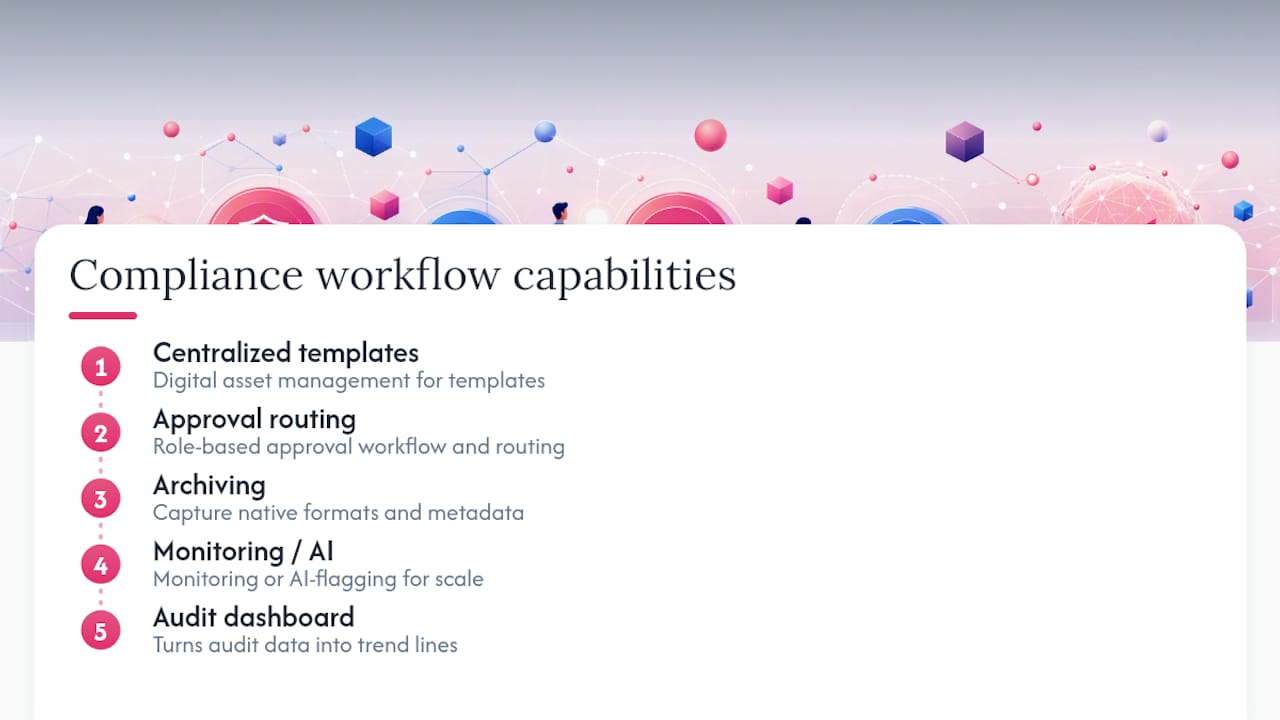
You don’t need every tool category on day one, but five capabilities matter most as you scale: a digital asset management system for centralized templates, an approval workflow with role-based routing, an archiving solution that captures native formats and metadata, monitoring or AI-flagging for scale, and a dashboard that turns audit data into a trend line instead of a stack of spreadsheets.
Integration priorities usually follow this order: single sign-on for access control, your CMS or website platform, your active social channels, and whatever archiving solution satisfies your industry’s retention rules.
Pro Tip: Pre-approved templates cut review friction more than any single policy change. When most published content starts from an approved template, your reviewers spend their time on the few pieces that are genuinely custom, not re-checking logo placement repeatedly.
When evaluating a platform, separate must-haves (approval workflows, audit trails, version control) from nice-to-haves (advanced analytics, extra integrations) so you don’t stall a purchase decision chasing a feature you won’t use for a year. A structured rollout guide for brand consistency tools can help you sequence that evaluation.
A 90-Day Plan to Roll Out Your Brand Compliance Program
Rolling out a new compliance system across a distributed team fails most often when it launches everywhere at once. A phased plan gives people time to adjust.
- Days 1 to 30: quick wins and pilot. Launch the Brand Card and checklist with one team or one region. Fix the most visible issues first, like outdated logos or missing disclosures, so early adopters see fast results.
- Days 31 to 60: structured training and scale. Run onboarding sessions for new users and refresher sessions for existing teams, including scenario-based training, like reviewing a mock non-compliant post together.
- Days 61 to 90: full rollout and partner enablement. Extend access to agencies and outside partners with secure, limited permissions and shared templates rather than raw brand files, then confirm every workflow has a named owner and backup approver before calling the rollout complete.
A documented 90-day governance framework gives distributed teams a shared timeline instead of a vague mandate to “get more consistent,” and a social reporting template helps translate audit results into a format leadership will actually read.
How Photofy Helps Teams Stay On-Brand at Scale
A template library paired with an approval workflow closes the gap between “we have brand guidelines” and “nobody can publish something off-brand.” When every asset starts from an approved template and routes through a defined approver, off-brand content stops before it goes live instead of getting caught after.
For franchises, direct selling networks, and agencies managing multiple client brands, white-labeling matters just as much: local teams get to create and personalize content, while headquarters keeps the underlying brand assets locked down.
When evaluating any platform for this job, look for:
- Centralized, version-controlled template libraries
- Role-based approval workflows with audit trails
- White-label distribution for franchise or multi-brand structures
- Reporting that ties activity back to compliance metrics
What Brand Managers Consistently Get Wrong First
Most teams try to build the perfect checklist before they’ve tested a single workflow. Start smaller: one Brand Card, one critical approval path, and a way to measure whether it’s actually working. Monitoring should feel like a five-minute habit before you add any heavy tooling on top of it, or the system collapses under its own weight within a month.
Train your highest-frequency publishers first, not your executives. The person posting daily needs specific, measurable rules, not a mission statement about brand values.
— Jon
Centralize Your Brand Standards With Photofy
Photofy gives distributed teams what a checklist alone can’t: a single workspace where templates, approvals, and white-labeled distribution actually enforce the rules you write down. Instead of emailing brand guidelines and hoping every regional rep reads them, you route content through role-based approvals and let local teams personalize pre-approved templates without touching the underlying brand assets. That combination is especially useful for franchises, direct selling networks, and agencies managing several client brands at once, where a single off-brand post can multiply across dozens of local accounts overnight.
If you manage a distributed team or franchise network, start with the enterprise solutions page to see how white-labeling and centralized templates fit your structure. Smaller teams and individual marketers can compare plans directly on the pricing page, where pricing details are available.
Sources
For deeper legal guidance, audit methodology, and channel-specific checklist formats, consult Hootsuite’s compliance guide, GoAudits’ audit framework, and Illinois’ brand checklist.
- Social media compliance: 2026 guide for regulated industries
- Brand Compliance: Definition & Checklist | Dasho
FAQ
What Does Brand Compliance Actually Mean?
Brand compliance means every piece of content, from a social caption to a printed brochure, follows the approved visual, verbal, and legal standards a company has documented. It covers logo usage, tone of voice, required disclosures, and version control, and it’s typically enforced through an approval workflow rather than after-the-fact correction.
How Do You Prepare a Brand Compliance Checklist?
Start by condensing your visual, verbal, and legal rules into a short Brand Card, then translate each rule into a specific, checkable item, binary where a hard standard exists and scored where judgment is involved. Group items into sections like visual, verbal, legal, and channel-specific, then attach the checklist to an approval workflow with a named owner, following the structure outlined in the Smartsheet compliance guide.
What Are the 7 Pillars of Branding?
Definitions vary across sources, but most frameworks include purpose, positioning, personality, visual identity, verbal identity, customer experience, and consistency across channels. A compliance checklist mainly protects the last two pillars: visual identity and cross-channel consistency, since those are what break down fastest without active enforcement.
What Is the 3-7-27 Rule in Branding?
This isn’t a standardized industry framework, and definitions of it vary widely depending on the source, so there’s no single authoritative version worth stating here. If you’ve seen it referenced elsewhere, treat it as informal shorthand rather than an established branding principle.
Does Photofy Support Brand Compliance for Distributed Teams?
Yes. Photofy centralizes approved templates and assets in one workspace, routes content through approval workflows, and offers white-labeling so franchises, direct selling networks, and agencies can let local teams create content while headquarters keeps brand assets locked down.