

Automate MDF and CRM: Six Steps to Through Channel Marketing That Scales
Through channel marketing is the practice of arming your distribution partners, resellers, dealers, or independent sales reps with the branded content, funding, and tools they need to market on your behalf, at scale, without going off-brand. The payoff you should expect is consistent, measurable demand generation across every partner, not just your top performers. Automation, market development funds (MDF), and partner-level attribution are what make that scale possible.
TL;DR:
- Automating partner workflows with CRM and PRM integration is crucial, as most SaaS companies report partner-sourced revenue around 24% of total income.
- Simplifying MDF approval processes and providing clear, self-service funding claims significantly boosts partner participation and content production speed.
- Using lockable, pre-approved templates and scheduling tools like Photofy ensures brand consistency and fast content delivery at scale.
- Measuring both partner-sourced and influenced pipeline is essential, with linked campaign IDs helping justify channel investments and demonstrate true ROI.
- Piloting with a small partner group and gradually scaling automation while maintaining governance prevents common breakdowns and facilitates long-term growth.
Table of Contents
- What Through Channel Marketing Actually Is
- What TCMA Platforms Actually Automate
- Getting Partners to Actually Use Their MDF
- How to Measure ROI on Partner-Driven Marketing
- A Six-Step Rollout Plan for Through Channel Marketing
- How Photofy Supports Distributed Partner Marketing
- Staying Compliant When Partners Send Email on Your Behalf
- Where Through Channel Marketing Programs Break Down
- What Successful Through Channel Programs Have in Common
- Getting Sales and Marketing Aligned Inside Partner Organizations
- What I’d Prioritize First
- A Practical Next Step for Running Partner Content at Scale
- Sources
- FAQ
What Through Channel Marketing Actually Is
Through channel marketing (TCM) means equipping the businesses that sell or represent your brand, franchisees, dealers, direct sellers, agency partners, with ready-to-use marketing assets and funding so they generate local demand under your brand standards. It differs from general partner marketing in one key way: general partner marketing often means co-branded campaigns you run together. TCM means marketing that flows through your partners to their local audiences, with you supplying the fuel and the guardrails.
A working TCM program needs five components, and skipping any one of them is usually why programs stall out.
- Partner segmentation — tiering partners by revenue potential, engagement history, and marketing sophistication so you don’t treat a five-person dealership the same as a 200-location franchise group.
- A content and asset library — pre-approved, customizable templates that let partners localize without breaking brand rules.
- MDF or co-investment structures — shared funding that gets partners to actually run campaigns instead of shelving them.
- Campaign provisioning — the workflow that pushes ready-to-deploy assets to the right partner at the right moment.
- Reporting — a way to see what partners actually did with the money and materials you gave them.
Through channel marketing automation (TCMA) platforms sit at the center of this stack, connecting your asset library, your MDF ledger, and your partner communications so none of it depends on someone manually emailing zip files. Without that layer, TCM tends to collapse into a once-a-quarter newsletter partners ignore.
What TCMA Platforms Actually Automate
A TCMA platform’s job is to remove the manual work that kills partner participation: chasing approvals, rebuilding assets for every region, and reconciling spreadsheets to figure out who used their funds. The core feature set typically includes:
- Lead distribution — routing inbound leads to the right partner by territory or tier, automatically.
- MDF management — request, approval, and reimbursement workflows with audit trails.
- Localized templating — one master campaign that partners can adapt to their market without a design team.
- Onboarding and certification — structured ramp-up so new partners hit the ground with brand standards intact.
- Reporting connectors — pulling partner activity data into a shared dashboard instead of a shared inbox.
AI is where the newest lift is showing up. Auto-generating partner-specific landing pages and email copy produces a median engagement lift of about 18%, while conversational onboarding agents cut time-to-first-deal by roughly 22%, and AI-driven partner-opportunity matching adds an 8 to 12 point lift in conversion. None of that works, though, without integration.
Statistic Callout: Partner-sourced revenue in SaaS companies runs at a median of about 24% of total revenue, and PRM adoption in the $25M+ ARR cohort sits near 62%, meaning most serious competitors have already automated the workflow you might still be running by hand.
Connecting your PRM system to your CRM and finance stack is the difference between reconstructing attribution manually every quarter and having near real-time, defensible numbers finance actually trusts.
Getting Partners to Actually Use Their MDF
Most MDF programs fail for a boring reason: partners find the paperwork more expensive than the payoff. Fix the friction and participation follows.
Frictionless design starts with clear, published eligibility rules, not a vague “talk to your channel manager” policy. Partners should know before they apply whether their campaign qualifies, and approvals should happen in days, not weeks. Self-service claims, where a partner uploads a receipt and gets reimbursed without three rounds of email, do more for utilization than raising the fund cap ever will.
Not every marketing format deserves equal MDF weight. Prioritize by proven yield:
- Joint case studies — these produce roughly a 28% engagement lift over single-vendor content because prospects trust a partner’s real customer story more than brand copy.
- Webinars — co-hosted sessions show a notable conversion lift, largely because they combine your product authority with the partner’s local relationships.
- Local events — smaller in reach but high in trust, especially for partners selling into tight geographic or vertical communities.
- Cold partner-list email — deprioritize this. It is the format partners run most often and the one with the weakest return.
Enablement is what turns funding into output. Give partners pre-approved templates they can customize themselves, short playbooks instead of dense brand manuals, and training sessions under 30 minutes. Pass-through co-investment, where you cover a percentage of the spend automatically rather than requiring a full reimbursement cycle, keeps smaller partners from opting out entirely.
Pro Tip: Publish your MDF eligibility rules on one page, in plain language, and put a dollar example next to each rule. Partners are far more likely to apply for funding they can calculate in their head than funding buried in a policy document.
How to Measure ROI on Partner-Driven Marketing
You need two numbers, not one: partner-sourced pipeline and partner-influenced pipeline. Sourced means the partner brought the deal in the door. Influenced means the partner touched a deal your own team originated, through co-marketing, a joint webinar, or a local event. Programs that only track sourced revenue routinely undercount their channel’s real impact by ignoring every deal partners helped move forward but didn’t originate.
The fix is structural, not procedural. Make MDF a CRM-native record: every funded initiative gets linked to a campaign ID, an opportunity, and a defined influence window (commonly 30 to 90 days after the partner touch), so a report can show planned outcomes against actual ones automatically instead of through a quarterly spreadsheet reconciliation.
A few reference points help when you’re setting targets:
- Median partner-sourced revenue in SaaS companies runs near 24% of total revenue.
- Deal registration paired with engagement-led growth (ELG) overlays can lift win rates by roughly 3.6 times versus unregistered, untouched deals.
- PRM adoption crosses around 60% once a company passes $25 million in ARR, a common threshold for scaling manual tracking efforts.
Statistic Callout: If your partner program can’t show finance a sourced-versus-influenced split tied to real CRM records, you’re likely presenting a smaller number than your channel is actually delivering, and finance has no reason to fund next year’s expansion.
A Six-Step Rollout Plan for Through Channel Marketing
Building a TCM program from scratch, or fixing one that’s stalled, follows a predictable sequence. Skipping steps is the most common reason programs get relaunched a year later under a new name.
- Audit what exists. Inventory current partner content, MDF spend, and whatever reporting (or lack of it) you have today. Most teams find scattered spreadsheets and at least one partner tier nobody has segmented properly.
- Choose your tech and data model. Decide what a “campaign” record looks like, what fields an MDF request needs, and which system, PRM, CRM, or a dedicated TCMA tool, owns that record.
- Integrate CRM, PRM, and finance. This is the step people try to skip and the one that determines whether your ROI numbers are trusted or ignored. Salesforce’s own PRM guidance treats this integration as the baseline for defensible attribution, not an advanced feature.
- Pilot MDF workflows with a small partner group. Run self-service claims and fast approvals with 10 to 20 partners before rolling out fund-wide. Track approval time and claim rate as your pilot success metrics.
- Enable partners with assets and training. Ship the customizable template library and a short onboarding session, not a 40-page brand book nobody opens.
- Scale and automate reporting. Once the pilot’s numbers hold up, extend the workflow to the full partner base and connect reporting dashboards so campaign performance flows in without manual pulls.
What to integrate, concretely: CRM opportunity fields tagged with partner ID, an MDF ledger with planned-versus-actual spend columns, and consistent campaign IDs applied at creation, not retrofitted after the fact.
Pro Tip: Roll out to your pilot group in phases of two weeks apart, not all at once. Partner fatigue shows up fast when everyone gets a new portal login and a training email on the same Monday.
Governance matters as much as tooling. Someone needs to own exceptions (the partner who doesn’t fit your tiering model), and someone needs to review MDF utilization monthly, not annually, or you won’t catch a stalled rollout until the budget’s already been reallocated.
How Photofy Supports Distributed Partner Marketing
If your rollout plan depends on partners actually producing on-brand content fast, the platform layer matters as much as the CRM integration. Photofy addresses the execution gap that trips up most TCM programs: partners have funding and approval, but no fast way to turn that into a post.
- Templated assets let a franchisee or dealer swap in local details without touching a design file.
- White-labeling keeps enterprise brand standards intact even when hundreds of independent partners are posting under their own accounts.
- Scheduling removes the bottleneck of a partner remembering to post a co-marketed campaign on the right day.
- Analytics gives you the partner-level activity data your MDF reporting needs without a manual pull.
Franchise networks and real estate teams are the clearest use cases: distributed groups where local reps need brand-safe content, fast, without waiting on a corporate marketing queue.
Staying Compliant When Partners Send Email on Your Behalf
Partner-sent commercial email carries the same legal exposure as email you send yourself, and that’s the part most brands miss when they hand a template to a reseller and move on. Under the CAN-SPAM Act, any commercial email a partner sends on your behalf must include accurate header information, a valid physical postal address, and a visible opt-out mechanism. The brand whose product is being promoted can share liability if a partner’s email violates these rules, even when the brand didn’t send it directly.
Build compliance into your template library rather than trusting partners to remember it. Every pre-approved email template should already have the postal address field populated and the unsubscribe link hardcoded, so a partner customizing subject lines and body copy can’t accidentally strip out the legally required parts. If your TCMA platform lets you lock certain template elements while leaving others editable, use that feature specifically for compliance fields.
Opt-out requests need to be honored within 10 business days under the statute, which means your partner program needs a real process for routing unsubscribe requests back to whatever list management system the partner is using, not just a “the partner handles it” assumption. Audit a sample of partner-sent emails quarterly. It’s a small operational cost against the penalty exposure of noncompliant sends going out under your brand name at volume.
Where Through Channel Marketing Programs Break Down
The most common failure mode isn’t a bad strategy. It’s a good strategy nobody built the infrastructure to run. A few patterns show up again and again.
The fix is almost always simplification: fewer steps, faster approvals, editable templates instead of static PDFs.
Attribution stays anecdotal. Without CRM-linked campaign IDs, you end up asking partners to self-report results, which nobody trusts, including the partners. This is the single biggest reason channel budgets get cut before they get expanded.
Brand consistency erodes at scale. The moment you have 50 partners customizing content instead of 5, small deviations, a wrong logo version, an off-brand color, compound into a fragmented brand experience. White-labeled, locked templates solve this more reliably than a style guide PDF that nobody rereads before every campaign.
AI pilots get used but not measured. Teams roll out AI-generated content or onboarding agents, see partners engage with them, and never connect that engagement back to pipeline. The lift is real in aggregate data, but if you can’t show it in your own CRM, you can’t defend the tool’s budget next renewal cycle.
MDF gets treated as a cost center instead of a revenue lever. Programs that track MDF spend without tracking MDF-influenced pipeline will eventually get cut in a budget review, regardless of how well partners actually used the funds.
What Successful Through Channel Programs Have in Common
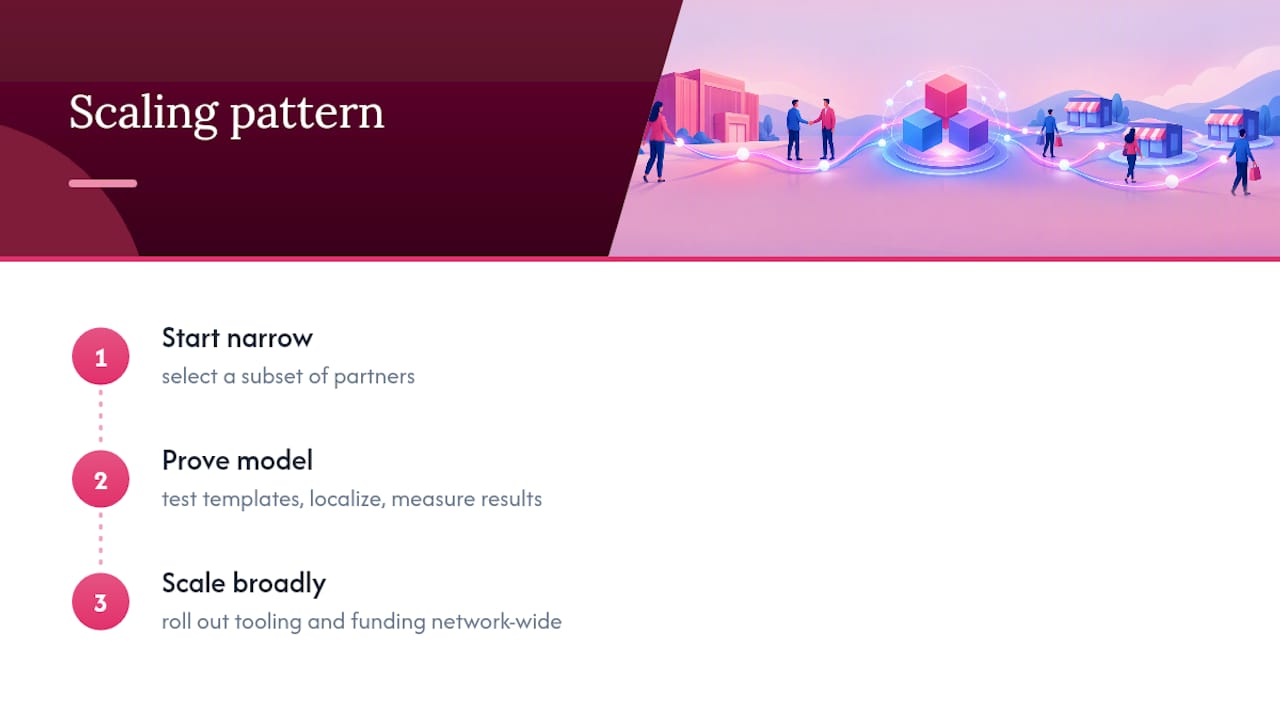
Programs that scale share a specific pattern: they start narrow, prove the model with a subset of partners, and only then expand the tooling and funding across the full network.
A franchise network rolling out a new regional promotion typically sees the clearest wins when corporate marketing supplies a single master campaign, an ad template, a social post series, a local event flyer, and lets each location swap in their address, hours, and a local photo. The campaign stays recognizably on-brand across every location while still feeling locally relevant, which is exactly the balance a distributed marketing model is supposed to strike.
Direct-selling organizations, where independent reps post daily on personal social accounts, show a similar pattern: reps who get pre-approved, easily customizable content post more consistently than reps left to build their own graphics from scratch, and consistency is usually the bigger lever than any single piece of creative.
Real estate brokerages tell the same story from a different angle. Agents operating under one brand, but marketing individually, need content that’s fast to localize (a new listing, an open house, a market update) and simple enough to post the same day it’s created. Programs that give agents that speed see materially higher posting frequency than programs that route every asset through a centralized design request queue.
The common thread across all three: the winning programs removed the gap between “corporate approved this campaign” and “a partner actually posted something,” and they measured what happened after.
Getting Sales and Marketing Aligned Inside Partner Organizations
A channel program can be perfectly designed on your end and still underperform if the partner’s own sales and marketing functions aren’t talking to each other, which is common inside smaller partner businesses where one person often wears both hats badly.
Start by giving partners a shared definition of a qualified lead. If your MDF-funded campaign generates 200 leads and the partner’s sales team only follows up on 20, the gap usually isn’t effort, it’s a mismatch in what “ready to buy” means between the marketing content you supplied and the sales process the partner actually runs.
Deal registration systems help close this gap because they force a moment of alignment: a partner’s sales rep has to log into the same system where the partner’s marketing activity is tracked, which naturally surfaces conflicts (a lead the marketing campaign generated that sales never worked, or a deal sales is closing that never touched a co-marketed campaign at all).
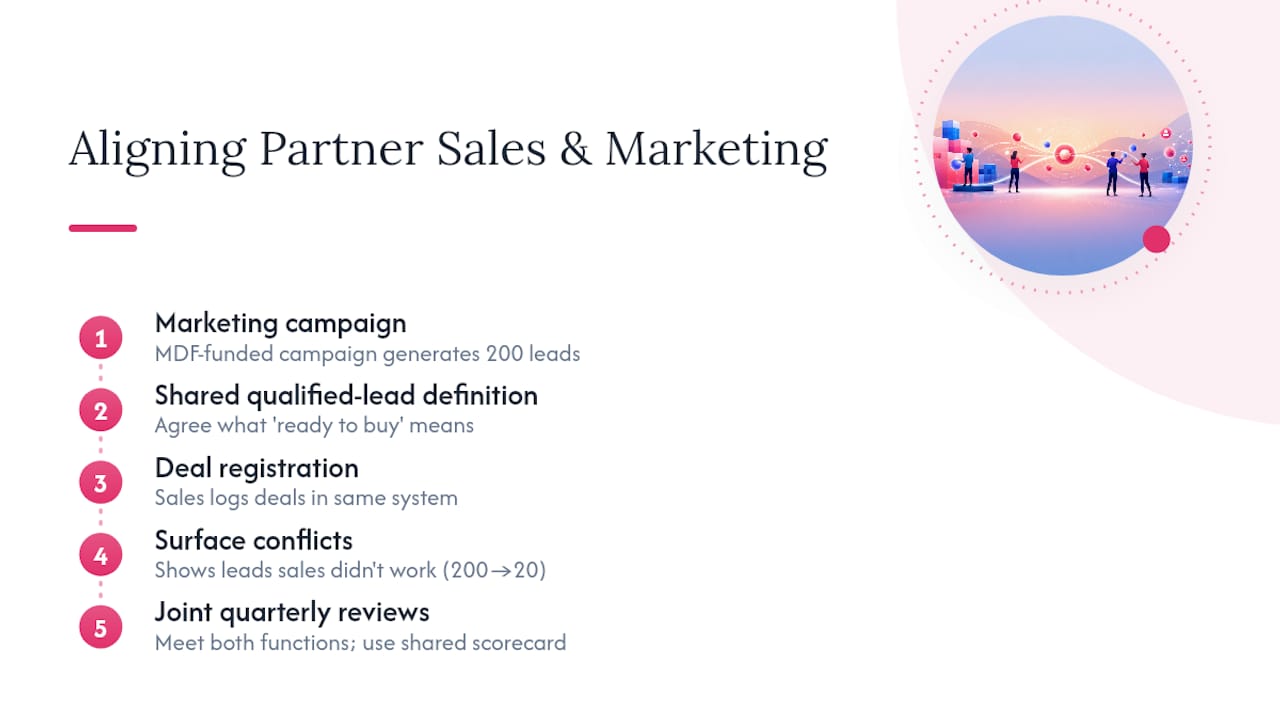
Joint quarterly reviews, where you sit down with both functions inside a partner organization rather than just the marketing contact, tend to surface these misalignments faster than any dashboard will. It’s a small time investment for programs with concentrated revenue in a handful of large partners, and worth automating lightly (a shared scorecard, a simple recurring report) for a long tail of smaller ones.
What I’d Prioritize First
If I had to pick three moves that separate through channel programs that scale from ones that stall, they’d be these: remove MDF friction before you add more funding, integrate your CRM and PRM before you invest in more content, and put customizable templates in partner hands before you build another training deck — learn more about multichannel marketing strategies to understand how this approach fits into a broader channel ecosystem. AI pilots for onboarding and personalization are worth running, but pair them with real in-person or live training. Partners adopt tools faster when a human walks them through the first use. Treat partner marketing like any other revenue channel: measured, attributed, and reviewed monthly, not as a goodwill budget line you fund and forget.
— Jon
A Practical Next Step for Running Partner Content at Scale
Between MDF approvals, CRM integration, and compliance checks, the operational weight of a through channel program often comes down to one unglamorous question: can your partners actually produce the content fast enough to use what you’re funding? Photofy is built for that specific gap, giving distributed teams a templated, white-labeled way to create on-brand social content without routing every asset through a central design queue.
A useful way to test fit before committing: run a three-task pilot with a small partner group. Have them customize a pre-built template with local details, schedule a post through the platform instead of manually, and pull a basic performance report at the end of two weeks. If all three go smoothly, and partners actually complete them without hand-holding, you’ve validated the platform against exactly the friction points that derail most TCM rollouts. Photofy’s enterprise and white-label plans are built for franchise networks and multi-location brands running this kind of distributed content model, and current pricing for individual and team plans is available directly on the site if you want to scope a pilot before going enterprise-wide.
Sources
Key sources behind the figures and frameworks in this article: the FTC’s CAN-SPAM compliance guide for partner email rules; Salesforce’s PRM guidance on CRM/PRM integration; Journeybee’s MDF ROI framework; Digital Applied’s partner marketing statistics; and Channelscaler’s report on AI in MDF.
- CAN-SPAM Act compliance guide for business | FTC
- Partner & Channel Marketing Statistics 2026: 150 Data | Digital Applied
- How to Track MDF ROI: A Practical Framework (2026) | Journeybee
FAQ
What Exactly Is Channel Marketing?
Channel marketing is any marketing effort run through third-party partners, resellers, dealers, or distributors, instead of directly by the brand to end customers. Through channel marketing specifically refers to campaigns that flow through partners with brand-supplied assets and funding, as opposed to co-branded campaigns run jointly.
What Is the 3-3-3 Rule for Marketing?
The 3-3-3 rule isn’t a standard framework tied to channel marketing specifically. Definitions vary by source and context, so it’s worth confirming which version a particular guide or team is referencing before applying it to a partner program.
What Are the Four Types of Marketing Channels?
Marketing channels are typically grouped into direct (brand to consumer), indirect (through retailers or distributors), dual (using both direct and indirect paths), and hybrid or partner channels, which include the dealers, franchisees, and resellers that through channel marketing programs are built around.
Can You Give an Example of Cross-Channel Marketing?
A retail brand running a coordinated promotion across email, social media, and in-store signage, all pointing to the same offer, is a common cross-channel example. In a through channel context, a franchise corporate team supplying one master campaign that partners adapt across their own email, social, and local ads follows the same principle.
How Much Does Photofy Cost for a Team Running Partner Content?
Photofy’s Individual Plans start at $11.95 per month, with quarterly and annual options available, while Pro Teams run $13.00 per month per user and Enterprise Teams run $9.00 per month per user. Small Business plans are listed at $10.99 per month or $99 per year, and enterprise pricing for larger partner networks is available on request through the pricing page.