
30/60/90 HQ Playbook for Franchise Social Media, With Photofy
The operating model that works best combines centralized governance with local empowerment: headquarters controls brand assets, templates, and paid strategy, while franchisees handle local offers and community engagement, supported by a platform like Photofy to publish and measure results. Franchise marketers consistently name social media management as one of their most time-consuming tasks. This model fixes that by giving every location a faster, safer way to post.
TL;DR:
- Headquarters should control brand assets and national campaigns, while franchisees manage local offers and reviews; require approval for pricing claims and national promotions.
- Lock logos, colors, and required disclosures in templates, but let locations edit headlines, photos, and dates; route local edits through shared calendars.
- Store level campaigns pairing national creative with local targeting can convert 2 to 3 times better than nationwide messaging; prioritize locations with organic engagement.
- Use UTM tags to connect social posts with store outcomes, and investigate locations when engagement or conversions fall 20% below their average across three months.
- Influencer posts involving payment or other incentives need clear disclosure in the post itself, with video disclosures spoken or shown onscreen and approval documented.
Table of Contents
- Why franchise social media is uniquely hard
- Governance and roles: the HQ vs. franchisee operating model
- Content workflows, templates, and quick-start assets for franchisees
- Local organic and paid tactics that drive store-level results
- Measurement and reporting: KPIs HQ must track for network and location performance
- Legal and compliance: practical FTC guidance for influencer and incentivized posts
- How Photofy supports the recommended model
- A straight answer and a 30/60/90 day starting point
- Getting started with Photofy for your franchise network
- FAQ
- Sources
Why franchise social media is uniquely hard
Running one brand’s social presence is manageable. Running the same brand across dozens or hundreds of locations creates a coordination problem that most marketing teams underestimate until it costs them customers.
The ACHQ Research Report found that managing social media ranks among the top operational challenges franchise marketers face, with many respondents citing it as a primary drain on their time. That burden compounds when every franchisee is left to improvise their own approach to posting, responding, and advertising.
Three pain points show up again and again in multi-location networks:
- Coordination gaps: corporate campaigns launch without local teams knowing how to adapt them for their market.
- Inconsistent assets: franchisees resort to outdated logos, off-brand fonts, or stock photos because they cannot find approved files quickly.
- Fractured tech stacks: different locations use different scheduling tools, making network-wide reporting nearly impossible.
The consequences are concrete. A location with a stale profile loses local visibility to competitors who post consistently. Slow or absent review responses signal neglect to prospective customers. Left unaddressed, these gaps translate directly into lost foot traffic and revenue that never shows up on a national report.
Governance and roles: the HQ vs. franchisee operating model
Clear role division is the foundation of franchise social media management. Without it, every post becomes a negotiation.
Headquarters should own:
- Brand guidelines, including logo usage, color palettes, tone, and approved hashtags.
- A centralized asset library of photos, videos, and templates every location can access.
- National campaign strategy and paid media planning.
- Standardized reporting templates so performance data rolls up cleanly.
Franchisees should own:
- Local offers and promotions tied to their store’s calendar.
- Community engagement, including comments, local partnerships, and event posts.
- Customer service and review responses for their specific location.
Approval rules work best when they are tiered rather than absolute. National campaigns and anything mentioning pricing or health claims should require HQ pre-approval. Routine local content, such as a photo from a community event or a reply to a review, can run on franchisee autonomy as long as it follows brand naming conventions and visual guidelines.
A simple rollout sequence helps this stick:
- Publish a written governance policy that spells out who approves what and how fast.
- Train franchisees on the policy, the asset library, and the approval workflow before launch.
- Enforce consistently, with spot checks and a clear process for correcting off-brand posts.
Pro Tip: Put your approval tiers in writing before you onboard a single franchisee location, not after the first off-brand post goes live.
For a deeper look at sequencing this kind of rollout, our brand governance framework walks through a 90-day buildout for distributed teams.
Content workflows, templates, and quick-start assets for franchisees
Franchisees need a kit they can open and start using the same day, not a binder of brand rules they have to translate into actual posts.
A workable quick-start kit includes:
- A pre-filled social profile setup guide, so bios, cover photos, and contact details match across every location.
- A naming convention for local pages and handles.
- Sample posts for common occasions: grand openings, seasonal promotions, local events, and holiday greetings.
- Locked image and video templates with editable fields for store name, address, and local offer text.
- A short FAQ covering how to run a local promotion without conflicting with national pricing.
The templates themselves should separate what stays fixed from what franchisees can change. Logo placement, brand colors, and required disclosures stay locked. Headline text, local photos, and promotional dates stay editable. This split lets a franchisee in one market adapt a post for a local festival while a franchisee in another market swaps in their own store photo, without either one breaking brand rules.
The approval flow that works best in practice runs in three steps: HQ drafts the national template, the local team tweaks the editable fields, and the post is scheduled through a shared calendar rather than published ad hoc. Automating the handoff between these steps, rather than relying on email attachments, cuts the time franchisees spend formatting posts.
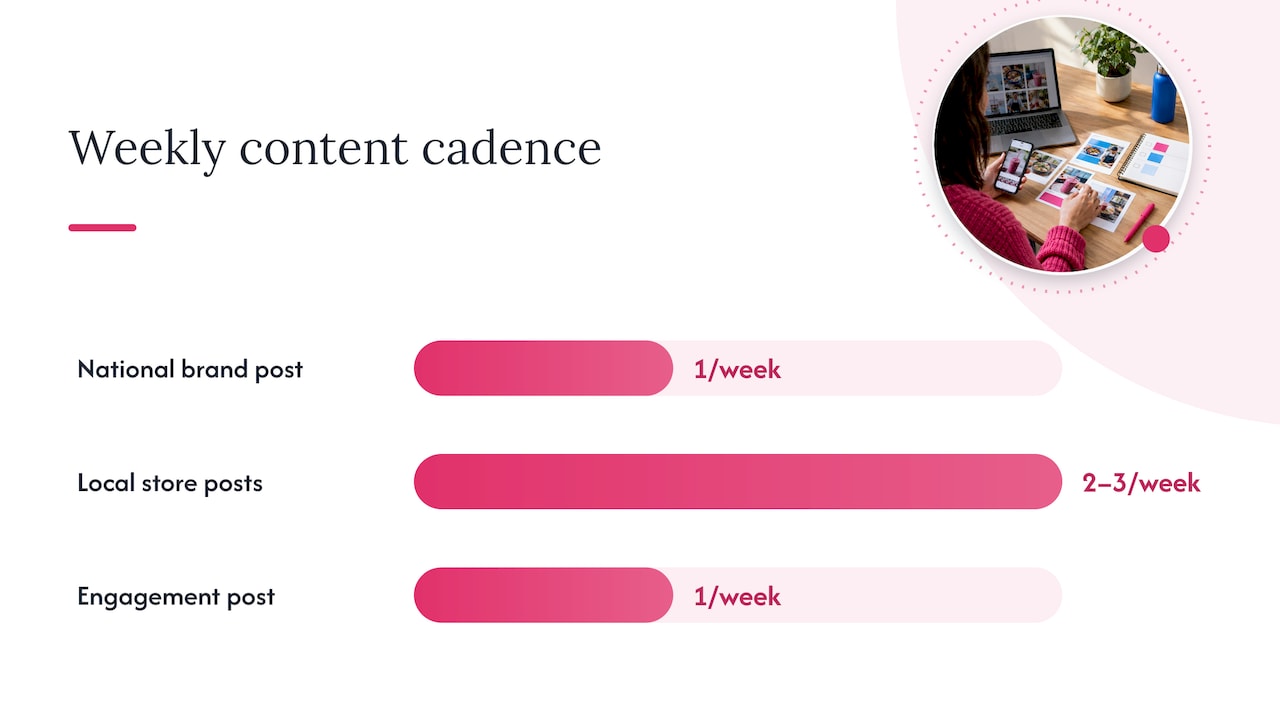
A sustainable cadence mixes content pillars so no single location feels neglected or overloaded: a weekly national brand post, two to three local posts tied to store activity, and one engagement post responding to community content or reviews. That balance keeps the feed feeling local without losing the brand’s throughline.
Local organic and paid tactics that drive store-level results
The highest-leverage move in franchise social media management is pairing national creative with local targeting rather than choosing one or the other.
Local-first campaigns that let each location own its local voice while headquarters supplies standardized creative can produce 2 to 3 times better conversion than a single national message run everywhere. That gap reflects how much more a geo-targeted offer resonates compared to a generic brand ad shown to the same audience nationwide.
On the paid side, a few patterns consistently perform well:
- Geo-targeted offers that reference the specific store, neighborhood, or local landmark.
- Localized product or service catalogs that pull from the national inventory but surface what’s available nearby.
- Event-based promotions tied to a store opening, anniversary, or community sponsorship.
Budget allocation should flex toward locations with stronger organic engagement first, since paid spend tends to amplify what is already working rather than fix a page that is not posting.
On the organic side, short-form video, user-generated content from happy customers, employee advocacy posts, and prompt review responses all build the kind of local trust that paid media alone cannot buy. The combination works because national creative sets the visual standard and voice, while local personalization gives each post a reason to matter to the people scrolling past it in that specific town.
Measurement and reporting: KPIs HQ must track for network and location performance
Franchise social media management lives or dies on whether headquarters can see, at a glance, which locations are performing and which need help.
The KPIs that matter most at both the network and location level:
- Local conversions, meaning bookings, store visits, or calls generated from social.
- Local ad return on ad spend, tracked separately from national campaign performance.
- Engagement rate per post, benchmarked against each location’s own history rather than a flat network average.
- Review sentiment and response time.
- Local search visibility for each store’s profile.
A workable reporting rhythm includes a weekly local snapshot for store managers, a monthly network roll-up for regional leads, and a quarterly executive summary tying social performance to broader revenue goals. Standardized UTM tagging on every local link is what makes this possible: it is the fastest way to connect social activity to store-level outcomes when combined with point-of-sale or booking data. Our reporting templates guide breaks down how to structure these dashboards by location and by network.
Set a threshold, such as engagement or conversion falling 20% below a location’s trailing three-month average, as the trigger for a check-in rather than waiting for a quarterly review to catch it.
Legal and compliance: practical FTC guidance for influencer and incentivized posts
When franchisees work with local influencers or run incentivized posts, the FTC’s Endorsement Guides require clear, conspicuous disclosure of any material connection, directly in the post itself, not buried in a bio or a link.
Practical controls to build into your franchise’s influencer marketing workflow:
- Require a disclosure like “#ad” or “Paid partnership” placed in the first few lines of a caption, not hidden after a string of hashtags.
- Adapt disclosure placement by platform: video needs a verbal or on-screen disclosure, not just a caption note.
- Build disclosure checks into your existing approval workflow, so no incentivized post goes live without sign-off.
- Train franchisees and any local influencers on what counts as a material connection before they post.
Headquarters can carry liability for a franchisee’s undisclosed endorsement if there is no evidence of a monitoring program. Documented approval logs and disclosure confirmations are the kind of record that demonstrates reasonable oversight.
Pro Tip: Keep a simple log of every incentivized post and its disclosure confirmation. It costs you five minutes and protects the whole network.
How Photofy supports the recommended model
We built our platform around the model described above: centralized control paired with local speed.
- A shared asset library and locked brand templates keep every location’s posts on-brand without a design request.
- White-labeling lets us package the platform under a franchise’s own look for its network.
- Built-in approval workflows route local edits back to headquarters before anything publishes.
- Scheduling and analytics let a marketing team see performance by location without juggling separate tools.
These features map directly to the governance, workflow, and reporting needs covered above: less time spent chasing approvals, more locations staying compliant with brand standards, and a single dashboard instead of a dozen disconnected ones.
A straight answer and a 30/60/90 day starting point
The franchises that win at social media are not the ones with the most creative national campaigns. They are the ones that make it easy for a store manager to post something on-brand in under five minutes.
A practical pilot:
- Days 1 to 30: write the governance policy, define HQ and franchisee roles, and build the quick-start kit.
- Days 31 to 60: launch the kit with three pilot locations and set baseline reporting.
- Days 61 to 90: review pilot results against your KPIs, fix friction points, and plan network-wide rollout.
Measure success by conversion lift and franchisee adoption, not just post volume.
— Jon
Getting started with Photofy for your franchise network
If your locations are losing time formatting posts instead of talking to customers, that is the gap we built Photofy to close. Our enterprise and franchise solutions give headquarters a locked brand kit, an approval workflow, and reporting by location, all in one place, so local teams can publish in minutes instead of waiting on design requests.
To see how this fits your network, start with our enterprise and franchise solutions page for an overview of white-label options and team plans, or check current pricing for individual and enterprise tiers. Our 90-day team content playbook lays out a similar pilot structure to the one above, built around our own scheduling and approval tools. Reach out through either page to talk through a pilot for your locations.
FAQ
What is the 5-5-5 rule on social media?
The 5-5-5 rule is an informal content planning guideline used as a habit-building framework rather than a formal industry standard, and definitions vary by source.
Are social media management businesses profitable?
Social media management can be profitable because demand for consistent, well-run profiles keeps growing, particularly among multi-location brands struggling with the coordination problems described in franchise industry research. Profitability depends heavily on efficient workflows and retaining clients long term, since the work is recurring rather than one-time.
What is the 5-3-1 rule on social media?
The 5-3-1 rule is a content mix guideline suggesting a balance of curated, original, and personal posts to help franchise accounts avoid feeling like a constant stream of promotions.
What is the 5:3:2 rule for social media posts?
The 5:3:2 rule is a similar content ratio concept balancing curated, original brand, and personal or interactive posts. It is a popular planning heuristic rather than a fixed industry standard, so franchises often adapt the ratio to their own audience.
Does Photofy support franchise-level brand governance?
Yes, we built white-labeling and locked brand templates specifically so franchise headquarters can control core brand elements while letting local teams edit approved fields. Pricing for team and enterprise plans is available on our pricing page.