

Social Media Across Multiple Locations: 5 Roles Keep Posts Local
The winning model for multi location social media pairs central governance with local autonomy: brand teams set approval gates, templates, and compliance rules, while local owners fill in community details and publish on a schedule. Tools like Photofy support that split, and frameworks from BrightLocal and Google Business Profile back it up. The payoff is content that stays on brand while still feeling like it came from the block, not headquarters.
TL;DR:
- Local owners can publish approved templates without signoff, but content involving claims, pricing, or promotions requires central review; above a dozen locations, add regional managers.
- Modular templates with locked fields and asset details for rights, localization, expiration, and approval can cut customization cycles from a week to under a day.
- Generative AI is used by 88% of multi location marketers, but human reviewers should check drafts involving claims, pricing, or medical, legal, or financial advice.
- Pilot the system in three locations for thirty days, define three success metrics in advance, and review engagement and reputation measures before expanding.
- Keep one Google Business Profile per physical site, with a local phone number and consistent names and categories across all listings.
Table of Contents
- Keep It Local, Keep It Personal
- Who Owns What: Team Structure and Governance
- Templates, Modules, and Fast Local Customization
- What to Look for in a Social Platform
- Calendars, AI, and Scheduling at Scale
- Measuring What Matters at the Local Level
- Applying the Model: A Walkthrough with Photofy
- What We’d Prioritize in a 90-Day Rollout
- Make the Governance Model Work with Photofy
- FAQ
- Sources
Keep It Local, Keep It Personal
Generic corporate posts get scrolled past. A NiemanLab review of an NPR Facebook experiment found that local, community-focused stories drove noticeably higher engagement than broader national content, a pattern that holds for brands as much as newsrooms. People respond to what happens near them, told by people they recognize.
The Brand Beacon Report from BrightLocal found that high-performing multi-location brands are far more likely to run a dedicated local marketing strategy than average performers, and nearly all of them invest in social as a core channel. That investment shows up in the content itself, not just the budget line.
Local posts that consistently perform well include:
- Hyperlocal event coverage tied to your location’s neighborhood or region.
- Staff spotlights that put a real face on the brand.
- Customer photos and reviews shared with permission.
- Location-specific promotions tied to local calendars.
- Partnerships with nearby businesses or community organizations.
Stay inside Google Business Profile rules while you do this: maintain one profile per physical location, use a local phone number, and keep names and categories consistent across listings, as Google’s own guidelines require.
Pro Tip: Ask each location manager for one local detail a month, a festival, a new hire, a regular customer, and build a post around it.
Who Owns What: Team Structure and Governance
Distributed social programs break down when roles are fuzzy. A clear map prevents both bottlenecks and brand drift.
- Central social lead sets strategy, templates, and approval rules.
- Regional manager coordinates several locations and resolves local escalations.
- Local owner gathers community content and requests posts.
- Content producer builds the actual graphics or video from approved templates.
- Brand or compliance reviewer signs off before anything goes live that touches pricing, claims, or regulated language.
A workable rule of thumb: local owners can publish from pre-approved templates without additional sign-off, but anything new, off-template, or touching claims, pricing, or promotions routes through central review first. Below a dozen locations, one coordinator can usually manage governance directly. Past that, regional managers become necessary to keep approval turnaround fast enough that local content still feels timely.
Templates, Modules, and Fast Local Customization
Consistency and speed usually feel like a trade-off. Modular templates remove that tension: build a master design once, then let local teams swap in their own photos, names, and offers inside locked brand guardrails.
A practical asset library needs a few metadata fields on every item:
- Usage rights, so nobody reuses a licensed photo past its term.
- Localization tags, so teams can filter by region or language.
- Expiration dates, especially for seasonal or promotional content.
- Approval status, so producers know what is cleared to use.
A simple localization workflow looks like this: pull the master template, swap in local photos and copy, run it past the compliance reviewer if it touches claims or pricing, then schedule. Done well, that whole cycle takes under a day instead of a week of back-and-forth email threads. Our guide to template management for distributed teams walks through setting this up from scratch.
Pro Tip: Build one template per content type, event, staff spotlight, promotion, rather than one template per location. It cuts your library size dramatically.
What to Look for in a Social Platform
The right platform makes governance enforceable instead of aspirational. A few capabilities matter more than the rest for multi location teams:
- Multi-account management across every location from one dashboard.
- Role-based permissions that match your governance structure.
- White-labeling, especially for franchise or enterprise rollouts.
- Built-in templating with locked and editable fields.
- Approval queues that route content automatically before publishing.
- Audit logs showing who approved what and when.
- Analytics roll-up that aggregates local performance into regional and national views.
Beyond the feature list, check integration fit: does the asset library sync with what your design team already uses, does the platform support single sign-on for larger teams, and does it connect to your CRM or ad accounts for retargeting. At rollout, lock in naming conventions, tagging rules, and content expiration policies early. Retrofitting governance after fifty locations are already posting is far harder than setting it up on day one.
Calendars, AI, and Scheduling at Scale
A rolling content calendar with three layers keeps local feeds fresh without reinventing the wheel every week: national pillars that repeat monthly, regional themes tied to seasons or campaigns, and local slots left open for location-specific content.
- Set national pillars first, four or five recurring themes for the year.
- Layer in regional themes a quarter ahead.
- Leave two or three weekly slots per location for hyperlocal content.
Generative AI has a real place here. BrightLocal found that 88% of multi-location marketers already use generative AI somewhere in their organization, usually for first drafts and localized copy variations. Keep a human review checkpoint before anything publishes, particularly for claims, pricing, or anything that could be read as medical, legal, or financial advice.
Scheduling hygiene matters just as much as content quality: stagger post times across locations to avoid duplicate content hitting the same regional audience at once, and tie local slots to actual events and promotions rather than filling them on autopilot.
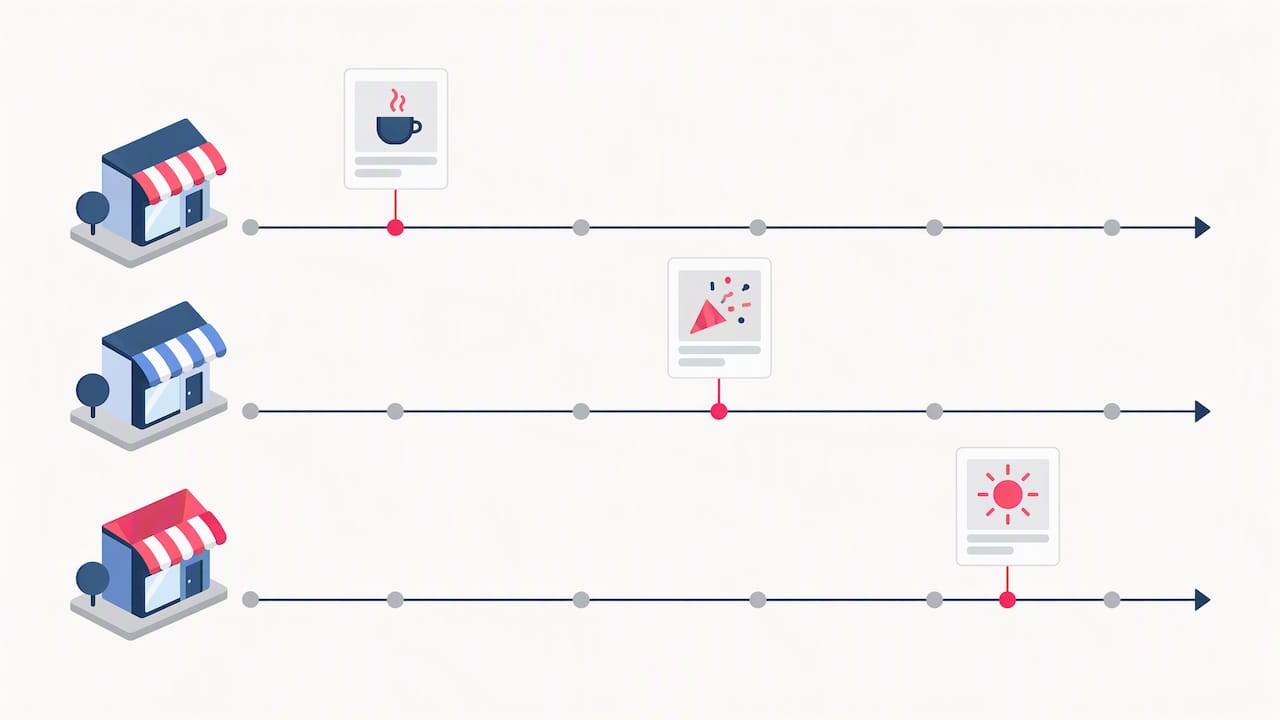
Pro Tip: Schedule local posts two to three days ahead of the event they reference, early enough to build awareness, late enough to stay accurate.
Measuring What Matters at the Local Level
National dashboards hide the details that actually drive decisions. Local KPIs should include engagement rate per location, review sentiment, local leads or appointments booked, and footfall signals where available.
Roll-up reporting works best when it preserves local nuance instead of flattening everything into one national average. A location dashboard might track engagement rate, response time to reviews, and local lead volume, while the regional rollup adds comparisons across locations to flag outliers.
High-performing multi-location brands treat reputation management as core infrastructure, not an afterthought. The Brand Beacon Report found that top performers invest noticeably more in reputation management than average brands, a gap that shows up directly in review volume and response speed.
- Set a response SLA for reviews, ideally under 24 hours for negative ones.
- Escalate any recurring complaint pattern to central operations, not just the local manager.
- Review local sentiment monthly alongside engagement numbers, not separately.
Applying the Model: A Walkthrough with Photofy
Photofy’s template libraries, asset management, scheduling, and white-label options map directly onto the governance model above: central teams build and lock templates, local teams customize within guardrails, and everything routes through approval before it publishes.
A workable implementation sequence:
- Central team builds content packs (templates, approved assets, copy blocks) by content type.
- Local owners customize packs with location-specific photos, names, and offers.
- Compliance reviewer approves anything outside the pre-cleared template set.
- Content publishes on schedule, with performance rolling up into regional reports.
Watch for faster approval turnaround and rising local engagement as early signs the model is working. Our content calendar examples and franchise rollout playbook are useful starting points for building out your own packs.
What We’d Prioritize in a 90-Day Rollout
Governance first, always. Lock approval rules and template structure in week one, not week ten. Launch a starter template library by week three, pilot it in three locations for thirty days, then baseline your engagement and review metrics before expanding further.
The most common pitfall is skipping the pilot and rolling out to every location at once, which multiplies confusion if the templates need adjusting. A short pilot checklist: assign one local owner per pilot site, define three success metrics in advance, and set a thirty-day review date before scaling further.
— Jon
Make the Governance Model Work with Photofy
We built Photofy to carry exactly this model: template libraries and an asset library keep every location on brand, role-based approvals keep compliance intact, and white-labeling keeps enterprise and franchise rollouts consistent across every market we serve.
- Small business teams can start with the Small Business plan.
- Individuals and solo marketers can compare Individual Plans.
- Enterprise and franchise teams can review full plan details on our pricing page.
Download our free content calendar template and see how the central-governance, local-execution model fits your locations.
FAQ
What is the 5 5 5 rule for social media?
The 5 5 5 rule suggests spending five minutes commenting on other accounts, five minutes engaging with your own followers, and five minutes creating or scheduling content each day. It is a time-management habit rather than a formal platform policy, and multi-location teams often adapt it per location rather than applying it company-wide.
What social media platforms use geolocation?
Instagram, Facebook, Snapchat, and TikTok all support geotagging and location-based discovery features that let posts surface to nearby audiences. For multi-location businesses, pairing geotags with accurate Google Business Profile listings helps local content reach the right community.
What is multi-location?
A multi-location business operates more than one physical site, store, branch, or franchise location under one brand. Multi location social media refers to managing distinct social presences, or distinct local content, for each of those sites while keeping brand standards consistent.
What is the 5-3-2 rule on Instagram?
The 5-3-2 rule is a content-mix guideline: of every ten posts, five share content from others or the community, three share original brand content, and two are personal or behind-the-scenes posts. It works as a rough content-mix target rather than a strict requirement, and local teams can adjust the ratio based on what their audience responds to.
How do multi-location brands keep content compliant across locations?
Compliance starts with routing anything touching claims, pricing, or regulated language through a central reviewer before it publishes. Platforms with approval queues and audit logs, like Photofy, make that review step enforceable rather than optional.
Sources
- Brand Beacon Report 2024: The Secrets to Multi-location Marketing Success – BrightLocal
- What kinds of local stories drive engagement? The results of an NPR Facebook experiment – NiemanLab
- Guidelines for representing your business on Google – Google Business Profile Help