

Enterprise Social Media Governance: A Practical Framework
Enterprise social media governance is the set of roles, rules and approval steps that decide who can post for your brand, what they can say, and who checks it before it goes live. Done well, it does not slow your teams down. It lets franchisees, dealers, direct sellers and local reps publish quickly because the guardrails are already built into the tools they use. Photofy brings branded content creation, team approvals, asset management and automated publishing into one platform, so governance lives in the workflow instead of in a PDF nobody opens.
TL;DR
- Governance is bigger than a policy. The policy writes the rules, while governance adds owners, access controls, approvals, training and measurement.
- Name the roles first: an executive sponsor, a content owner, legal review and technical support, as public-sector guides lay them out.
- Limit who holds account access, require multi-factor authentication (MFA) on admin accounts and vet every third-party app.
- Sort content into risk tiers so routine posts move fast and sensitive ones get a named reviewer.
- Put approved templates, assets and approvals in one place, then measure turnaround time, compliance and reuse.
Table of Contents
- What enterprise social media governance covers
- Roles: who owns what
- Access control and account security
- Approval workflows that match the risk
- Keeping the brand consistent while local teams post
- Governing AI-assisted content
- Privacy and compliance in the U.S.
- How to roll out and measure governance
- Governance inside the content platform
- FAQ
- Sources
What enterprise social media governance covers
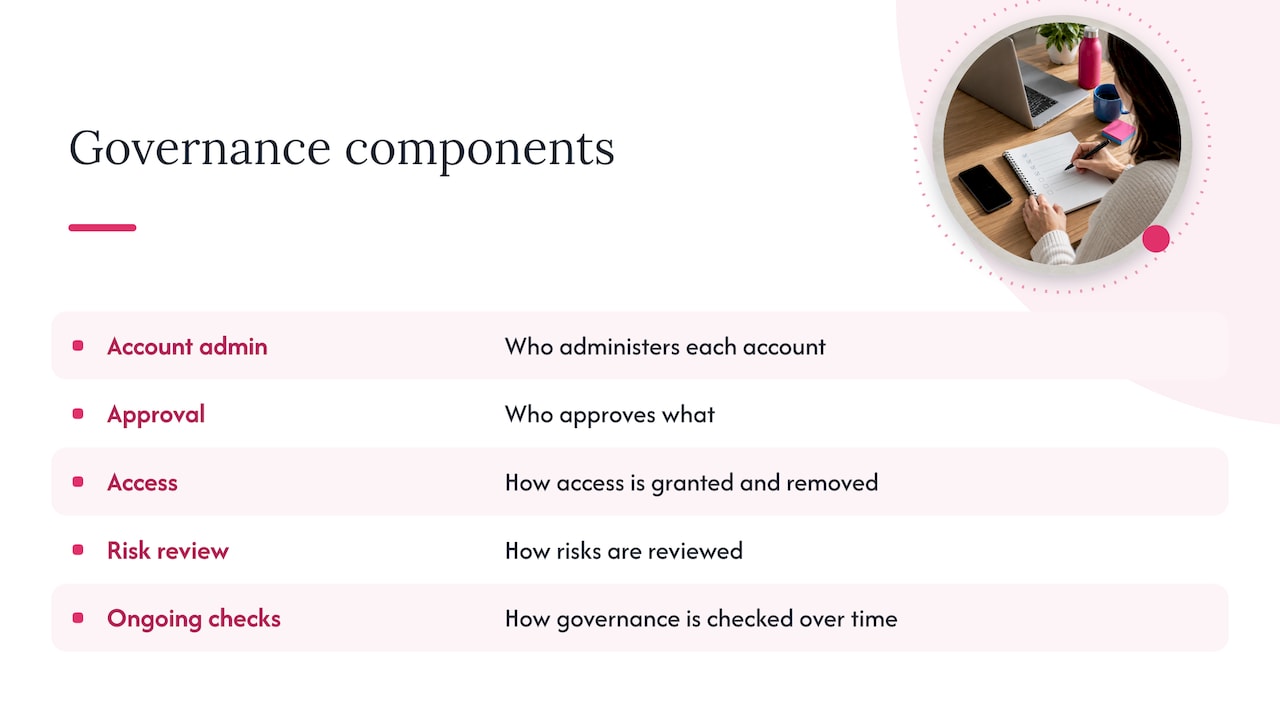
A social media policy is a document. Governance is the system around it. The policy says what employees and partners may and may not post. Governance adds who administers each account, who approves what, how access is granted and removed, how risks are reviewed and how the whole thing is checked over time.
That difference matters most when your content is created far from headquarters. A franchise network with hundreds of locations, a car manufacturer with dealers who each want to post about this weekend’s sale, or a direct selling company with thousands of independent consultants all face the same tension. Local people need to move fast and sound authentic. The brand needs every post to be accurate, compliant and recognizable.
Research on large organizations’ guidelines points to the same ingredients. A classification of 34 enterprise social media guidelines found they guide user behavior, describe the social media landscape, make users aware of risks and explain how the company sees social media as a communication channel. Good governance does all four, and it makes them usable at the moment someone is about to post.
Roles: who owns what
Governance fails first when nobody knows who is responsible. The Texas Department of Information Resources’ Social Media Resource Guide lists a useful set of roles that translate well to any large organization:
| Role | What it does |
|---|---|
| Executive sponsor | Secures leadership approval and leads the policy workgroup |
| Communications outreach specialist | Runs the day-to-day public voice |
| Policy or legal counsel | Checks compliance with contracts, laws and internal policies at every step |
| Content manager or director | Owns the editorial calendar and quality |
| Content writers | Draft posts and creative |
| Technical support and subject-matter experts | Such as HR and security staff, who handle access and specialized questions |
A small business owner will not fill six seats, and that is fine. One person can hold several roles. The point is that each duty has a name beside it. A freelancer managing a client’s accounts can use the same list as a checklist: who signs off, who holds the logins, who answers if something goes wrong.
For a deeper look at how permission levels map to these roles, see our guide to user permissions in social tools.
Access control and account security
The fastest way to lose control of a brand voice is to lose control of the accounts. The Cybersecurity and Infrastructure Security Agency (CISA), the U.S. federal agency for cyber defense, publishes a guide to social media account protection with clear advice:
- Limit the number of employees who have access to organizational accounts.
- Use each platform’s corporate account features to assign roles and privileges.
- Enforce strong MFA on administrator accounts.
- Keep personal and organizational accounts separate.
- Maintain a policy covering credential management and privacy settings, and review it and train staff periodically.
The University of Maryland’s communications office gives a practical example of the same idea. Its social media guide recommends assigning page control to a Business Manager account rather than to an individual, using multi-tiered access, and documenting an approval process that makes responsibilities clear. When page ownership sits with a person, it leaves when they do. Tie it to the organization.
Offboarding belongs here too. Oregon’s Enterprise Information Services social media best practices say a policy should define its scope, who administers accounts, what authorization forms and codes of conduct people sign, and the offboarding steps taken with HR and IT. Write down who removes access when a dealer, consultant or agency relationship ends.
Vet the apps connected to your accounts
Every tool that can publish to your accounts is part of your attack surface. CISA advises organizations to set up a process to evaluate and approve third-party apps that have access to social accounts, and points to NIST Special Publication 800-163 Rev. 1 for vetting guidance. Keep a short approved list and review it on a schedule.
Approval workflows that match the risk
The most common governance mistake is a single approval path for everything. If a holiday greeting waits in the same queue as a product claim, people route around the process. The fix is risk tiers.
A simple version:
- Tier 1, pre-approved: locked templates with approved logos, colors, disclaimers and fonts. Local users change only the editable fields, such as a name, photo or price, and publish.
- Tier 2, reviewed: custom posts, new offers, testimonials and anything with a claim. A named manager approves.
- Tier 3, escalated: legal, regulatory, crisis or executive communications. Policy or legal counsel signs off.
The FDA’s social media policy shows how formal this can get in a regulated environment: official uses must be pre-approved by center or office management in consultation with the communications office, and new accounts require a proposal first. Most businesses do not need that much process, but the logic carries over. Decide in advance which actions need permission.
Our walkthrough of building a content approval workflow with risk tiers covers the seven steps in detail, and the five FTC-ready automation workflows show how to keep routine publishing compliant.
Keeping the brand consistent while local teams post
Governance is only worth having if people actually use it. Employees and partners want to share, and many are not equipped. A Harris Poll survey of U.S. adults, fielded December 4 to 8, 2025, found that 41% say their company has not provided tools or training to represent the brand externally. The same survey found that 32% of people who saw an employee’s post about their job said it positively affected their view of the company or industry, against 19% who said negatively. It also found 80% agree brand ambassadorship should be voluntary and 71% want employees to disclose where they work.
Three practical lessons follow:
- Give people something approved to share. A library of on-brand templates, photos, videos and PDFs removes the temptation to improvise.
- Keep participation voluntary. Invite your dealers, franchisees and consultants to use the library rather than forcing it.
- Build disclosure into the template. If posters should say they work for or represent the company, make that wording part of the caption.
For employee programs specifically, our 30 to 90 day employee advocacy content playbook lays out a rollout. If you want to see how templates support consistency, read about how photography templates enhance brand consistency.
A note for dealers and franchises
Automotive and franchise networks have an extra challenge: content arrives as photo, video and PDF, and local rules differ. A shared library with approved formats keeps the offer, legal line and logo correct everywhere. Our guides on automotive social media templates for dealers and OEMs and dealer marketing assets show what to build and share.
Governing AI-assisted content
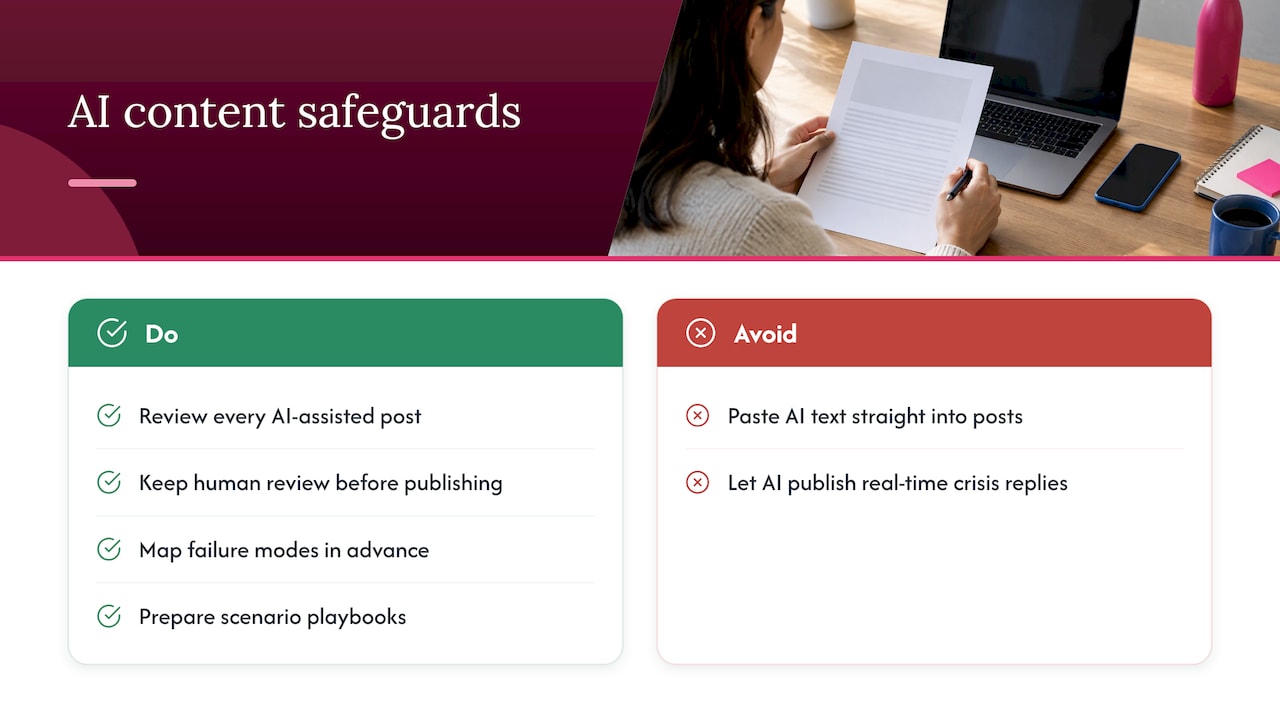
AI now writes captions, resizes images and drafts replies, so your framework needs rules for it. The University of San Diego’s AI social media guidelines are a clear model: never paste AI text straight into a post, review every AI-assisted post for accuracy, brand voice, grammar and context, and do not let AI create or publish real-time responses during a crisis or brand safety issue.
The Public Relations Society of America (PRSA) adds a smart structural point. In a September 2026 article, Dr. Gleb Tsipursky recommends classifying workflows rather than software into low-risk assistance, governed use and prohibited use, naming the person who reviews, the source of truth and the questions to answer before release. A policy built on a list of approved products ages quickly, while one built on what could go wrong stays useful.
If you automate production at scale, whether captions, articles or posts, keep the human review step. Tools for content marketing automation speed up output, which is exactly why approval processes need to be clear about who checks what before anything is published.
For crises, Forbes Agency Council’s Meghan Tisinger recommends mapping failure modes in advance: bias, invented facts, copyright misuse, data privacy breaches and off-brand responses. Prepare scenario playbooks with pre-approved holding statements and role-specific talking points, and keep a living FAQ where your teams already talk, such as Slack or Teams.
Our 90 day content governance plan shows how to secure the brand and trace AI-assisted content from the start.
Privacy and compliance in the U.S.
There is no single federal social media law for companies, so U.S. enterprises work from a patchwork. State privacy law is the part that moves most. Gibson Dunn’s review reports that seven states enacted comprehensive privacy laws in 2024 and that 20 states would have effective comprehensive privacy laws by early 2026. It also notes state laws aimed at minors, such as Georgia’s, effective July 1, 2024, and Florida’s, effective January 1, 2025.
On the security side, NIST released Cybersecurity Framework 2.0 on February 26, 2024, adding a governance function covering roles and responsibilities for managing cyber risk. That mirrors the structure in this article.
Practical steps: have counsel review your disclosure language, keep a record of who approved what, and adjust location and data-sharing settings on accounts. For questions about a specific law that applies to your business, speak with your legal counsel.
How to roll out and measure governance
Start small and expand. A 90 day plan works well:
- Days 1 to 30: name your roles, audit every account and its admins, turn on MFA and write the tier rules.
- Days 31 to 60: build the template and asset library, set permissions by role and train a pilot group.
- Days 61 to 90: open it to the wider network, review results and adjust.
Measure what shows whether governance helps or hinders. Useful indicators include:
- Time from draft to approval for each tier
- Share of published posts that used approved templates
- Number of accounts with an assigned owner and MFA enabled
- Corrections or takedowns after publishing
- Adoption: how many dealers, franchisees or consultants post each month
Set your own baseline in the first month and compare it each quarter. Our brand governance framework for distributed teams and rollout guide to brand consistency tools go deeper on this, and a metadata-first asset library setup keeps approved files easy to find.
Governance inside the content platform
Photofy is built so the rules travel with the content. You get pre-designed and custom templates, a stock asset library, video stitching, graphic and text overlays, scheduling and analytics on iOS, Android and desktop. For franchises, direct selling brands and enterprises, white-label content management keeps brand integrity while local people customize what they are allowed to change.

Published plans start with Small Business at $10.99 per month or $99 per year. Individual Plans are $11.95 per month, $29.97 per quarter or $99.95 per year, Pro Teams are $13.00 per month per user and Enterprise Teams are $9.00 per month per user, all on the plans page. Individual and Enterprise tiers are also listed on our pricing page, and you can start at photofy.com.
Our view: governance is what lets local teams say yes
We hear the word governance and many marketers picture a locked door. We see it the other way around. When your dealers, franchisees and consultants have approved templates, a shared asset library and a clear approval path, they stop asking whether they are allowed to post and start posting.
That is why we put branded content creation, team approvals, asset management and automated publishing in one platform. Controls that sit in a separate document get skipped. Controls built into the tool get used, and your people get compliant, authentic content out quickly.
Start with your roles and your risk tiers, then let the platform carry them. Your brand stays consistent, and your network feels empowered to represent it.
Jon
FAQ
Is a social media policy enough for governance?
No. A policy sets the rules, but governance also assigns owners, controls account access, defines approvals and reviews results. Think of the policy as one part of a larger system.
Who should own social media governance in a large company?
An executive sponsor should back it, and a content or communications lead should run it day to day. Legal counsel and IT or security staff join the group, as public-sector guides like the Texas DIR’s recommend.
How do I govern content from dealers or franchisees without slowing them down?
Use risk tiers. Pre-approved templates let local users publish quickly, while custom claims or offers go to a named reviewer. Shared libraries make the compliant option the easiest one.
What should we do about AI-generated posts?
Treat AI as a draft tool. Require a named human to review every AI-assisted post for accuracy, tone and context, and keep AI out of real-time crisis replies.
Sources
- A Framework for Enterprise Social Media Guidelines (AMCIS 2013)
- Social Media Resource Guide, Texas DIR (March 2023)
- Social Media Account Protection, CISA
- Social Media, University of Maryland
- Social Media Best Practices, Oregon EIS
- U.S. FDA Social Media Policy
- Staff to Storytellers, The Harris Poll
- Leveraging AI: Social Media Guidelines, University of San Diego
- AI Guardrails That Protect Trust, PRSA
- When AI Causes A Communications Crisis, Forbes
- U.S. Cybersecurity and Data Privacy Review and Outlook 2025, Gibson Dunn
- Data Privacy and Security Review Newsletter, July 2024, Cravath